


👋 Hey there, I’m Lenny. Each week, I share deeply researched product, growth, and career advice. For more: Lenny’s Podcast | Lennybot | How I AI | Become an AI-Native Builder and other favorite AI/PM courses
P.S. Get a full free year of Cursor, Lovable, Google AI, Notion, Manus, Replit, Gamma, n8n, Canva, ElevenLabs, Factory, Wispr Flow, Fin, Supabase, Bolt, Linear, PostHog, Framer, Railway, Granola, Warp, Gumloop, Magic Patterns, Mobbin, ChatPRD, and Stripe Atlas, by becoming an Insider subscriber. While supplies last. Yes, this is for real.
This newsletter wouldn’t exist if I hadn’t taken a sabbatical.
Seven years into my stint at Airbnb, I took a three-month break. It was the first time I’d taken more than two weeks off in my more than 15-year career. I spent those months tinkering, reading, and traveling—and even snuck in a 10-day silent meditation retreat. At the end of it, I realized my heart wasn’t in the work anymore and that it was time for something new. So I left my job without much of a plan and spent the next six months exploring. Those six months turned into a year, that year turned into this newsletter, and the rest is history.
Looking back, I can say those were among the three most important months of my life, because they led me to what I do now—the most interesting, fulfilling, and impactful work I could have imagined.
Life makes it hard to get off the default path and back onto a road of your own design. Sometimes that looks like leaving your job, like I did. Other times, it means reconnecting to why you’re doing the work you’re already doing. Either way, in my experience and that of many friends, significant time away from your day-to-day is necessary for the mental, physical, or emotional shift that will reveal what’s next. What you need is what today’s guest author DJ DiDonna calls “Big Time Off.”
DJ is the founder of The Sabbatical Project and an early guest contributor to this newsletter, and today DJ’s book Big Time Off comes out! It’s a beautifully written, deeply researched book on the value of taking time off, with tangible advice, real-world case studies, and practical considerations for anyone who wants to shake things up. Below are some excerpts from his excellent book to help you start thinking about what a sabbatical might look like for you now or down the road.
I’d always wished there were a guide to help me think through that decision and make the most of this precious time off. We finally have one.
DJ will be in person in San Francisco at the Commonwealth Club on Thursday, July 23 (also streaming live online), interviewed by NPR podcast host Aarti Shahani. As a bonus, all Lenny’s readers are invited to the afterparty at Barebottle in Bernal Heights (8–10:30 p.m.)—your first drink is on DJ.
Also, for anyone who wants support on this journey, DJ has created a private WhatsApp community for Lenny’s readers. There he will host a live AMA on August 4 at 5 p.m. PT, as well as maintain an ongoing asynchronous forum for sabbatical questions, concerns, and ideas—click here to get your invitation.
Let’s get into it.
Almost 10 years ago, I stepped away from my dream job—a fintech company I’d co-founded—to spend a few months prioritizing the important over the urgent. I walked a long pilgrimage, cared for my mother during an illness, and knocked out some smaller items on my list, like writing a song and remodeling my kitchen.
Like Lenny, I came back changed. The time away made it clear that my old life no longer fit who I wanted to become.
So I left my company and set out to learn if my experience was unique or part of something bigger. I spent two years interviewing hundreds of sabbatical alums, which became a peer-reviewed paper and the foundation of my book, BIG TIME OFF: The Transformative Power of Sabbaticals and How to Take One.
Making sabbaticals accessible to everyone—not just the lucky few like me—takes rigorous evidence: evidence to convince business leaders (many of you included) to create supportive workplace policies, and policymakers to create supportive public policies. In this book, you’ll find plenty of evidence with which to make a business case.
But human stories of change are also necessary to convince the part of you that thinks taking time off would be irresponsible or impossible. That’s why personal journeys like Lenny’s matter, and that’s what’s at the core of the book: inspiration, permission, and a blueprint for the experience of a lifetime.
I’ve included excerpts from two practical chapters below to help you figure out how to approach your sabbatical, and how to avoid some common mistakes from the start. I hope it’s helpful.
Excerpt from Chapter 4: Catalysts, Archetypes, and Barriers
The three archetypes of sabbatical takers
The type of sabbatical you choose depends on your life stage, job status, and a variety of other factors, such as personal responsibilities and desires. A 45-year-old father of three will not have the same considerations—or priorities—as a 30-something who just sold her company or a 26-year-old between jobs. That being said, a sabbatical doesn’t have to map perfectly with your age or the expectations of others. A gap year, for example, can make as much sense at 55 as it does at 18.
On top of what you’re able to pull off logistically, it’s important to consider your intentions for your time off in the context of who you are and what you really need. Which part of you is planning your sabbatical—is it your exhausted work self, your internal productivity monster, or the creative version of you from deep down? Understanding your tendencies doesn’t just give you a lens to help choose the most suitable sabbatical; it also provides a mirror to help you see the life that warrants reexamination. Ultimately, understanding the various types of sabbatical intentions will help you align your sabbatical to what you need and to return with greater self-understanding.
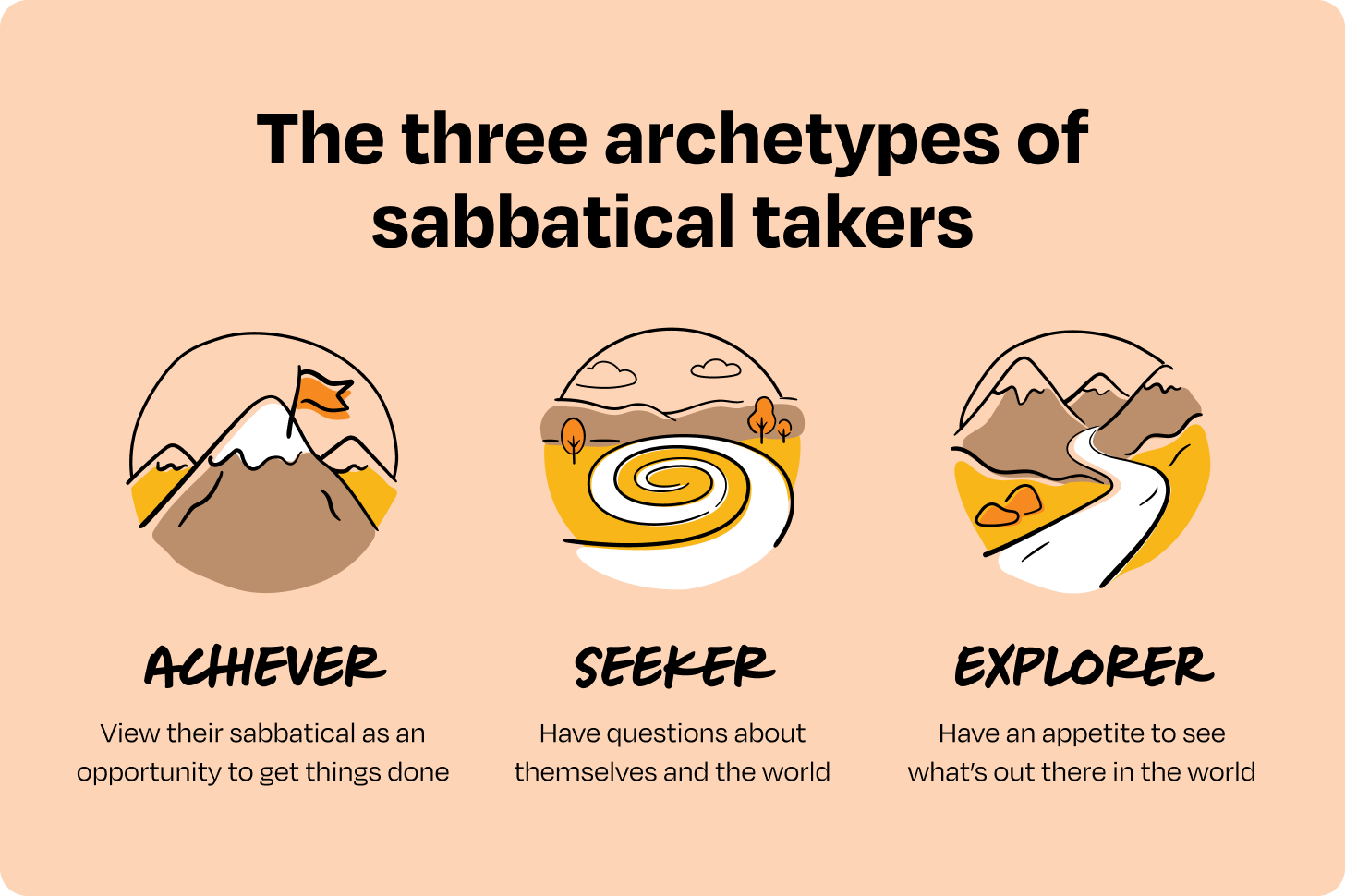
Over the course of my work, I have come across three archetypes among sabbatical takers: Achiever, Seeker, and Explorer. Recognizing yourself in these archetypes can help you make the best of your hard-earned break from routine. (You will likely identify with more than one of these archetypes, and that’s completely normal. In fact, many folks experience all three during their time off.)
Understanding what each archetype hopes to gain and into which traps they’re likely to fall will also allow you to take advantage of the experiences of many alumni who have gone before you. You’ll be better equipped to know when your work-obsessed self may be taking over. For example, sometimes you can redirect a competitive, work-obsessed mindset into a beneficial sabbatical activity, like volunteering your time for others or whipping yourself back into shape with gusto. Other times, you may realize that it’s this mindset itself, not your chosen activities, that you need some time away from.
The Achiever
The first and most common archetype is the achiever. Achievers view their sabbatical first and foremost as an opportunity to get things done.
Achievers are easy to recognize. They’re looking to make up for lost time by trying to squeeze years of life goals into a few months. They’re primed to view their sabbatical from the perspective of what they got done instead of how it made them feel. Don’t judge—most people initially conceive their sabbatical this way. Because we so rarely have freedom over large swaths of our life, it can be hard not to think about a sabbatical as a prime opportunity for productivity on the personal front.
What this archetype wants:
The achiever approaches their sabbatical with an accomplishment mindset. They often use external benchmarks—like fluency in a foreign language or completing a long hike—to determine whether they’re making progress. Or they attack private goals, like writing a book or organizing a community garden. This way, the achiever comes away from their sabbatical having accomplished something. Whether the product is applicable to their post-sabbatical life is beside the point. The achiever’s biggest fear is feeling like they wasted the opportunity to make some sort of tangible impact. They’ll use easily explainable milestones to guard themselves from looking or feeling unproductive.
An achiever can turn anything into an achievement. Type-A yogis are a textbook example. Instead of using their time off to simply do more yoga or attend a yoga retreat in a more exotic location, achievers devote their sabbaticals to becoming certified yoga instructors. It doesn’t matter that most of them don’t ever intend to teach yoga; the structure, magnitude, and mere fact of the accomplishment offer proof that they’ve “done something” on their time off. And that certified proof is irresistible.
What traps this archetype falls into:
Ironically, almost everyone I’ve spoken to who took this achievement-oriented approach to yoga regretted not taking the time to simply practice, learn, and play. What’s more, many of them found that the experience was almost anti-yoga. When you find yourself trying this hard to do something with your time off that’s supposed to be fun, the achiever mindset might be taking a little too much control over your sabbatical.
Tips for this archetype:
If you see yourself in this archetype, you’d be wise to force yourself to schedule a period of rest and healing at the start of your sabbatical. This is the time when many overachievers finally realize that their relationship to work has tangible negative effects on their bodies and minds. From ulcers to trigger fingers to insomnia and worse, stories of unexpectedly rapid healing from achievers who tend to themselves first when taking a sabbatical abound.
Consider how you think about your sabbatical wish list. Deconstruct the list of things you want to accomplish on sabbatical, paying attention to which goals have meaning for you personally versus ones that satisfy your accomplishment mindset. Does becoming a certified scuba instructor simply make a better post-sabbatical story than telling people your most treasured moments were playful days with your children? It’s almost inevitable that you will try to stuff your days and weeks on sabbatical with planned activities and aspirations, but for most, the real magic lies in serendipity and discovery, through play and experimentation.
The Seeker
The seeker also wants to accomplish something, but it’s less about reaching a destination than embarking on the journey. Seekers have questions, as much about themselves as the world outside them. The type of project a seeker pursues rarely feels urgent among the chaos and routine of normal life but remains important across large swaths of their life. Seekers are drawn to pilgrimages or road trips to reconnect with friends, family, people, and places from their past.
What this archetype wants:
Seekers are like personal archaeologists. They’re likely to engage in activities they used to love, trying to pick up on the scent of joy and engagement from the past. The external journey is a metaphor for the seeker’s ongoing internal search. They are deeply engaged in identity work, sensemaking on a path from uncertainty to certainty. A sabbatical beckons them to answer questions that have been bubbling up about the world and how they relate to it. Aspiring career switchers, or just folks looking to discern between garden-variety burnout and a strong signal to switch jobs, fit into this bucket.
I embarked on my sabbatical as a seeker. I had an overriding feeling that I’d ignored some core parts of myself for a long time. Primarily, that I’d neglected to make progress on deep questions within me about spirituality. I sensed that this project was important to me and required a lot more time and effort than I’d given it so far. I needed a more active approach if I wanted to make progress.
What traps this archetype falls into:
Seekers are prone to unrealistic expectations, which can put them at high risk of disappointment when they return from a sabbatical. The fact that they’ve finally made the time and space for something incredibly important and long overdue adds pressure to find the perfect next steps upon return. The kind of “good enough” steps that follow most sabbaticals—like staying at your old job for a bit longer or changing things up slightly before you make a big career move—are unlikely to satisfy seekers. In short, the quest for perfection becomes the enemy of success, spurring a more protracted sabbatical that becomes increasingly expensive and anxiety-inducing. Seekers should consider two strategies to avoid this vicious cycle.
Tips for this archetype:
Restrict the amount of time you allow yourself to seek. Seeking is a lifelong pursuit, not something you’re likely to knock out in several months. Instead of expecting to find your dream job (or state of being) by the end of your sabbatical, consider it a success to identify the next tangible step toward what your dream could be. You can control the process of the search, not the results. For example, have 20 coffee chats about career possibilities with people you admire. Your first sabbatical won’t be your last. To avoid burning out or spinning your wheels, it’s far better to end your sabbatical a bit closer to your ideal self than to flounder in the liminal state between the last thing and the next.
Prioritize others during your sabbatical. Seekers can easily lose track of time peering deep down into their personal rabbit hole. But sometimes the best way to learn about yourself is by setting your concerns aside entirely. Our research interviewees consistently recalled the time they spent with others as their most treasured moments. This finding emphasizes what the happiness literature has found over and over—that supporting other important people in your life and nurturing your relationships are instrumental to self-fulfillment.
The Explorer
Explorers have an appetite to see what’s out there in the world. They’re less concerned about how or if it will apply to their lives at the other end.
You don’t have to travel across the world to qualify as an explorer—I’ve met plenty of folks who, during their sabbaticals, spent time closer to home. They volunteered in their communities, experimented with new hobbies, and took shorter regional trips. All these detours took them out of their routine and cracked open their shells. Even going through a stack of books on your reading list can trigger awe. It can widen the aperture on what’s possible.
It’s rare to encounter a sabbatical that doesn’t incorporate a segment of pure exploration. Setting off on a journey is the most natural way to break free from routine life and to celebrate what’s next.
What this archetype wants:
For those who can afford to explore someplace far away, a sabbatical enables them to both get off the beaten path and to sufficiently sink in once they get there. As a burned-out marketing executive from our study put it, “I was having a very difficult time disengaging from my work for a couple of weeks after my sabbatical started, checking my personal email constantly and reflexively looking at my calendar. But as soon as my plane’s wheels left the runway en route to Bali—laptop behind—my work concerns evaporated completely.” Challenge yourself to get as far away from your routine experience of life as possible.
Exploration introduces uncertainty into our lives. In our world of limited vacation, we simply can’t afford to go off track and get lost. We can’t miss work, we can’t fly on weekdays, and we can’t risk traveling during shoulder seasons to save money. On sabbatical, you become time wealthy. Mistakes and inconveniences transform from vacation ruiners to serendipitous encounters. Exploring on our sabbaticals asks us instead to leave some important things to chance for a change. Living in the present and traveling flexibly leads to higher reported satisfaction among travelers and is correlated with greater psychological resilience.
What traps this archetype falls into:
While traveling far away may be the surest way to get out of your comfort zone, explorers who take an exotic, far-flung sabbatical often miss the beautiful things nearby, alienate themselves from their community, and set impossible standards for what quenches their sense of adventure. As a dyed-in-the-wool explorer, I know how difficult it is to go from a jet-setting expat to living a more sustainable life. But a well-balanced sabbatical (and life) requires also finding beauty in the mundane, closer to home.
Tip for this archetype:
Spend a significant portion of your sabbatical as a tourist in your own land. If you’re able to travel to far-flung places, do that first to completely disconnect and satisfy your more traditional sense of adventure. But then return to your routine surroundings and try to inhabit the energy that newcomers to a city have: Sign up for a special interest club, like a pottery or dance class. Volunteer locally or go to a city council meeting. It’s a totally normal mistake to treat your home turf as unworthy of the same attention and awe as some exotic locale. No matter how far afield your sabbatical takes you, the point isn’t to leave forever but to return home better off.
Excerpt from Chapter 9: First Principles
A field guide to your sabbatical
There’s a limit to how much you can prepare for a sabbatical.
There’s also a limit to how much you should prepare. You must make room for the unexpected opportunities that arise precisely from the lack of a plan, and the emotional discomfort that may accompany that. I get that this sounds like the worst-case scenario for the type As among us, but exploration enables growth, and growth requires discomfort. That’s the threshold you must cross on any journey of transformation, and the gooey insides of Sabbatical Land.
The advice you’ll appreciate the most from me won’t be a concrete recommendation for a beautiful beach or secluded retreat. Rather, it will be what helps you create the initial conditions for success: Your sabbatical should be long enough, it must contain the right components, and these pieces must be in the right order. These are the three guiding principles—setting, ingredients, and order.
This is a scaffolding to frame the journey in front of you, not be a “do this, don’t do that” checklist.
Three guiding principles
1. Setting: Duration and disconnection
Take big time off (more than you’re comfortable with)
In our time-scarce society, carving out enough uninterruptible time for your sabbatical is undoubtedly the most difficult step you’ll face. Is it any wonder that the most common question I receive is “How much time is sufficient for a sabbatical?”
I believe the sweet spot for sabbaticals is between six and 12 months1. It’s not easy to take such a big chunk of time off, which is why most people take an abbreviated break of a month or six weeks, kicking the can down the road for a longer break when things open up in the future. While you’ll still undoubtedly get some benefits from an extended vacation, which we’ll discuss further in chapter 11, don’t mistake a shorter break for a sabbatical. Not taking enough time off puts you at risk of ending up just short of the sought-after experience. It often takes six to eight weeks to begin to feel like you’re truly disconnected from routine life.
We’ve all experienced that moment toward the end of a vacation when we finally feel like we’re sinking in and enjoying ourselves, only to realize it’s time to head back to reality. It’s like that with sabbaticals. The most transformative aspects of sabbaticals often don’t start until at least two months in, after we’ve had a chance to heal and sufficiently leave our former life behind.
While there is ample evidence to suggest that anything under two months is too short, there’s less clarity on how long is too long. A small chunk of people I’ve interviewed felt as though being out of the workforce for more than a year felt right, and it worked for them. That said, I’ve witnessed significantly more folks who kept moving their return dates further and further into the future, getting caught in a cycle of self-doubt and guilt the longer they stayed outside of routine life. This makes sense: sabbatical takers feel enormous pressure to make their hard-won time off “worth it.” If their problems haven’t been resolved or their lives completely changed, can they really return to regular life satisfied?
Stressing yourself psychologically and financially while waiting for the perfect job is almost always worse than taking a modest next step toward your ultimate goals. So plan for sufficient time in Sabbatical Land, but consider setting a deadline for returning to work, even if—especially if—you haven’t yet landed on your dream job.
Set impenetrable boundaries to truly disconnect
Once you create the right container, you need to protect it by setting boundaries. This is more difficult than ever. Some 30 years ago, going abroad meant untethering. Your boss couldn’t reach you. Getting in touch with the folks at home meant an expensive long-distance call. As for the news, the New York Times didn’t go online until 1996, and you’d need to be in a cybercafe to read it. Now, a flick of the thumb could reveal a crisis at work, a salacious news story, or a pressing issue closer to home, and in the process spoil your serenity for the rest of the day.
I’m a purist when it comes to not working while on sabbatical, particularly when it comes in the form of consulting gigs related to your routine job. No matter how attractive the opportunity seems—no matter how little time it claims to take up—these projects tend to expand to fill the time available. A two-hour call once per week has a surprising amount of disruptive force, preventing spontaneity, requiring connectivity, and psychologically tying you to a past version of yourself. So set an away message and create a mail rule to auto-delete all inbound emails. Make sure your colleagues understand what constitutes a sufficient “break the glass” moment to interrupt your time off.
Money might be able to buy you incrementally more time off, but it can never replace the large swaths of uninterrupted time off it destroys. No matter how tempting it may seem, you will regret porous boundaries between your old life and your time off.
2. Ingredients: Embodiment and play
Get out of your head and into your body (and soul)