


👋 Hey there, I’m Lenny. Each week, I share deeply researched product, growth, and career advice. For more: Lenny’s Jobs | Lenny’s Podcast | Lennybot | How I AI | Become an AI-Native Builder and my other favorite AI/PM courses.
P.S. Get a full free year of Cursor, Notion, Replit, Lovable, Wispr Flow, Linear, ElevenLabs, Factory, PostHog, Granola, Brain.fm, Waking Up, and more, by becoming an Insider subscriber (while supplies last). Learn more.
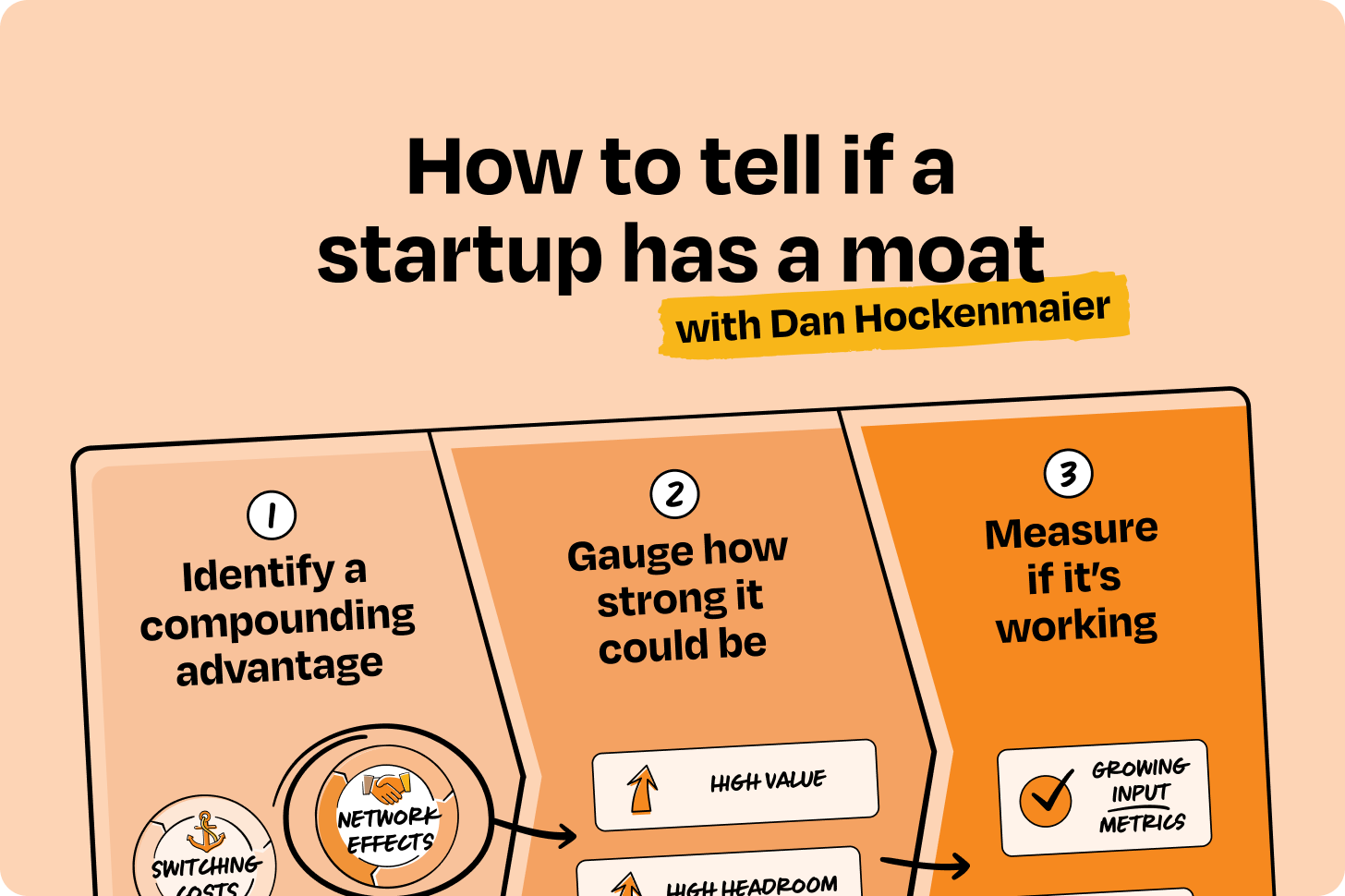
Moats! Does anyone have one anymore? As AI makes it easy to build anything, this is one of the biggest questions on people’s minds right now. Especially people trying to decide where to work. I teamed up with my frequent collaborator, the incredibly smart and insightful Dan Hockenmaier, to answer this question: How do I know if a given startup has a moat? The answer is a lot more interesting, and straightforward, than you’d expect. Let’s get into it.
For more from Dan, definitely subscribe to his fabulous newsletter. You can also find him on LinkedIn and X.
There is a pervasive belief that startups are a lottery ticket. It’s impossible to pick winners, so it’s just a roll of the dice.
I couldn’t disagree more.
Not only can startups be a great learning experience and a lot of fun, but they can also provide economic rewards comparable to (or greater than) the “safe” route into big tech.
However, for this to be true, you must rigorously evaluate the startup you’re considering joining. Some of this is obvious: Does it have a strong team? Do customers love the product? Is it growing fast? But perhaps because it seems harder to measure, people often skip one of the most important criteria: Does it have a moat?
A company can check all your boxes and look like a rocket ship. If it doesn’t have a moat, though, it’s going to stall out. It won’t be able to keep growing once competition gets fierce, and it’s unlikely to reach a major liquidity event. That can mean wasting years of your life.
Moats are more important than ever in the AI era. Anyone can create a product; they can do it faster than ever before, and everyone is building the same things. But only some of these products will win.
Of course, assessing a startup’s moat isn’t an exact science. The good news is, there’s a simple framework that could meaningfully increase your odds of picking a winner or avoiding a flame-out, and you can apply it in just an hour after receiving an offer. The process will also teach you a lot about the business.
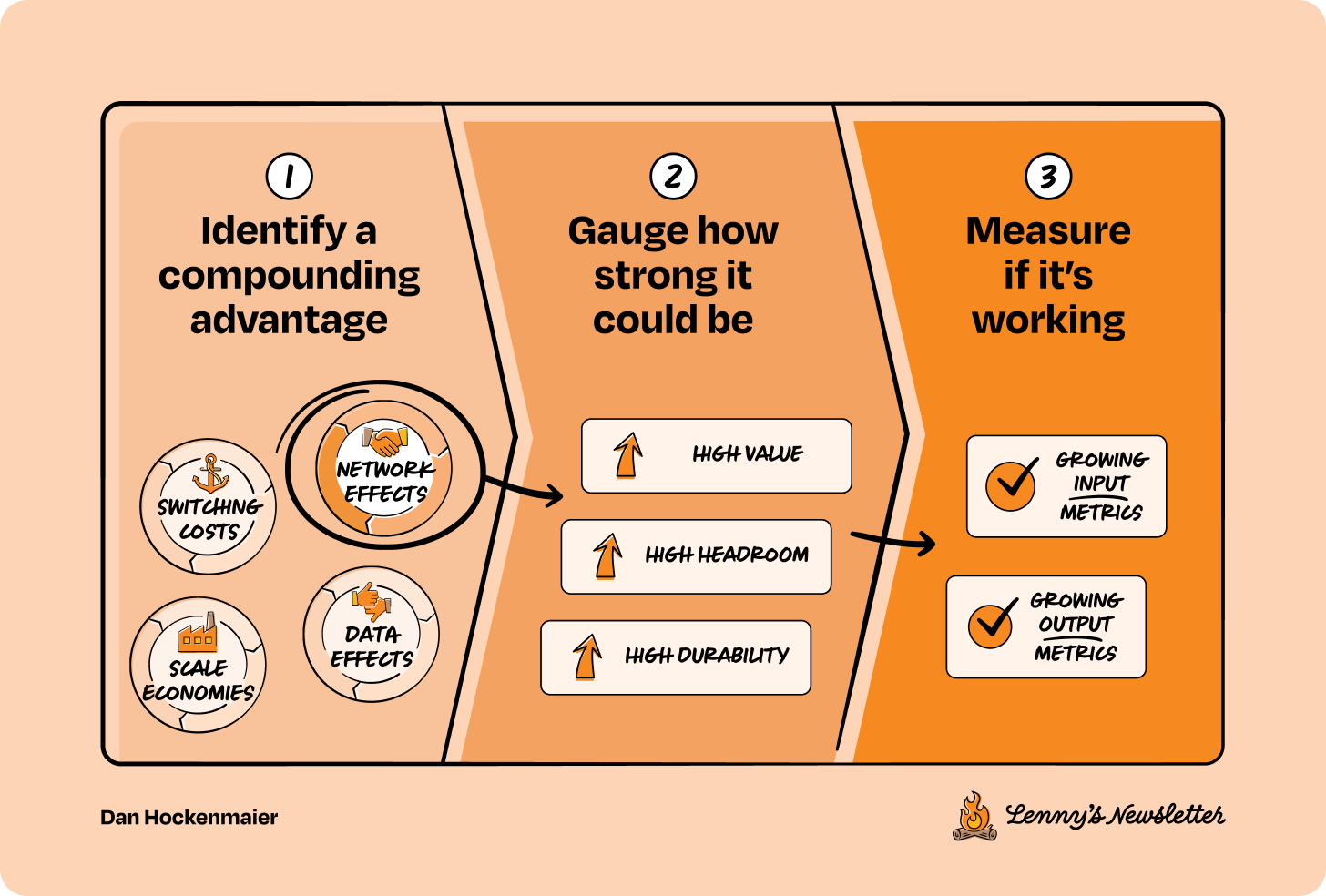
The framework has three steps:
Identify a compounding advantage
Gauge how strong that advantage could be
Measure if it’s working
Step 1: Identify a compounding advantage

The first step is to figure out what kind of moat a startup could have. This can seem daunting, especially given how frenetic the conversation is on the topic right now. The term “moat” is being used much too loosely, as a stand-in for basically anything that gives a company an edge.

In reality, only a small subset of what people call moats actually drive the vast majority of long-term value.
They’re what I’ll call compounding advantages: not just a temporary edge, but a self-reinforcing flywheel that gets stronger and stronger over time, ultimately making a company very hard to compete with.
There are only four compounding advantages that really matter. Every major tech company has at least one. If you can’t see the potential for any in the startup you’re evaluating, that’s a red flag.
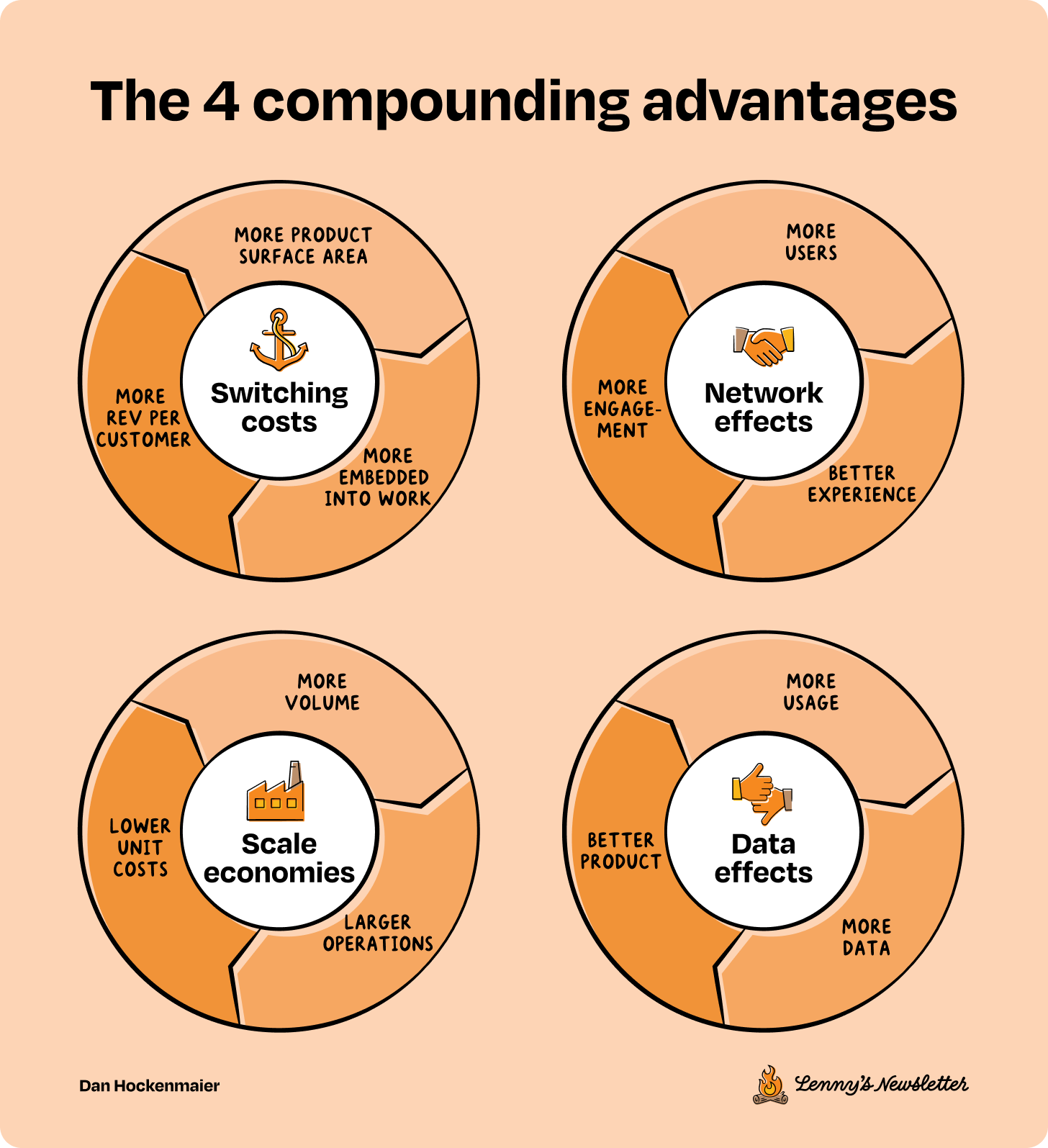
1. Switching costs: The more deeply embedded a product is in the way a customer works, the harder it is for that customer to switch. This increases retention and revenue per customer, which can be reinvested into the product.
2. Network effects: The more users a product has, the better it gets for everyone. This increases engagement and attracts more users.
3. Scale economies: The more volume a company has, the larger and more efficient its operations can be. This lowers unit costs, funding lower prices or a better product at the same price, further driving up volume.
4. Data effects: The more usage a product has, the more data it generates. This data can be used to improve the product and increase usage.
What about all of the other moats people talk about? Can they be compounding advantages as well?
A common one is speed of execution. It’s true that speed is critical for startups. But a company that has to sprint forever is not a good business. Ultimately, it will misstep, slow down, and competition will catch up. Speed gives a company more shots on goal as it tries to build a great product and a great business, but it must eventually find something more durable.
Another favorite is distribution. It does matter more than ever: building products has gotten easier, but getting them to customers has not. But distribution is not a compounding advantage either. It helps create the raw ingredients for one, but it is not one itself.
Finally, we have brand. The idea is that when everyone is building the same thing, the most resonant brand will win. But for startups, brand works more like customer acquisition spend: Put money in, get growth out. It’s not something that will effectively keep others from competing long-term. Brand can become a true compounding advantage (as with Coke or Nike or Apple), but it just takes too long to really matter for most startups.
Speed, distribution, brand, a great founding team, and lots of funding—these are all fuel. They get the car moving in the right direction. The four compounding advantages are what it looks like when the car starts rolling downhill on its own.
How to identify the compounding advantage
Your job is to identify which kind of compounding advantage a startup has the potential to build. It won’t be in full force yet (it takes a long time to develop), but it should be pretty clear which path they are on. That’s because it’s not something you can “bolt on”; it’s not some clever competitive tactic or a tweak you can make to your business model.
A compounding advantage is the core loop at the center of the business through which you add more value for customers. Defensibility emerges as a byproduct of turning the flywheel over and over.
So as you evaluate a company, don’t focus on what they say they are or what their “strategy” is. Focus on what they’re actually doing. What is the team working on every day? What’s on their roadmap? Which teams are large and influential inside the company?
Here is what to look for:
1. Switching costs
Switching costs are sometimes viewed negatively: as something that keeps customers trapped or a reason clunky legacy software never gets replaced.
But think about what it takes for a product to get into this position in the first place. It first has to become so deeply embedded into the way a customer works, so essential to their business, that they can’t remove it. That requires creating a product that delivers enormous value.
Mike Vernal recently wrote something of a manifesto for anyone building this kind of business today:
If you are building a venture-backed software company, I think the answer is once again “do it all.” Just build the whole thing—your moat is the totality of what you’ve built and completely owning the buying center.
Some have argued that AI is making switching costs irrelevant. AI does make the actual migration faster and cheaper, but that is not where most switching costs actually come from. The bigger cost is what I’ll call the “workflow tax”: all of the time the team spends learning a product and building it into how they work, and how disruptive it is to do that over again. AI also helps teams build products much faster, which could allow them to become even more embedded across a wider range of surfaces.
At the core of these companies is a machine to both deepen and broaden customer engagement. The roadmap is rich with efforts to better serve existing use cases or create ways to serve new ones. They’ll often be focused on integrations and working with other parts of their customers’ stack. The team should be heavily tilted toward product and engineering, with an emphasis on shipping rapidly.
The classic examples are large incumbents with broad, deeply embedded products in SaaS, fintech, and healthcare, like Salesforce, Datadog, ADP, and Epic. But there are many earlier-stage companies that are currently on a path to creating something similar.
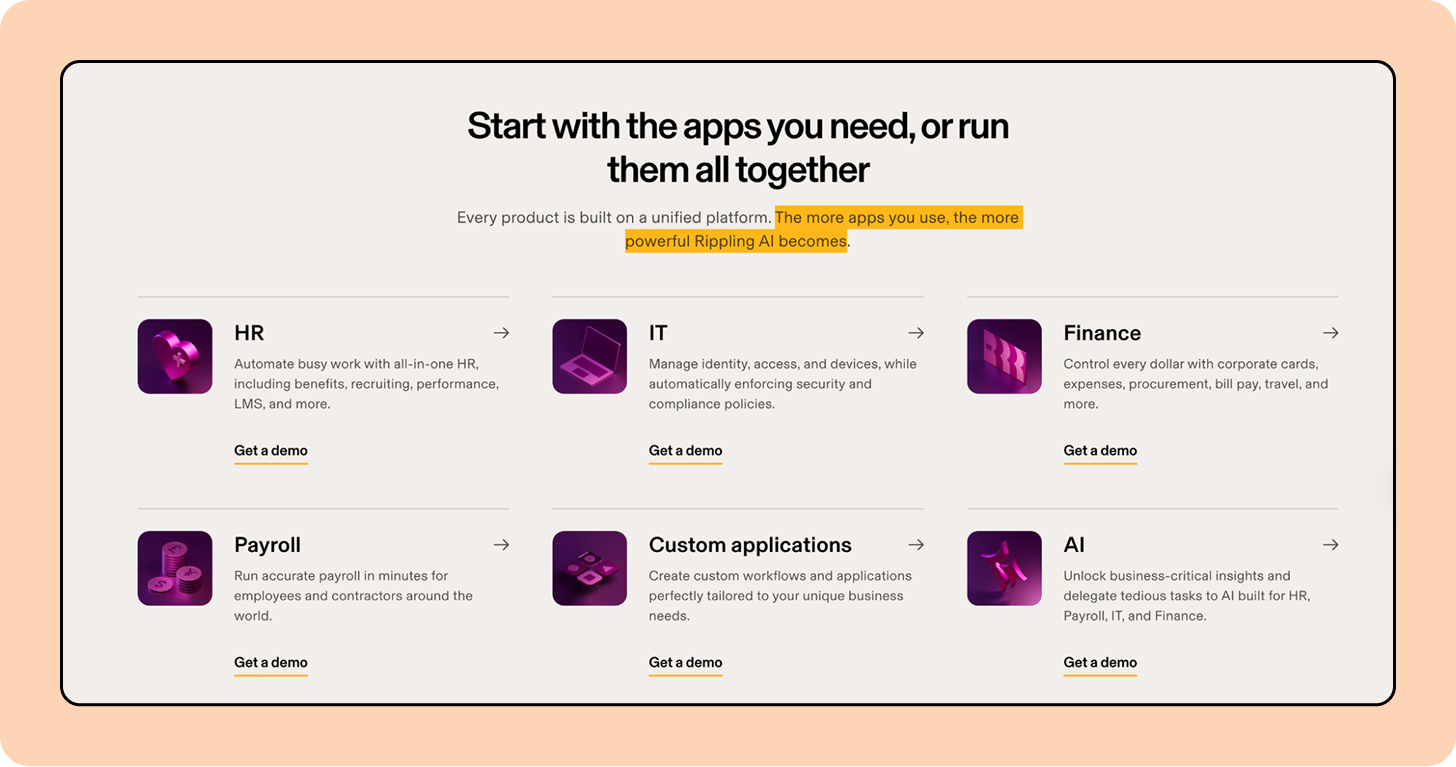
Rippling is a great example. Parker Conrad is building what he calls a “compound startup.” They started with employee onboarding and expanded rapidly across HR services, talent, finance, payroll, and business intelligence, all operating on shared infrastructure. This is the kind of product that gets embedded so deeply it rarely gets ripped out.
2. Network effects
Network-effect businesses are totally different—so different, in fact, that most product features and the UI itself matter very little. How is it that Craigslist can still get so much traffic when it looks like this, in 2026?
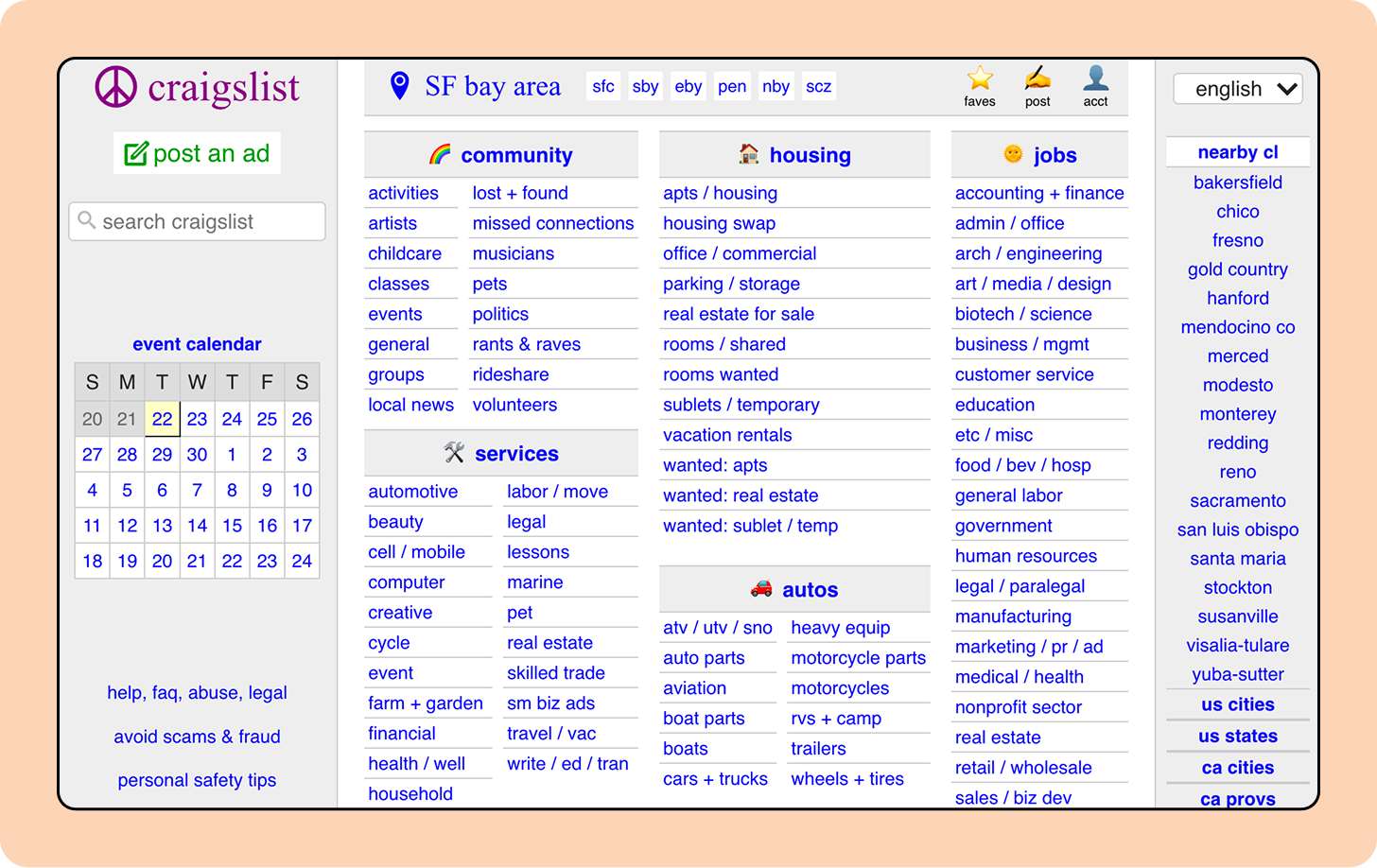
Because what matters most is the network. The value of a network-effect business increases with each additional user. It’s all about having all of the people customers want to interact with, all of the content they want to consume, or all of the products they want to buy.
Network-effect products are common in industries like social (LinkedIn), gaming (Roblox), and marketplaces (Amazon).
The emphasis of a network business is less on building out the surface area or feature set of the product, and more on growing the network and making it easier and easier for that network to interact.
For example, during my years at Faire (a marketplace connecting local retailers and independent brands), the vast majority of our roadmap was focused on just a few things:
Getting more retailers
Getting more brands and making sure we had all of their products
Improving the search and discovery algorithm to recommend the right products
Reducing risk so retailers could try more products (free shipping, net terms, bigger credit limits)
Every decision gets filtered through one lens: “Does this strengthen the network?”
3. Scale
Businesses with scale as their compounding advantage are all about making it possible to offer the same product at a lower cost or a higher-quality product at the same cost.
These businesses are often highly capital-intensive: They make a big investment, such as in a production facility, warehouse, or LLM training run, and figure out how to get it to pay back. And then they do it again, but this time try to do it bigger and faster.
They’ll often have larger operations, engineering, and finance teams. And they will usually be focused on expansion: into newer, higher-scale operations and into new geographies and categories. Scale businesses are commonly found in industries like manufacturing (SpaceX), retail (Costco), media (Netflix), and now in the frontier labs.
Zipline (the autonomous delivery robot company) is a good example of a startup where scale economies are starting to emerge. They benefit from scale in two ways: by manufacturing more drones to reduce unit costs and by increasing delivery density to improve their utilization rate. The result is a cost per delivery that has fallen from $300 at launch to $12 today. Anyone who wants to compete with them will first have to go through the expensive part of that curve.
4. Data effects
The final type of compounding advantage has historically been relatively rare, but AI is making it much more common.
These are businesses with data at the core. It’s the input that makes the product higher-quality, more efficient, or work for more use cases. And by using the product, customers generate even more data, which further compounds this effect.
In these companies, you’ll often see a large effort to collect and sanitize data, and to build algorithms and products on top of it. ML and data science are usually large and influential teams.
One good example is Stripe Radar. They use transaction data across all merchants to get better at detecting fraud for each of them. Stripe has processed over 70 trillion data points and $1.9 trillion in transaction volume. 92% of all transactions use a card it has seen before. The result is a product that a company with access to less data can’t match.
Many AI products have the potential for this compounding advantage because of how much they can be improved with more data. Cursor is a clear example: with each accept or reject from users, the model gets better at understanding what good code looks like. Many vertical AI products have the potential to do the same thing for other domains like law, healthcare, and customer service.
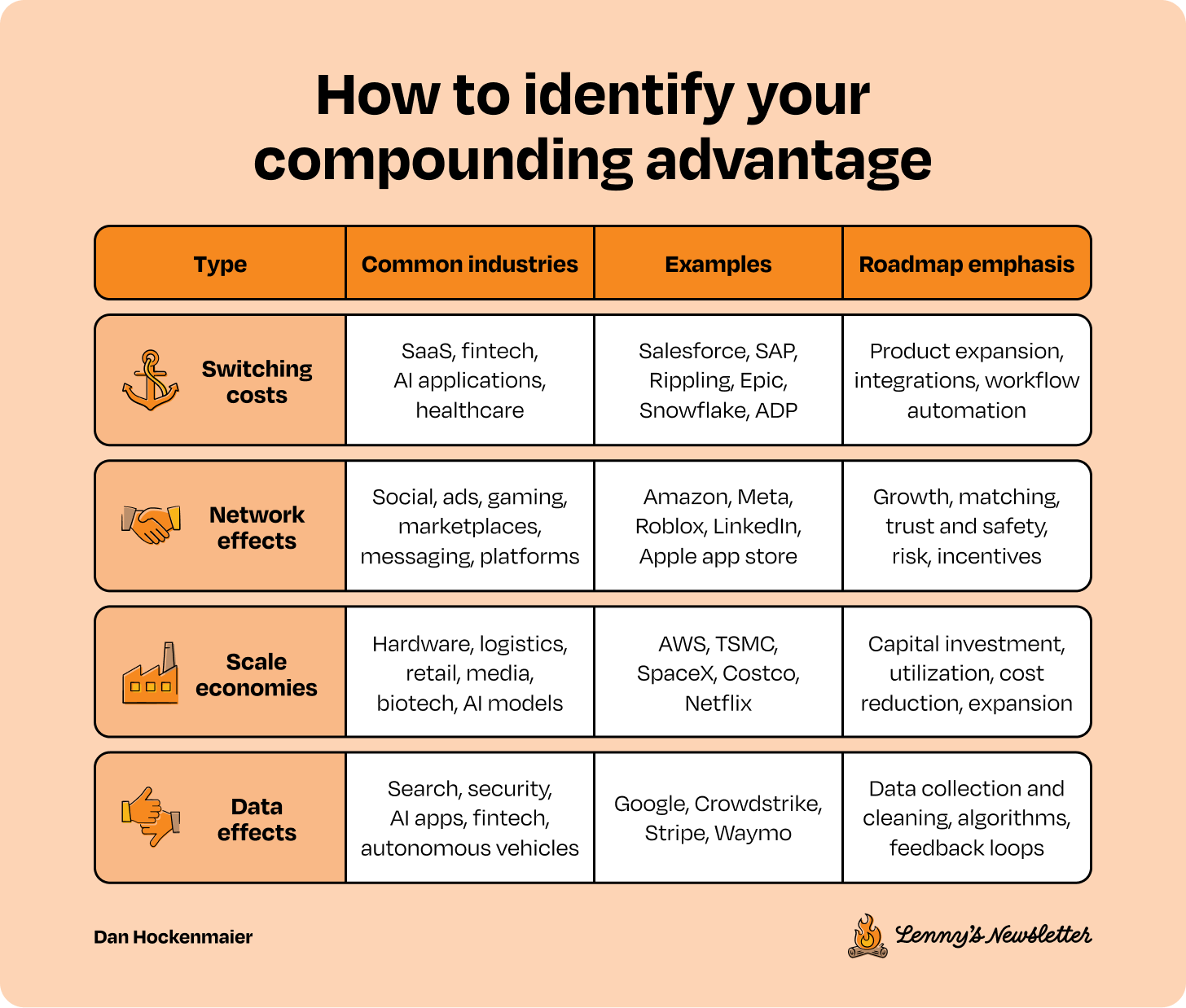
Here’s a cheat sheet you can reference for the four compounding advantages:
For anyone who wants to go even deeper on defensibility, the best book on it is 7 Powers by Hamilton Helmer. He is also a past guest on Lenny’s Podcast!
Step 2: Gauge how strong the compounding advantage could be

At this point, you should have identified which compounding advantage the startup might have. Let’s say it’s a network effect.
The next step is to assess how powerful that compounding advantage could become. Not all compounding advantages are created equal. For example, every marketplace has some form of a network effect, but many still fail to become good businesses.
