👋 Hey there, I’m Lenny. Each week, I answer reader questions about building product, driving growth, and accelerating your career. For more: Lenny’s Podcast | Lennybot | How I AI | My favorite AI/PM courses, public speaking course, and interview prep copilot
P.S. Get a full free year of Google AI, Cursor, Lovable, Notion, Manus, Replit, Gamma, n8n, Canva, ElevenLabs, Factory, Wispr Flow, Fin, Supabase, Bolt, Linear, PostHog, Framer, Railway, Granola, Warp, Gumloop, Magic Patterns, Mobbin, Stripe Atlas, and ChatPRD, by becoming an Insider subscriber. Yes, this is for real.
I’m teaming up with AI native and my many-time collaborator Hilary Gridley on a project that will accelerate your AI learning more than anything you’ve tried. For free. Open this link in a new tab, and keep reading.
For more from Hilary, find her on LinkedIn and X, and check out her newsletter and her course, How to Become a Supermanager with AI.

“I keep meaning to really dig into AI, but I can’t seem to find the time. I’m just too busy.”
I hear this from executives, from managers, from ICs, from technical and non-technical people alike. From people with jobs, people looking for work, students, entrepreneurs, stay-at-home-moms. They’re all underwater and hungry for more leverage, but it’s not totally clear how to go from “asking it questions” to something that meaningfully gives them time back—especially when investing that initial effort takes time away from work they already know how to do.
This challenge is not new and not reserved for AI. I’ve spent much of my career working on products that consistently change people’s behavior to improve how they live and work (WHOOP, Dropbox, Big Health), which means I’ve had thousands of conversations with people who say they want to make a positive change in their life but struggle to actually do it.
When you dig into what is standing in their way, time is always the first thing they say. You hear it over and over: “I’m just too busy; I can’t find the time right now.” But even when they find time, they rarely end up making progress on the goal that’s been eluding them. As a result, I’ve learned to become very suspicious of the word “busy.” When people say they want to do something but are too busy, there is almost always something else standing in their way.
This is the root of procrastination. At its core, you are waiting for some external force to change—like your endless to-do list magically disappearing, or your calendar suddenly opening up—rather than making a change in your actions, which is hard.
So how do you get over procrastination? Tim Pychyl, a psychologist and procrastination expert, says, “Research and our lived experience show very clearly that once we get started, we’re typically able to keep going. Getting started is everything.” So the answer is very simple: Break down the task into the smallest possible first step you could take, and then take that step. Then the next one, then the next one.
I’ve seen this philosophy transform all aspects of people’s lives. We took it to heart at WHOOP when we launched Healthspan, which tracks nine key metrics to calculate your physiological “WHOOP Age” and “Pace of Aging.” When people saw their WHOOP Age, they often wanted to make big changes across lots of behaviors to improve it. But we found that the best way to help them make progress was the simplest: offer a new bedtime to aim for tonight. Likewise, a digital depression treatment I developed at Big Health focused on helping patients take one mood-lifting action every day. The most common failure pattern was taking on too big of an action, like trying to plan a whole dinner party, and then getting overwhelmed and making no progress on it. So the key to keeping people engaged (and to driving clinically validated improvements in depression symptoms) was to help them break it down and commit to just the first step.
This philosophy has influenced the products I build, how I manage my team, and, most recently, how I help people transform their work with AI. Taking one single, simple step each day is the key to building your AI expertise.
What you need is a Couch-to-5K for AI: a progressive daily practice that builds the habit, using the same behavior-change principles that make fitness programs work. Small wins build confidence, confidence builds momentum, and momentum motivates you to keep going. It starts to feel like you’ve discovered a better way to make real progress instead of adding yet another thing to your to-do list.
In 2024, I created a very simple version of this called “30 Days of GPT,” which I shared in my last guest post on this newsletter. It was extremely popular and was featured in outlets like Harvard Business Review.
Now I’ve updated the program for 2026 to get you from chatting with AI to actually building with it, no matter who you are or what kind of work you do, using Claude Code.
Get started with your Couch-to-5K for AI
Couch-to-5K for AI is free, takes fewer than 10 minutes a day, and is designed to build your AI practice progressively. I took a very deliberate approach to each piece of the system: what you do each day, what order things go in, and how the skills build on each other. You can stop reading this post now and get started here.
Seriously, you can skip the rest of this post if you want and just get learning.
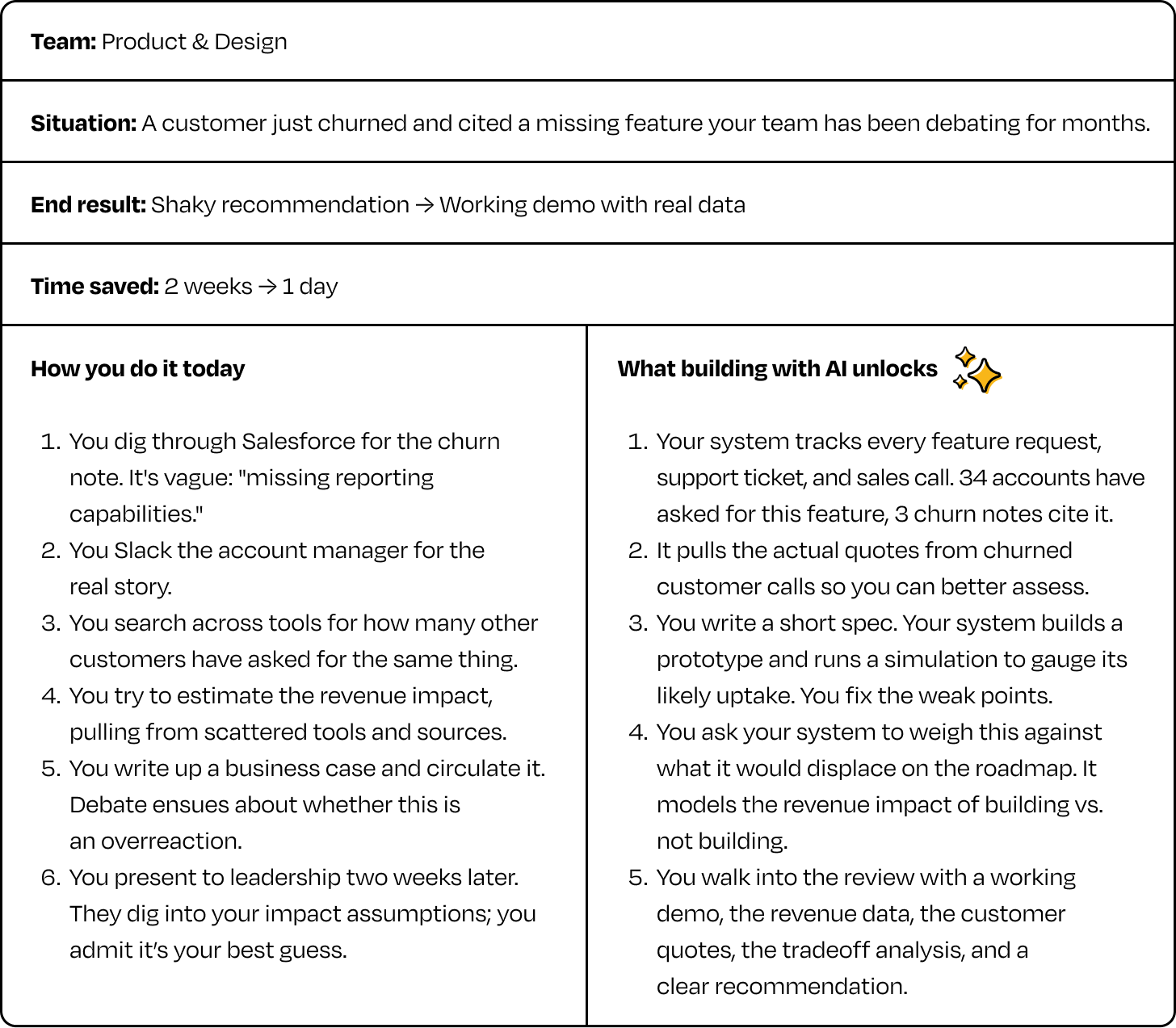
Or, if you’re not sure that this will be worth your time, here are the before-and-after pictures across different types of roles:
A months-long debate, resolved