


👋 Hey there, I’m Lenny. Each week, I share deeply researched product, growth, and career advice. For more: Lenny’s Podcast | Lennybot | How I AI | Become an AI-Native Builder and other favorite AI/PM courses
P.S. Get a full free year of Google AI, Cursor, Lovable, Notion, Manus, Replit, Gamma, n8n, Canva, ElevenLabs, Factory, Wispr Flow, Fin, Supabase, Bolt, Linear, PostHog, Framer, Railway, Granola, Warp, Gumloop, Magic Patterns, Mobbin, ChatPRD, and Stripe Atlas, by becoming an Insider subscriber. Yes, this is for real.
A year ago, we ran our first large-scale survey of how tech workers feel about their jobs and careers. We summed up what emerged in four words: burned out, but optimistic. Today we’re back with the results from our 2026 survey, and it’s a tale of two workforces.
One half feels amplified by AI—more capable, more confident, more excited than they’ve been in their entire career. The other half feels shaken by it—less sure of their value and whether there’s still a place for them. Which side of that line people fall on predicts how they feel about their career more than anything else, including their current role, seniority, company size, or any other measure we collected. The workforce is bifurcating into two realities.
But there’s more: Burnout overall jumped 11 points in a single year, and four in 10 respondents are worried about losing their job. Even those who feel optimistic about their own career may not recommend that friends follow their path. In the AI era, everyone agrees the ground is moving. No one is sure yet if it’s an earthquake or a launch.
We think these findings are important enough that we’re making this post free for everyone.
Let’s break it down.
Our biggest takeaways
The workforce is splitting in two. Tech workers are either amplified by AI or shaken by it, and that divide shapes their feelings about work more than any title, tenure, or company.
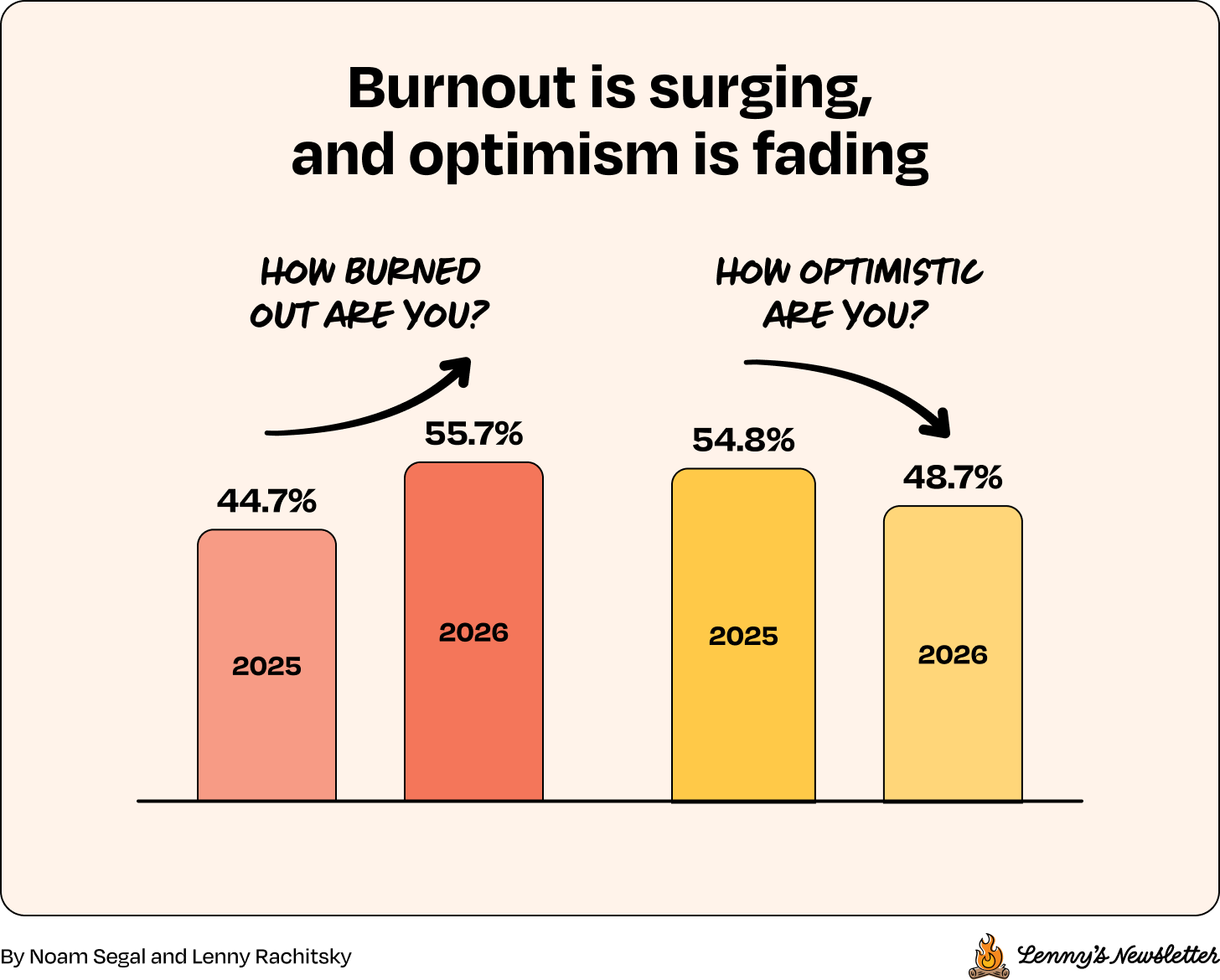
Burnout is surging, and optimism is fading. Significant burnout rose from 44.7% to 55.7% of respondents, while career optimism fell from 54.8% to 48.7%. Those who feel destabilized by AI are feeling the least optimistic and the most burned out. A worrisome trend.
Tech workers wouldn’t recommend their own field. More than half (53%) would steer a newcomer away from a career in their role, even though they’re optimistic about their own future.
Productivity is up, but quality is questionable. 82% say AI is making them measurably more productive, but many worry the gains are coming at the cost of the sharpness of the work and the worker.
The underlying fear is of being overworked. Only 22% worry about “losing my job to AI.” Far more worry about being expected to do more for the same pay (51%), getting trapped in an unsustainable pace (46%), and the quality of their work going down (41%).
Almost everyone is ambivalent. 77% of respondents picked at least one positive and one negative emotion about AI. The average person selected more than five emotions. The defining feeling about AI is ambivalence.
Designers and researchers are the most worried. They report the most AI anxiety, the most fear of job loss, the worst-rated managers, and the lowest willingness to recommend their field. It’s a continuation of a trend we flagged last year.
Founders are still the happiest people in tech, and small companies are still the best places to work. Both findings replicate from 2025, and both are statistically robust.
Managers are still the biggest lever for happiness. Manager quality remains the strongest driver of burnout and one of the strongest drivers of everything else.
The industry, in tech workers’ own words, is “chaotic.” Asked to describe the state of tech in a sentence, the most common theme by far was chaos, though the sentiment was split almost evenly between excitement and dread.
Takeaway 1: The workforce is splitting in two
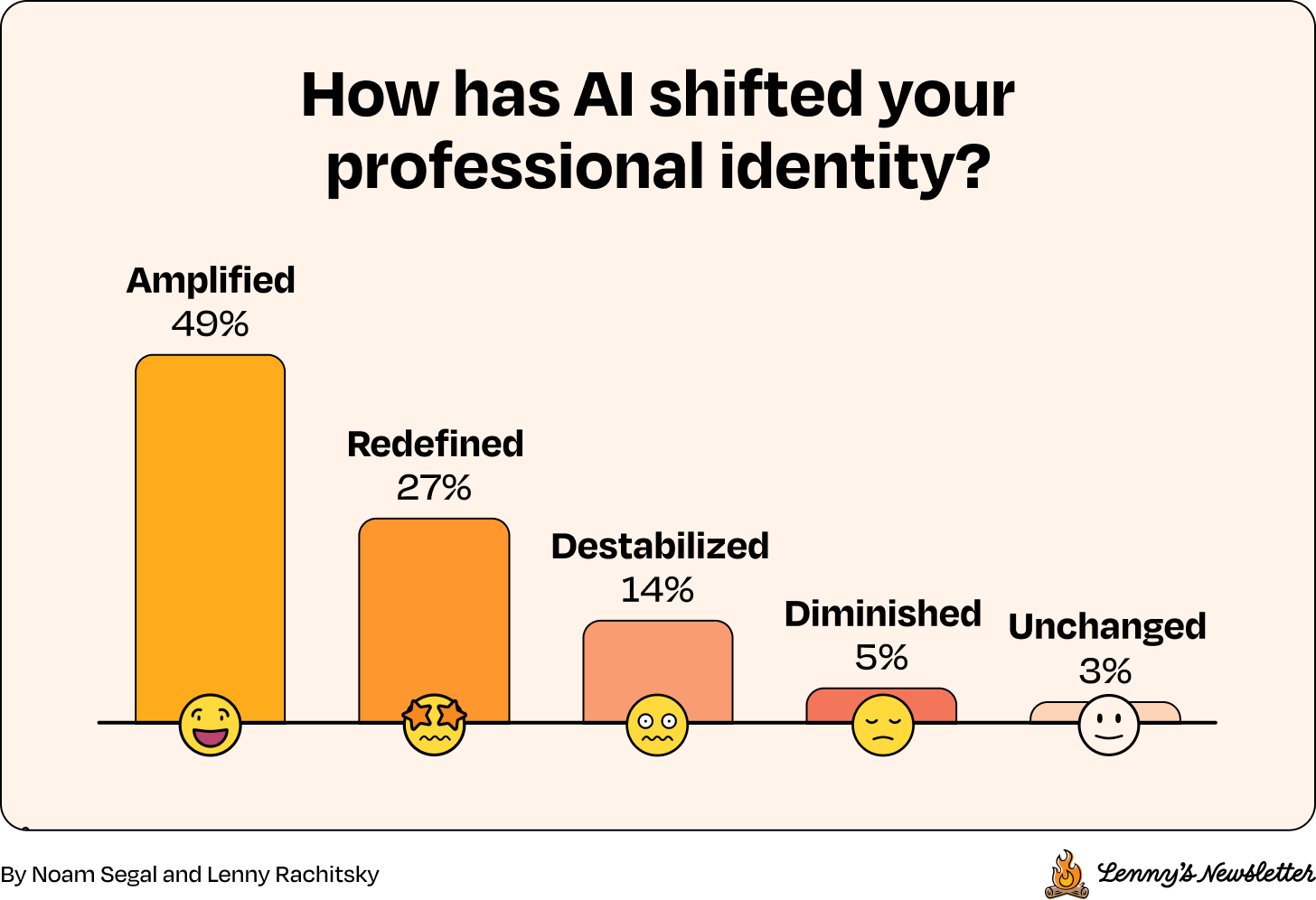
To understand AI’s deeper impact on people, we asked an existential question: How has working with AI shifted how you see yourself as a professional? We gave respondents five options. Here’s how they responded:
“Amplified (I can do more, and better)”: 49.0%
“Redefined (My role is changing shape, but I don’t see that as clearly positive or negative)”: 27.4%
“Destabilized (I’m less sure where I stand or what’s really mine)”: 13.9%
“Diminished (I feel less essential or less valuable)”: 5.0%
“Unchanged”: 3.2%
When we lined up that question against the rest of the survey, the four identity groups differed dramatically:
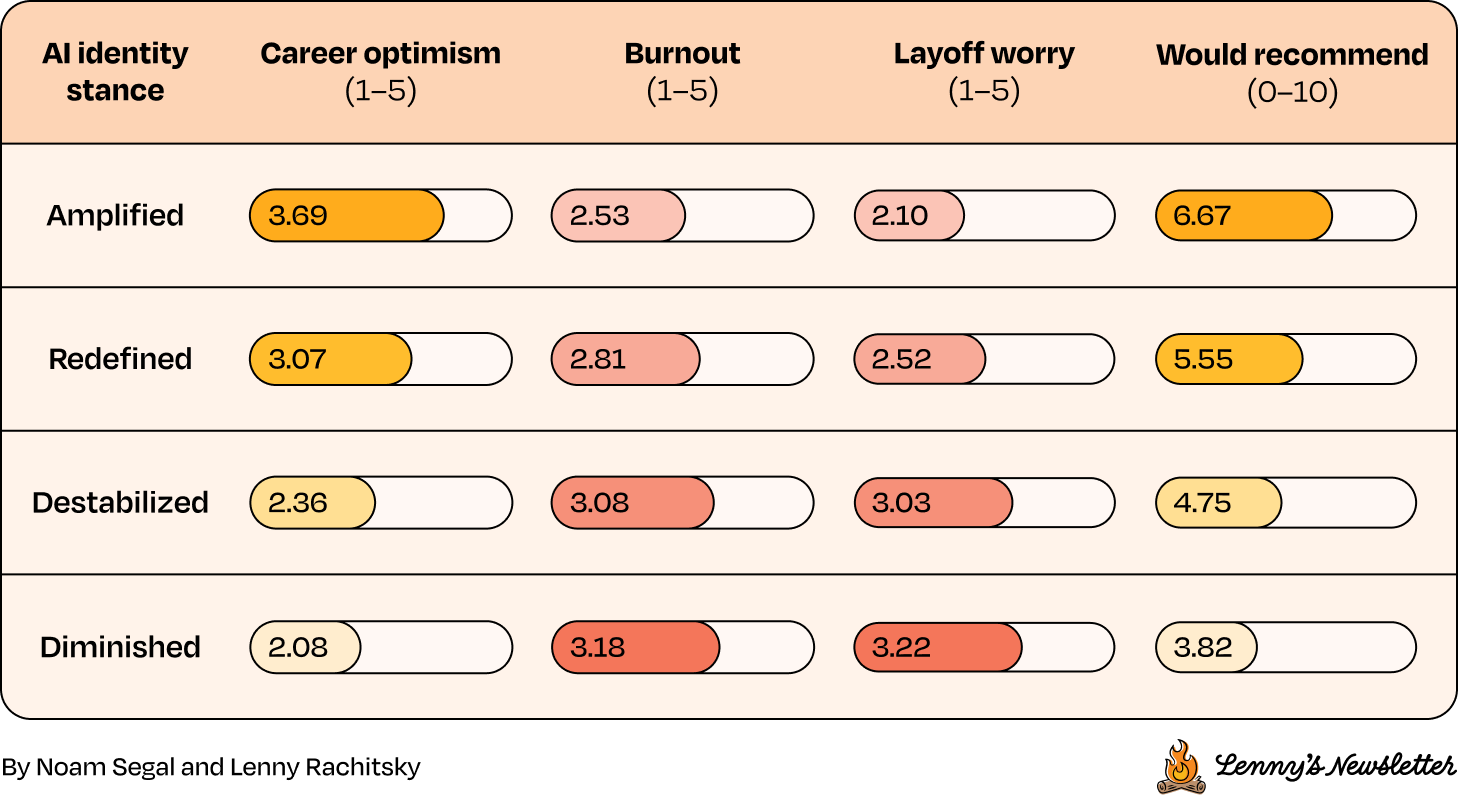
As you go from “amplified” to “diminished,” optimism collapses, burnout climbs, layoff fear climbs, and willingness to recommend the field falls off. The people who feel amplified by AI are thriving. Those who feel diminished by it are in distress on every measure.
To make sure this wasn’t an artifact, we ran the numbers a few different ways:
In a regression pitting every variable against each other, AI-identity stance was the single strongest predictor of career optimism (standardized β = +0.39) and of whether someone would recommend their field (β = +0.60)—stronger than role, level, and company size combined.
As an effect size, the gap between the “amplified” and “diminished” groups on optimism is large (Cohen’s d ≈ 1.55). For context, the famously strong “founder effect” we’ll discuss later clocks in at d ≈ 0.56. The AI divide is roughly three times as large as that. It is, by a wide margin, the biggest effect in the dataset.
The question that best predicts how a tech worker feels about their work, in 2026, is no longer “What do you do?” or “Where do you work?” It’s “What has AI done to your sense of who you are?”
Meet the four tech workers of 2026
We did one more pass on this data: instead of using a single identity question, we clustered respondents based on the full pattern of emotions they reported about AI. Four types emerged, and you almost certainly recognize them.
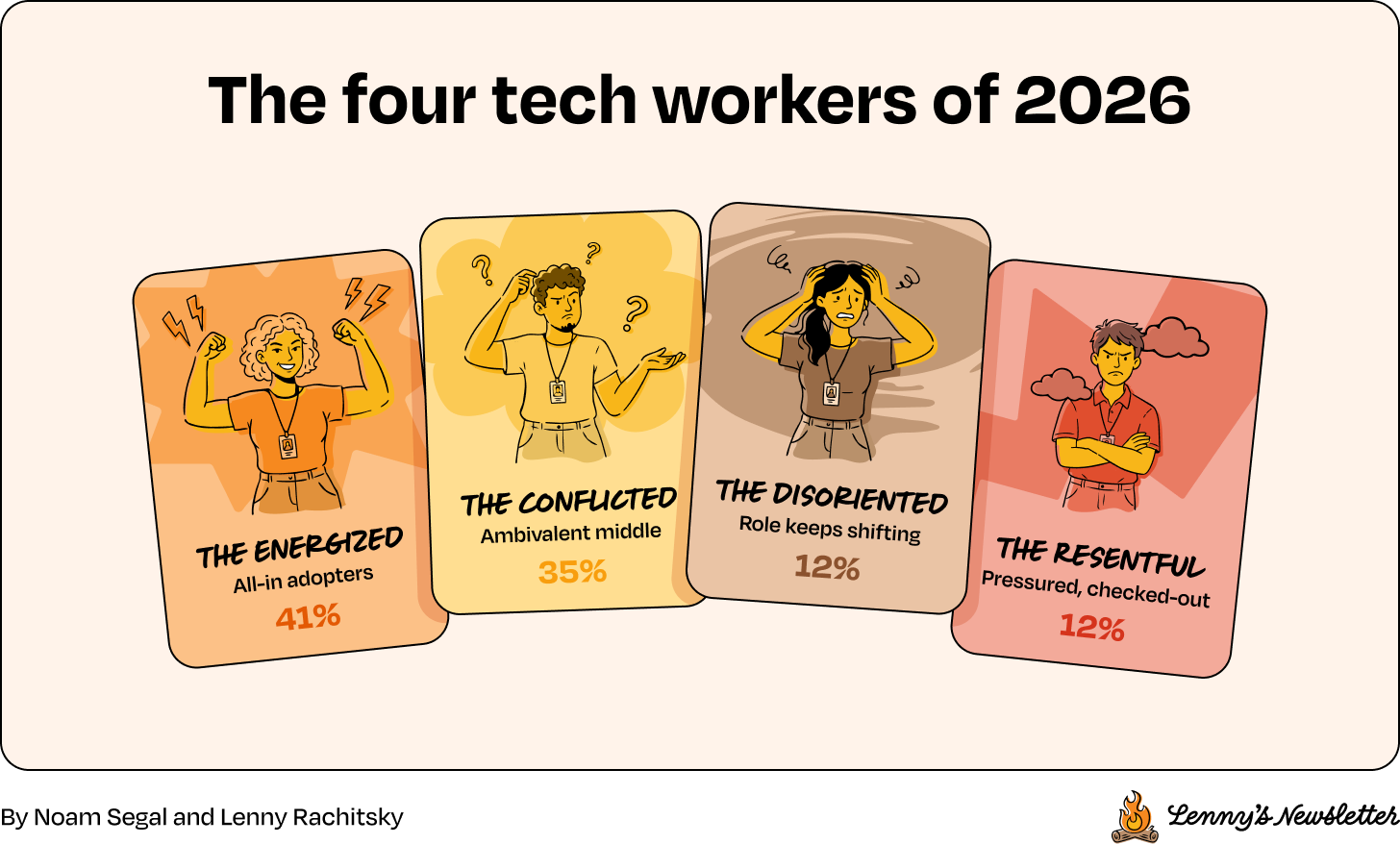
The Energized (41%). The all-in adopters. They lead with “excited” (91%), “curious” (83%), and “hopeful” (59%). They’re the most optimistic group, the least burned out, and the only segment with a clearly positive read on their field. For them, AI truly seems like a superpower.
“Product has become fun again! You become an explorer, you play around . . . you spend long hours full of excitement. We’re in an amusement park.” —PM, Principal IC
The Conflicted (35%). The ambivalent center of gravity—and the largest group after the Amplified. Their signature emotions are “conflicted—holding positive and negative feelings at once” (68%)—and “curious” (64%), trailed closely by “overwhelmed” (56%) and “tired” (55%). They haven’t soured on AI; they’re just exhausted by the work of keeping up with it while holding two feelings at the same time.
“I’m simultaneously having the most fun I’ve had as a product builder and also feeling the most uncertainty I’ve felt. I’m confident I’ll be able to keep my skills sharp and adapt, but I’m not yet sure what it is that I’ll need to adapt into.” —PM, Senior IC
The Disoriented (12%). Defined almost entirely by one feeling: “disoriented—my role keeps shifting,” layered with “overwhelmed” (74%) and “tired” (73%). These are people watching their job change shape beneath them faster than they can find their footing again. They still think AI is somewhat useful. They’re not “refusers.” They’re just losing the thread of their role in the workplace.
“Things are so uncertain, we’re like farmers on the cusp of the industrial revolution. We know going into farming is the wisest long-term career choice, but we don’t see a clear path. This kind of uncertainty crowds out productivity.” —VP Product
The Resentful (12%). The burned-out and checked-out. Every one of them selected “resentful—I feel pressured to use AI,” and they cluster with “tired,” “conflicted,” and “overwhelmed.” They report the lowest optimism, the lowest willingness to recommend their field, and the lowest sense that AI is helping them at all. This is AI fatigue transformed into resistance.
“Tech overall kind of sucks right now. We used to adopt new technology because we were excited about the cool new things we could do. Now all we hear is ‘Use AI or you will lose your job’—and then people get fired anyway. I hate it.” —Director of Product
Takeaway 2: Burnout is surging, and optimism is fading
Significant burnout is now the majority experience for tech workers. 55.7% of working tech professionals report significant burnout—meaning they describe themselves as “moderately,” “very,” or “completely” burned out. Last year, that number was 44.7%. More than a quarter (26.2%) are now “very” or “completely” burned out.
Career optimism is dropping. Fewer than half (48.7%) of respondents are optimistic about the future of their career (down from 54.8% being optimistic last year). We’ve gone from “burned out but optimistic” in 2025 to “significantly burned out, and not that optimistic” a year later. We’re curious (and a little scared) about how this will look in a year.
That being said, job enjoyment is holding up: 42.6% enjoy their work “very much” or “extremely”; another 36.7% rate it “moderately”; and only about one in five (20.6%) enjoy it slightly or not at all.
Why the apparent contradiction? Enjoyment, burnout, and optimism are different constructs. Enjoyment is about the work itself, and people still like the work. Burnout is about pace, and people are increasingly worn out by how much they have to do. Optimism is about where things are heading. You can love your craft, be worn out by how much of it you’re doing, and feel doubt about the future all at once.
How worried are you about layoffs?
This year, we also added a question to the survey: How worried are you about being laid off in the next year?
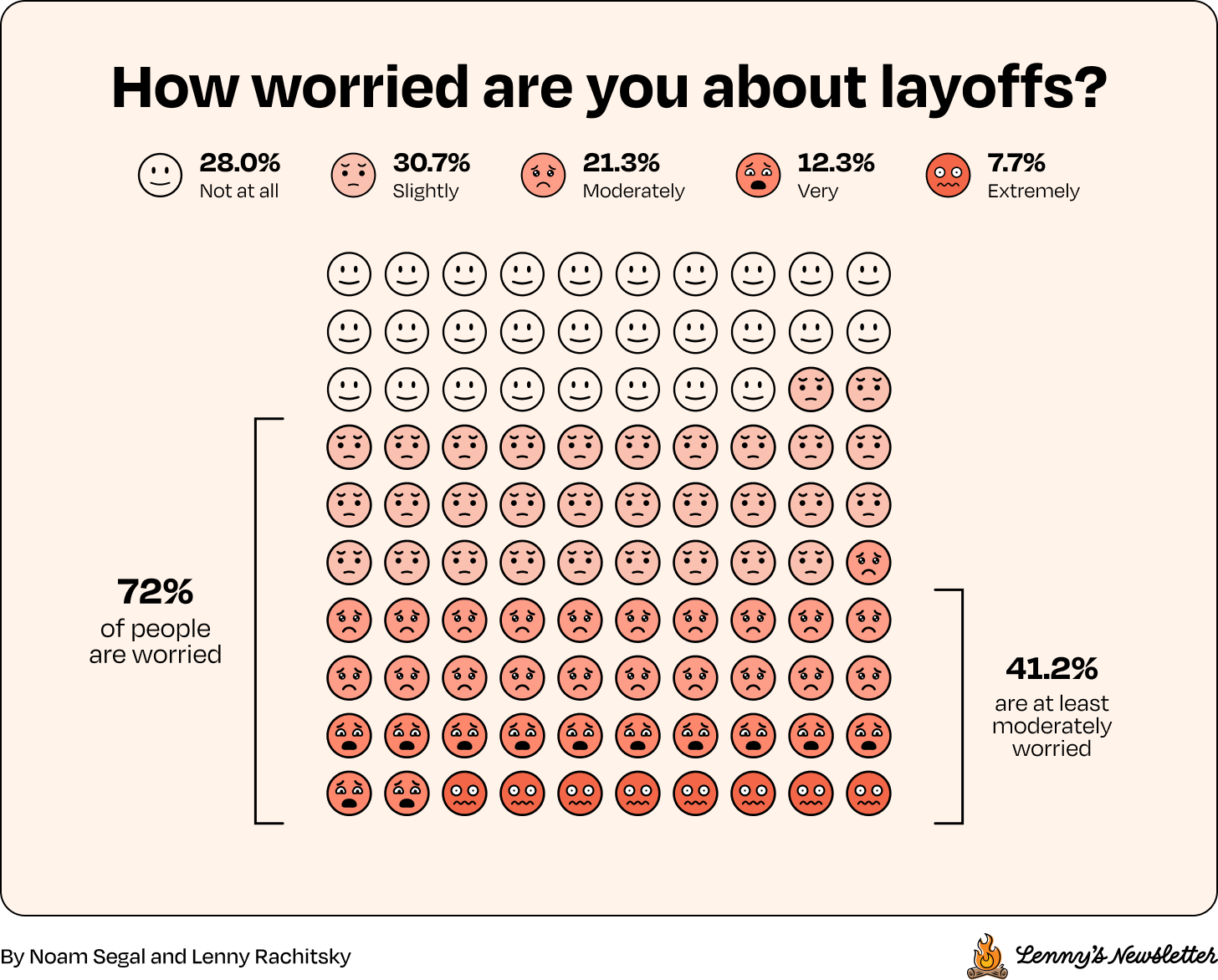
41.2% are at least moderately worried, including 19.9% who are “very” or “extremely” worried. 28% aren’t worried at all. So roughly four in 10 tech workers are carrying real job-security anxiety into their week—a sizable undercurrent.
What makes layoff worry worth its own question is how tightly it’s bound to everything else. Of all the things we measured, layoff worry is the single strongest correlate of career pessimism (r = –0.47). Nothing else tracks negative outlook as closely. When people are scared of losing their jobs, their optimism goes first.
We’ll come back to who is most worried later. It’s not who you might guess.
Takeaway 3: Tech workers wouldn’t recommend their own field
This year, we asked an NPS-like question about people’s careers and roles: On a scale of 0 to 10, how likely are you to recommend a career in your role to a friend starting out today?
More than half of working tech professionals would actively steer a newcomer away from the path they chose. That translates to an average NPS score of –39. Moreover, a third of the people who call themselves optimistic still wouldn’t recommend their own field.
The cleanest way to say it: “The water’s fine; don’t come in.” People have largely made peace with their own trajectory. They’ve got the skills, the relationships, and the seniority to ride it out. But they’ve lost faith that the on-ramp still works for someone behind them.
“I’m lucky I’m later in my career . . . AI can augment what I’ve built. I think I won’t be in a position to hire and mentor new PMs, but I’ll be safe. Which feels really crappy to say.”
“I’m at the point where I can just retire and choose not to, so I’m not worried about my own career. But I’m worried about the younger generations.”
The recommendation score varies enormously by role, and the spread is its own story.
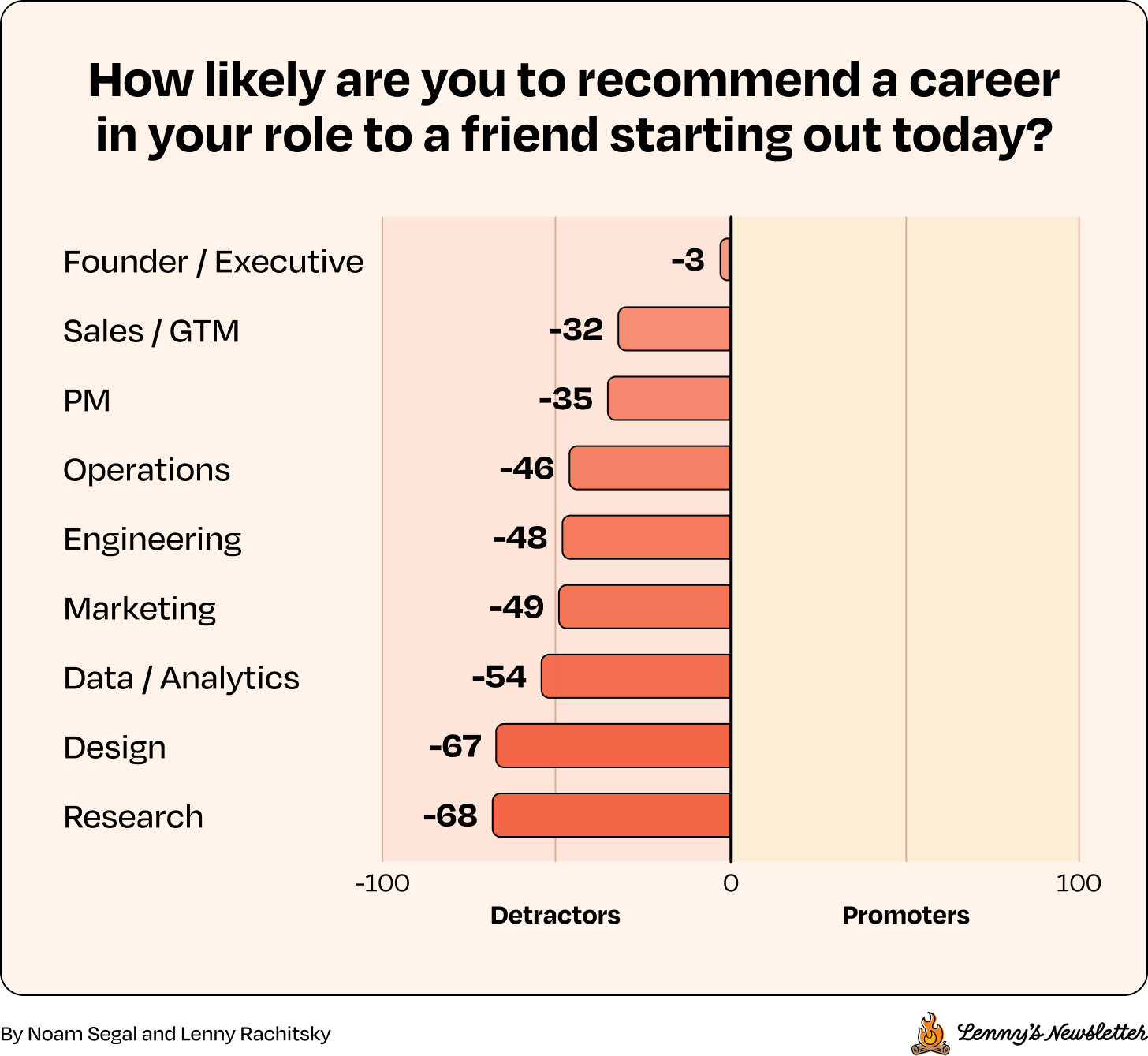
Founders would (just barely) still wave you in. Designers and researchers very much would not. And the score climbs steadily with seniority: senior and staff-level individual contributors are the least likely to recommend their field (both at NPS –49), while VPs (–23) and founders (–5) are the most. The further up you’ve climbed, the more the ladder still looks worth it; the people on the rungs below are the ones telling others not to start the climb.
Takeaway 4: Productivity is up, but quality is questionable
Given the rising burnout, the layoff anxiety, the doom in the discourse, you’d expect tech workers to be rather sour on AI. They’re not.
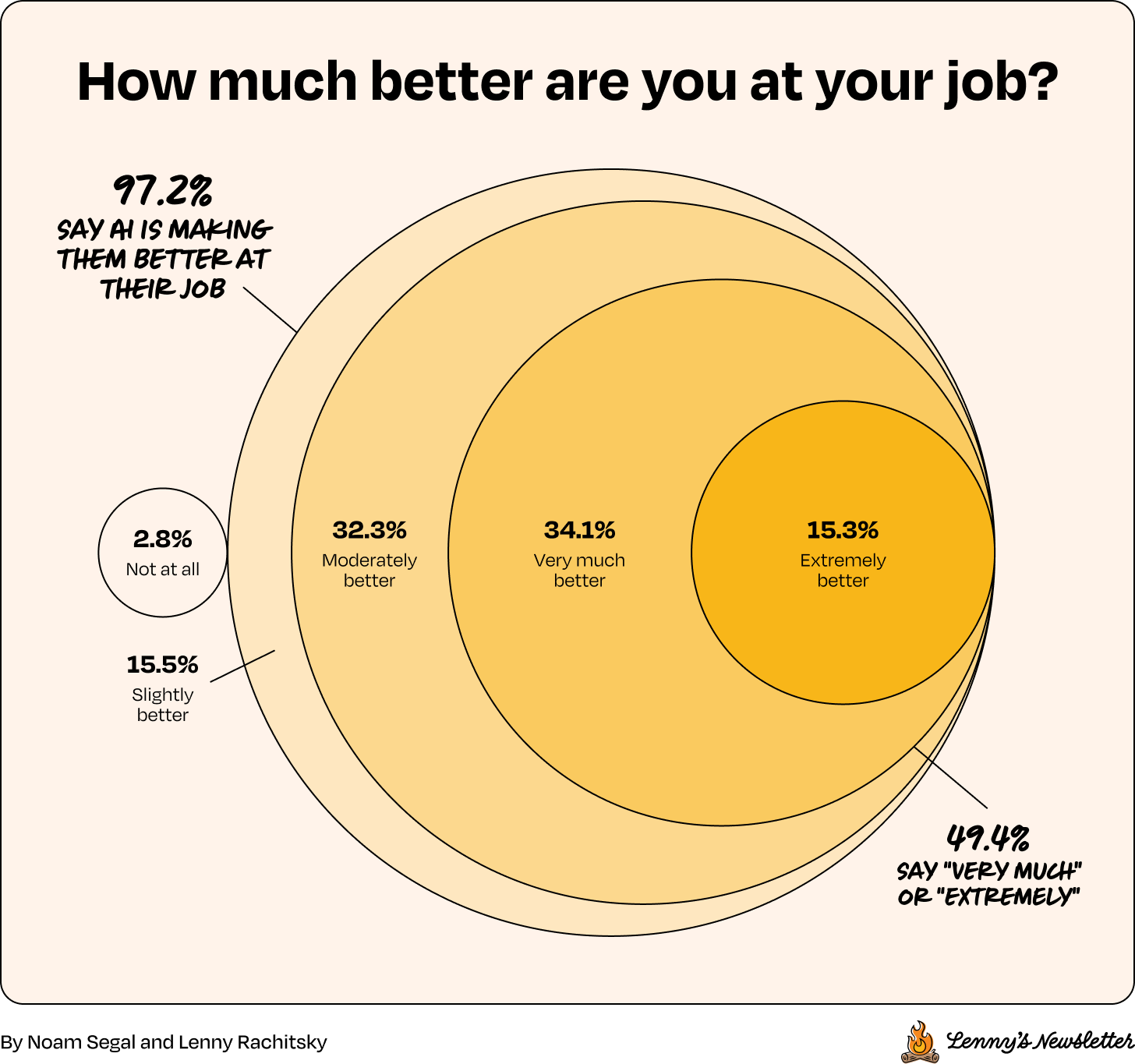
At the individual level, the AI numbers are among the most positive in the survey. 82% say AI is already making them at least moderately better at their job, and nearly half (49.4%) say “very much” or “extremely.” 60% feel confident or ahead of their peers in AI skills, compared with just 22.5% who feel anxious or behind.
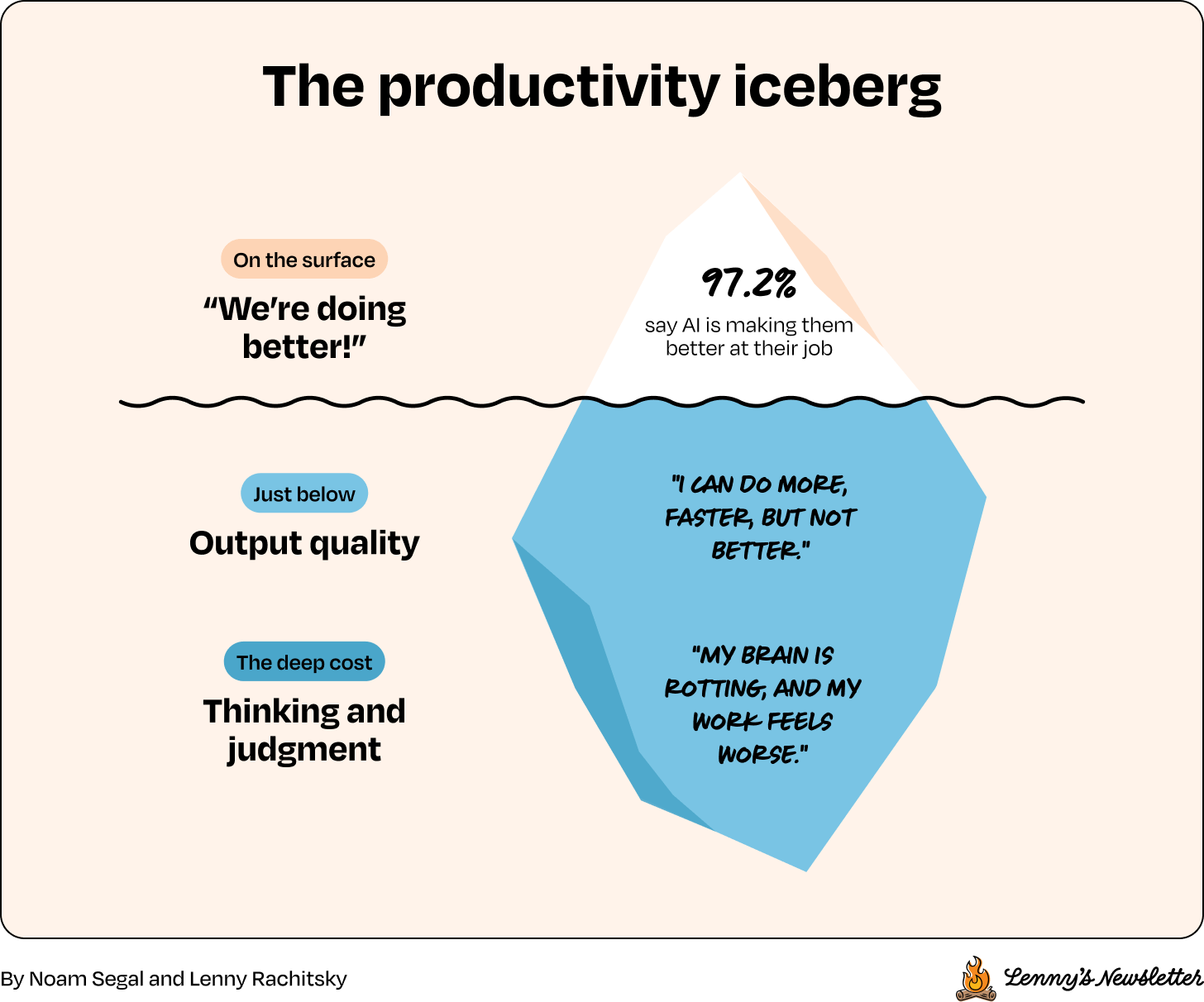
But then we looked closer at what “better at my job” means. When we asked people to describe in their own words how AI had changed their work, “better” turned out to mean producing more and faster, but not higher quality. The productivity gains are coupled with deep unease about the costs of leveraging AI.
“I can do more, faster, but not better.”
“Amplified and destabilized at the same time. We just set a new denominator for the job. And it moves higher and higher every month.”
And the cost isn’t only in the quality of outputs. A striking number of people described their focus, their judgment, and their thinking as suffering:
“I’m amplified, but my brain is rotting, and my work feels worse.”
“I feel like I don’t think hard enough anymore—I just follow Claude. I don’t fully understand what I merge.”
“I miss feeling smart and having aha moments. I miss talking [to] and brainstorming [with] humans instead of machines.”
The productivity gains are real, but the quality of the work and the sharpness of the person producing it are taking a hit. The bar keeps rising to match what AI makes possible, and a growing share of people feel that neither the output nor their own mind is keeping up.
Takeaway 5: The underlying fear is of being overworked
Respondents’ number-one worry about AI’s impact on their career is the squeeze—AI raised the bar for output, and the reward was . . . more output expected, for the same paycheck.
They’re scared that the work will get harder, faster, and cheaper, and that they’ll be expected to keep smiling through it.
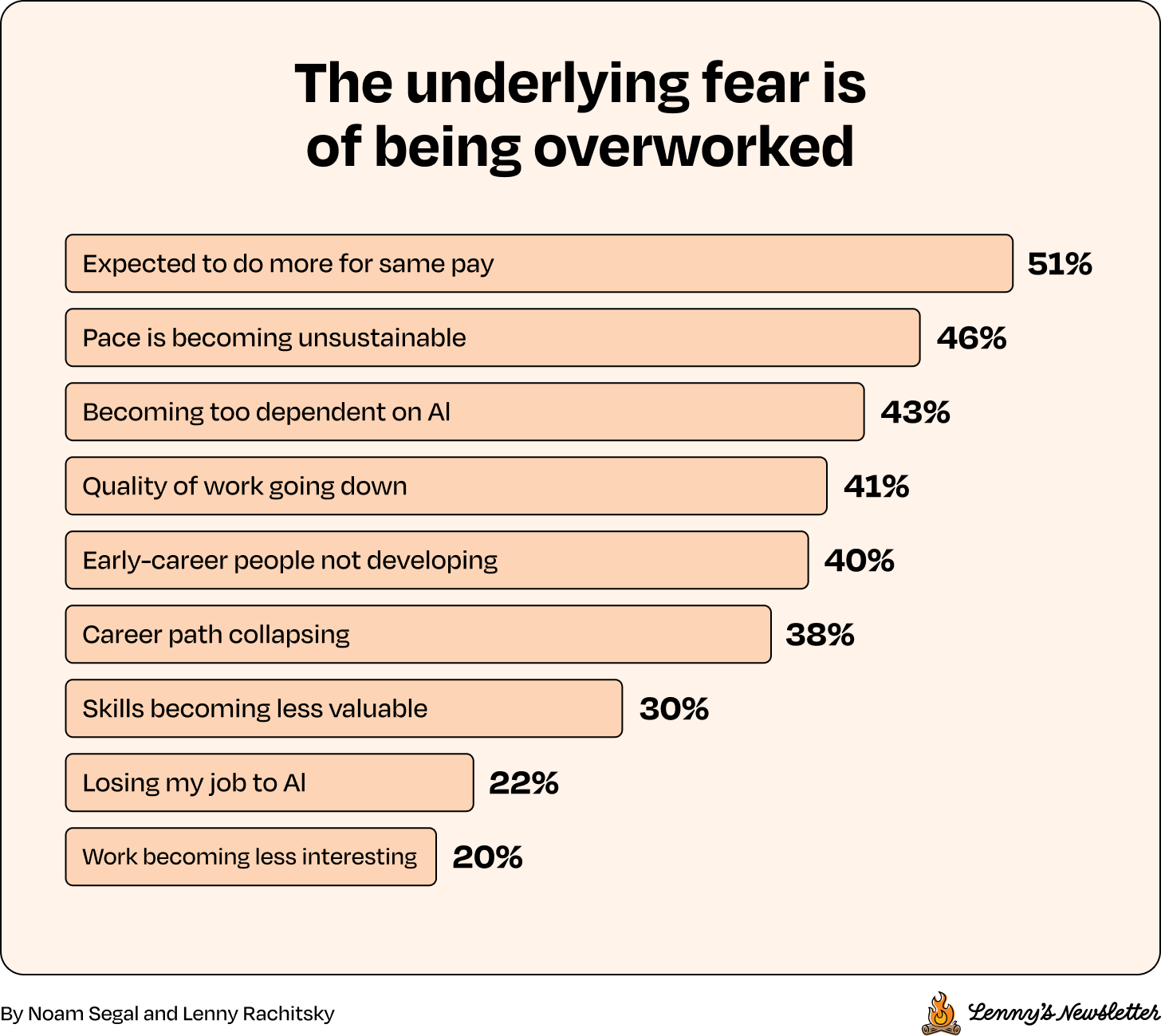
It feels like the dominant narrative about AI and work has been about replacement: the robots are coming for your job. Clearly, that’s not what tech workers are most afraid of. “Losing my job to AI” came in near the bottom of the list, at 22%.
Remember the “AI is replacing parts of my job” question? Half of the respondents say it’s happening to at least a moderate extent. You’d expect that feeling to drive layoff anxiety, but it doesn’t. The correlation between “AI is taking over parts of my job” and “I’m worried about being laid off” is essentially zero (r = +0.05).
What people are actually worried about is being asked to do more for the same pay, and watching the quality of their work slip.
It shows up vividly in the open-ended answers:
“More and more work is being handed off to me because I can use AI to get it done. But that makes it impossible to keep up with quality standards and not burn out.”
“AI helps with the toil, but then it’s also an enabler to do even more toil.”
“When we automate intellectual tasks, we’ll have to do high-value creative or strategic work only—doing that eight hours a day is not realistic. I used to take rest during repetitive tasks.”
This might sound like it contradicts the layoff worry from earlier. It doesn’t. People fear layoffs, but they mostly don’t blame AI for them. What they fear from AI is being buried in more work.
Add this all up, and you get a workforce that’s more productive than ever but quietly dreading what comes next. The speed AI unlocked got plowed straight back into expectations. Every gain becomes the new baseline, and the people expected to hit it are running out of room to breathe.
Takeaway 6: Almost everyone is ambivalent
If there’s one feeling that defines tech workers’ relationship with AI in 2026, it isn’t excitement, and it isn’t fear. It’s both, at the same time.
We asked people to check off every emotion that described how they feel about AI in their work. Here’s the full list, in order:
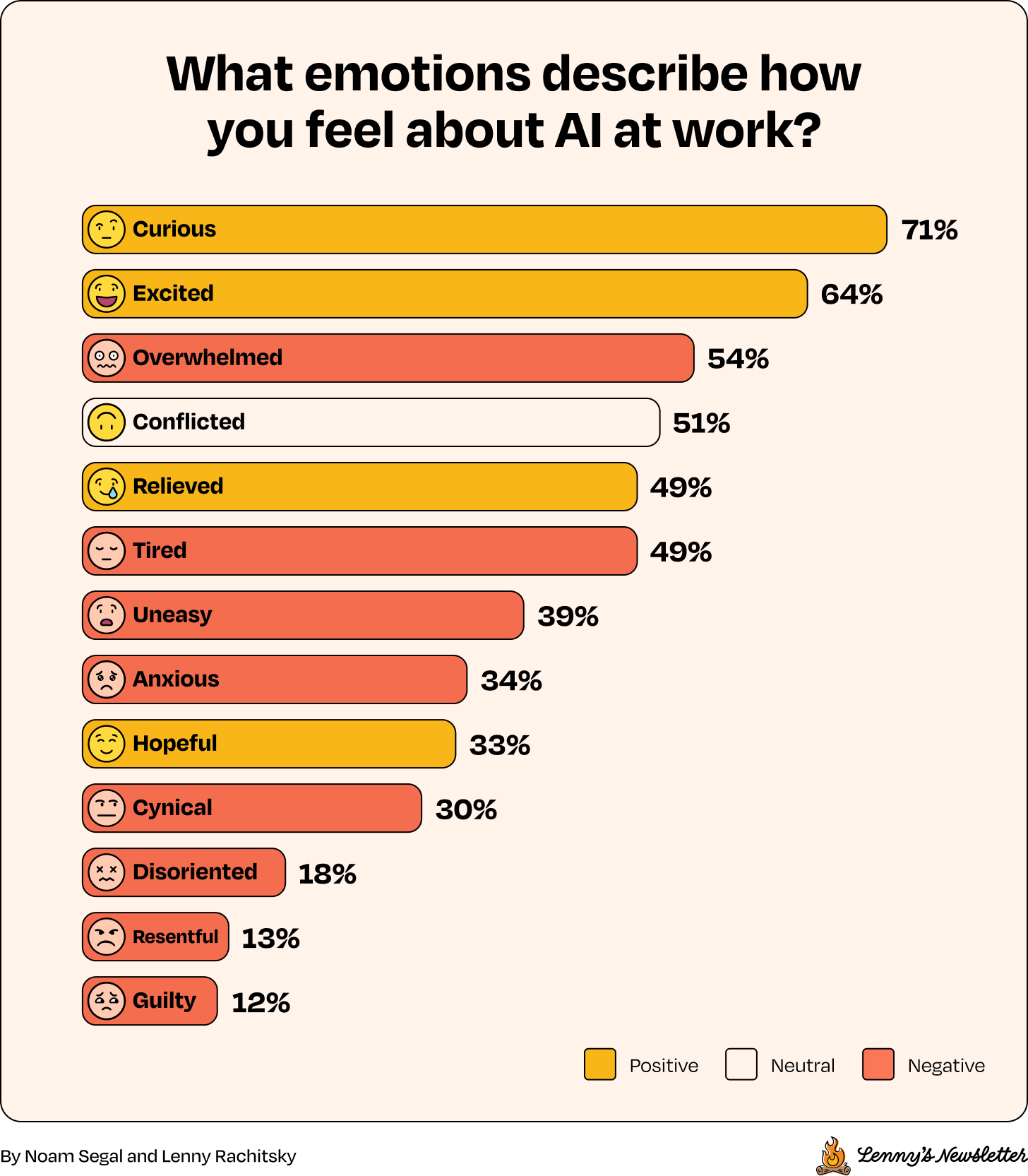
The two leaders are unambiguously positive (curious, excited). But the next cluster (if we ignore “conflicted”) is made up of people who are overwhelmed and tired. People are curious and overwhelmed. Excited and tired. Only 33% feel “hopeful,” even though 64% feel “excited.” Excitement about the present is running well ahead of hope about where this all goes.
Nikhyl Singhal named this phenomenon “smiling exhaustion.” The burnout of a few years ago was grim—all overhead and no agency. Today’s is different. People are shipping again, compensation has climbed, and many roles seem reborn. The catch is that there’s no off-switch: the tempo is brutal, and the rules rewrite themselves every month. It’s relentless, but it can also be exhilarating.
You see this in that 51% explicitly selected “holding positive and negative feelings at once.” But that undercounts the real ambivalence. When we looked at who picked at least one positive and at least one negative emotion, the number jumped to 77%. The average respondent selected five or more emotions (one person selected 13). It’s a workforce in which three out of four individuals are carrying a complex set of emotions about work.
Takeaway 7: Designers and researchers are the most worried
If AI is dividing the workforce, the obvious question is: along what lines? Who’s getting amplified, and who’s getting left behind?
The clearest pattern is by role: designers and researchers are at the epicenter of AI anxiety across the board, while founders and executives are feeling the best. We measured the share of each role that landed in negative identity or emotional buckets, and the spread is stark:
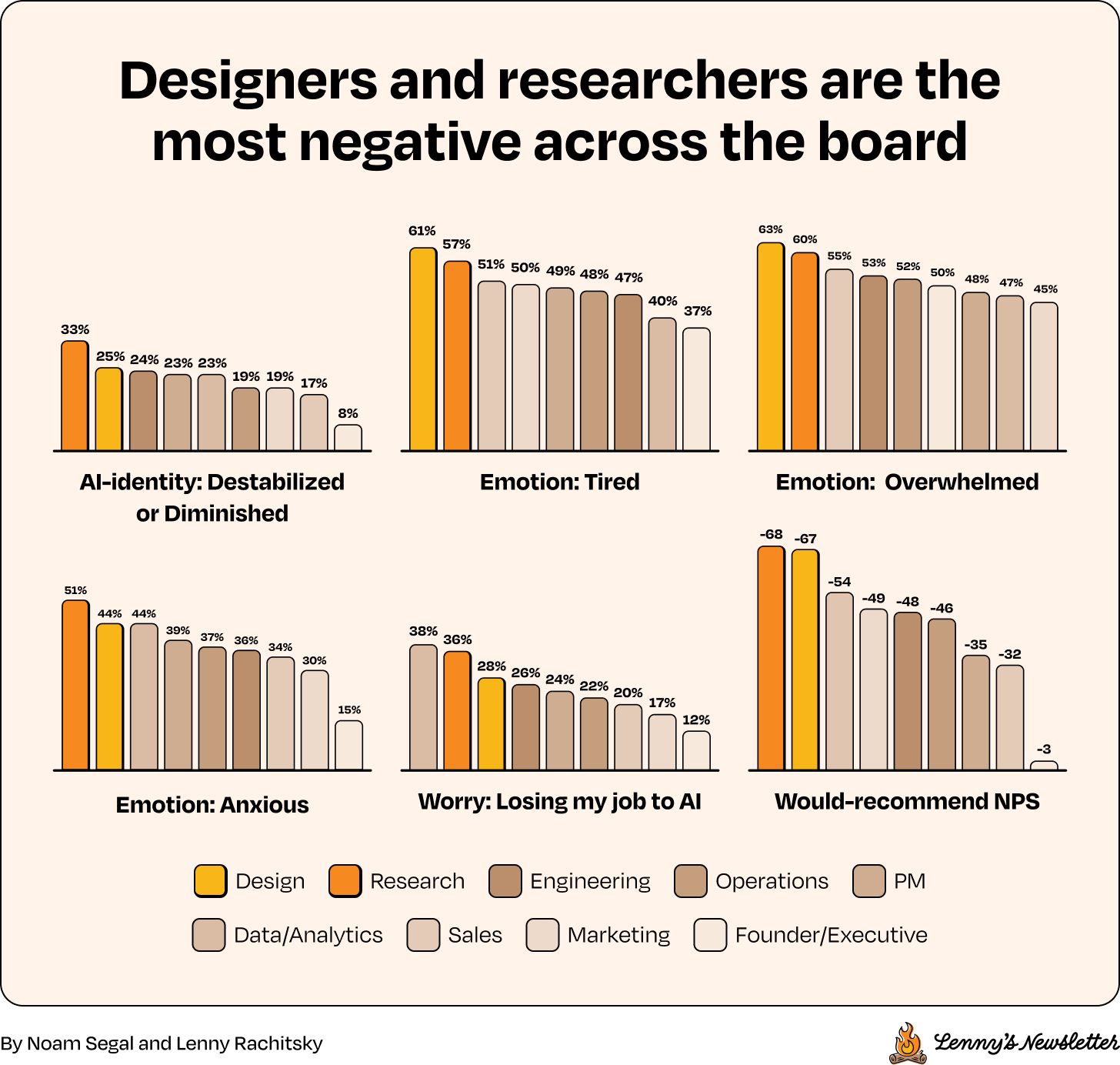
Among researchers, 51% are “anxious about my job security,” versus 15% of founders. Among designers, 63% feel “overwhelmed by the pace of change” and 61% feel “tired,” the highest of any role. Researchers are among the most likely to fear “losing my job to AI” (36%, just behind Data/Analytics at 38%), and designers are the most likely to feel the comp squeeze (61% selected “expected to do more for the same compensation”). Both report the lowest willingness to recommend their field of any role, and designers, as we’ll see, report the worst-rated managers in the survey.
Last year, designers and researchers showed the largest negative sentiment shift of any group. A year later, they’re the most negative on nearly every measure we have.
As a researcher, I’m acutely aware of the years of insecurities plaguing the research community. The biggest discussions for us have always been about getting a seat at the table and democratizing research across other functions. Many now feel the seat is being pulled from under us, and the work is being democratized, not to other roles but to AI.
By level, the most identity-destabilized group is early-career ICs (27%). (This is a wrinkle we’ll untangle in a moment, because those same early-career folks are, paradoxically, among the more optimistic.)
And the bigger the company, the more likely its people are to feel adrift in the AI transition: 23% feel destabilized at 10,000-plus-person companies, versus 15% at companies of 1 to 10.
AI is hardest on people in creative and research roles, on the most junior people, and on people working at the largest companies.
Takeaway 8: Founders are the happiest people in tech, and small companies are the best places to work
For all the AI upheaval, some of last year’s biggest findings came back almost unchanged, and their persistence through such a turbulent year makes them all the more convincing. Founders are still the happiest people in tech, and smaller companies are still better places to work than big ones. Before you read those as good news, it’s worth saying what “best” means here. The whole industry is sitting on a high baseline of burnout and a rather negative career view, and the winners of this section are the people who feel a little less of it.
Founders aren’t just the happiest people in tech—on most measures, they’re genuinely happy.
Founders and executives top nearly every measure in the survey: the highest optimism, the highest job enjoyment, the lowest burnout, the lowest layoff worry, and the most excitement about AI. That gap between founders and execs versus everyone else holds up statistically. On career optimism, it measures d ≈ 0.56, a medium-size effect and the second-largest in the entire dataset, behind only the AI divide.
As we wrote last year, the likeliest explanation is ownership: founders have the most control over their own destiny, and control turns out to be one of the best buffers against everything else. 71% are optimistic about their careers, they enjoy their work more than any other role, and they’re the least worried about layoffs of any group.
Ownership has limits, though. Nearly half of founders (47%) are still at least moderately burned out, with 18% very or completely burned out, even with the most control and the most upside of anyone in tech. And when we asked whether they’d recommend their path to a newcomer, founders landed at an NPS of –5. That is far healthier than the field’s –39, but it’s still bad. Even the happiest people in tech come out slightly net-negative on telling someone to follow their path.
One caveat: we only surveyed people who are founders today. The ones whose startups failed aren’t represented, and most startups don’t make it. Keep that in mind before you quit to go start something!
Smaller companies are still better places to work than big ones.
Company size predicts sentiment with almost eerie consistency. Walk from the smallest companies to the largest, and every measure of well-being gets steadily worse as the company grows:
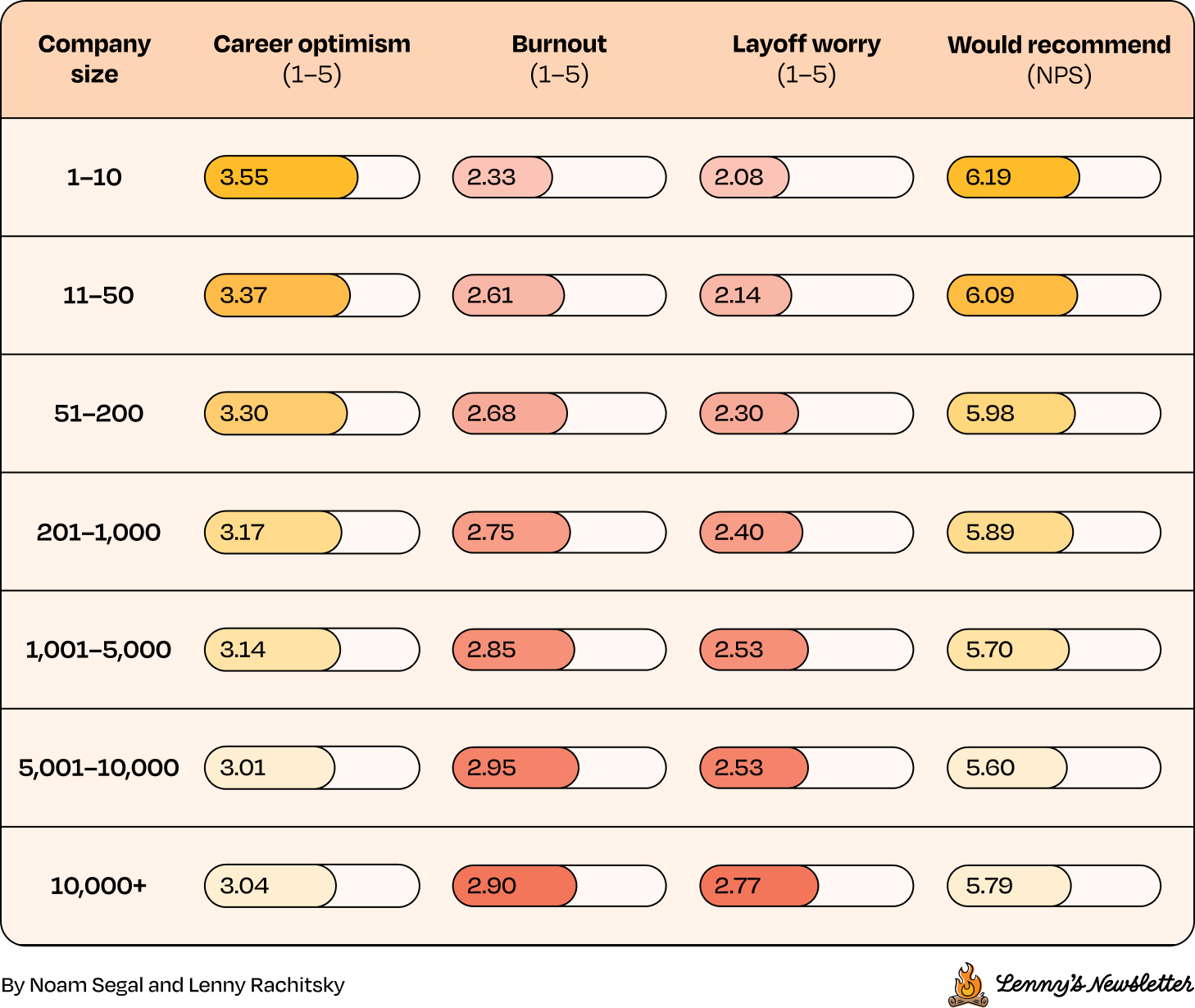
People at small companies are more optimistic, less burned out, less worried about layoffs, and even feel AI is helping them more, likely because they have more freedom to actually use it. The “big-company blues” we described last year have settled in.
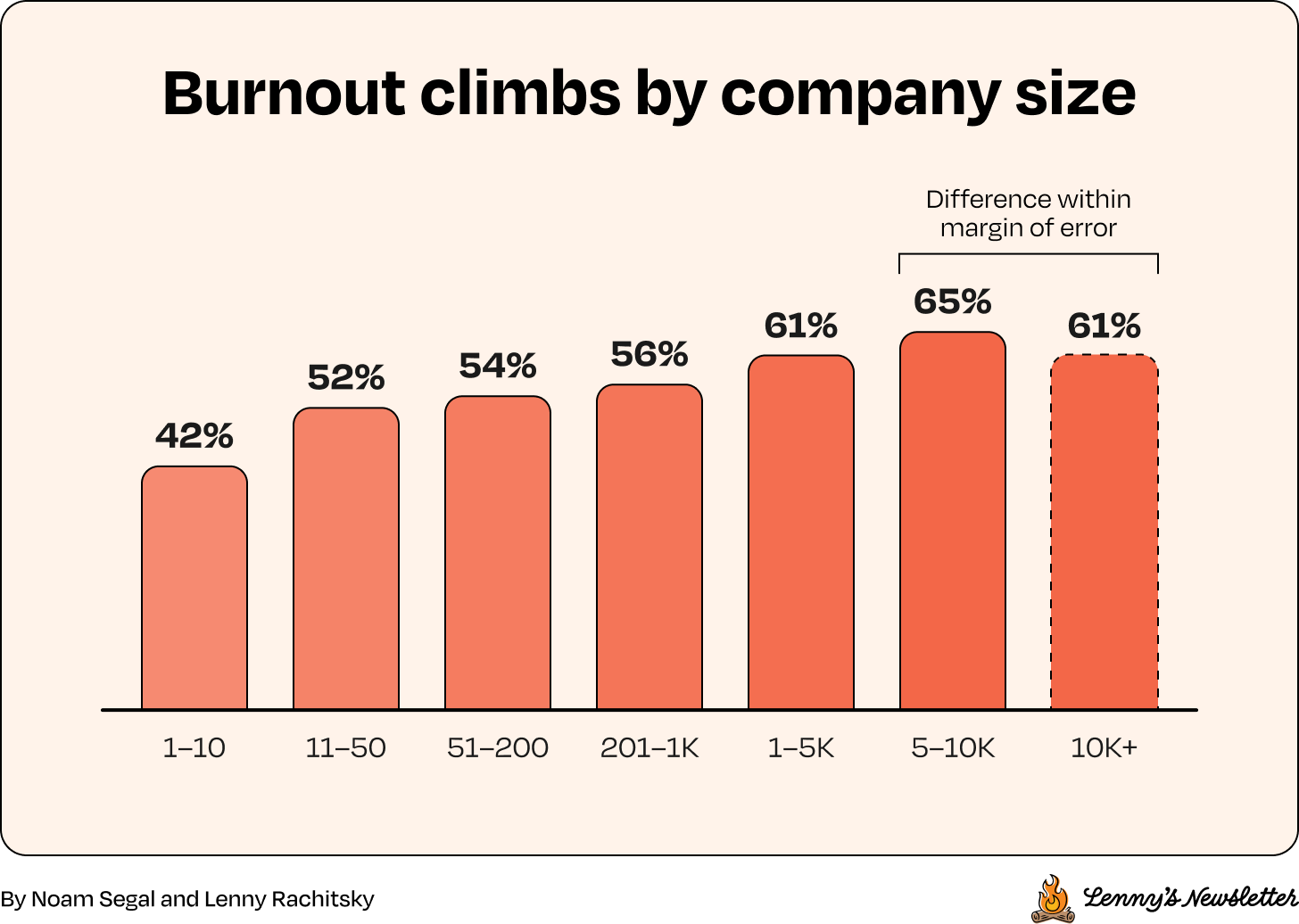
Look at the absolute numbers, though, not just the slope. Even at the smallest companies, 42% of people are at least moderately burned out, and the would-recommend score never climbs out of the red, sitting at –28 at 1-to-10-person shops. Small companies are winning a race to the least bad.
Two smaller echoes of 2025:
Where you physically work still hardly matters. There are barely any differences between how fully remote, hybrid, and in-office workers feel. Hybrid workers come out marginally the happiest (and in-office workers rate their managers the worst), but the gaps are small, just as we found last year. Employment type tells a familiar story with one twist. Founders and the self-employed are the happiest and least burned out, while contractors and freelancers are an interesting split—they are among the least burned out (less of the grind) but the most worried about layoffs (no job security).
One wrinkle you may have noticed: the largest companies (10,000+) tick up slightly in optimism and down in burnout compared with the 5,001–10,000 tier, breaking the smooth gradient. But neither difference is statistically significant (5,001–10,000 is our smallest sample), so the line flattens at the top rather than reversing. The one measure that does keep climbing to the very top is layoff worry. Workers at 10,000-plus-person companies are the most worried of anyone in the survey.
Takeaway 9: Managers are still the biggest lever for happiness
One more finding held firm from last year, and it may be the most actionable of all. Manager effectiveness remains the strongest driver of burnout in the entire dataset (it beats role, company size, and AI sentiment), and one of the strongest drivers of everything else. The gradient is dramatic:
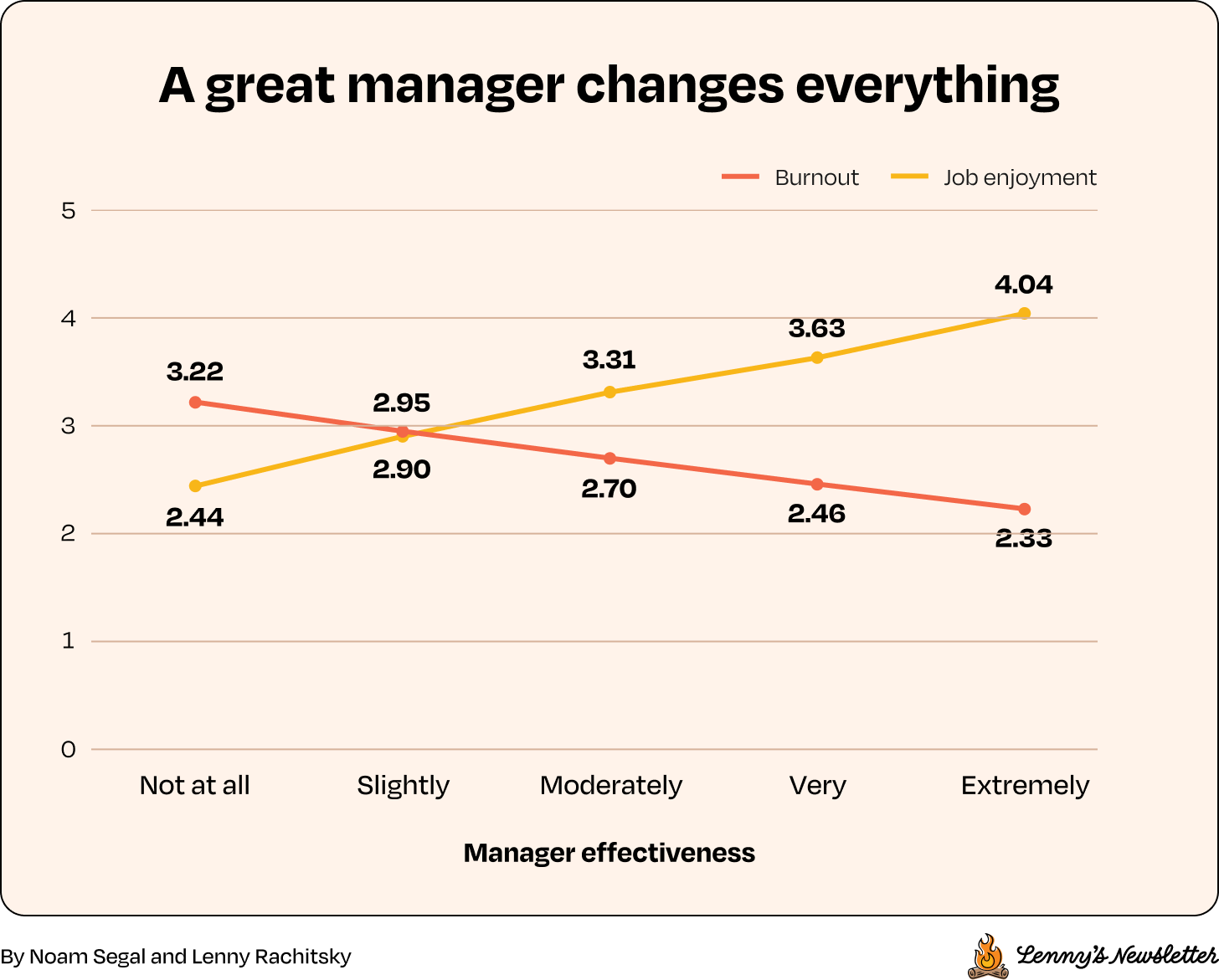
Workers with an extremely effective manager report roughly 65% higher job enjoyment and dramatically lower burnout than those with an ineffective one. Yet only 25.5% of tech workers rate their manager as highly effective, while 36.5% rate theirs as ineffective, numbers that have barely budged since last year. The most powerful retention lever in tech is also the most neglected. (Notably, the worst-rated managers cluster in Data/Analytics and Design. The latter is a double blow, since designers are also among the most AI-anxious.)
Takeaway 10: The industry is “chaotic”
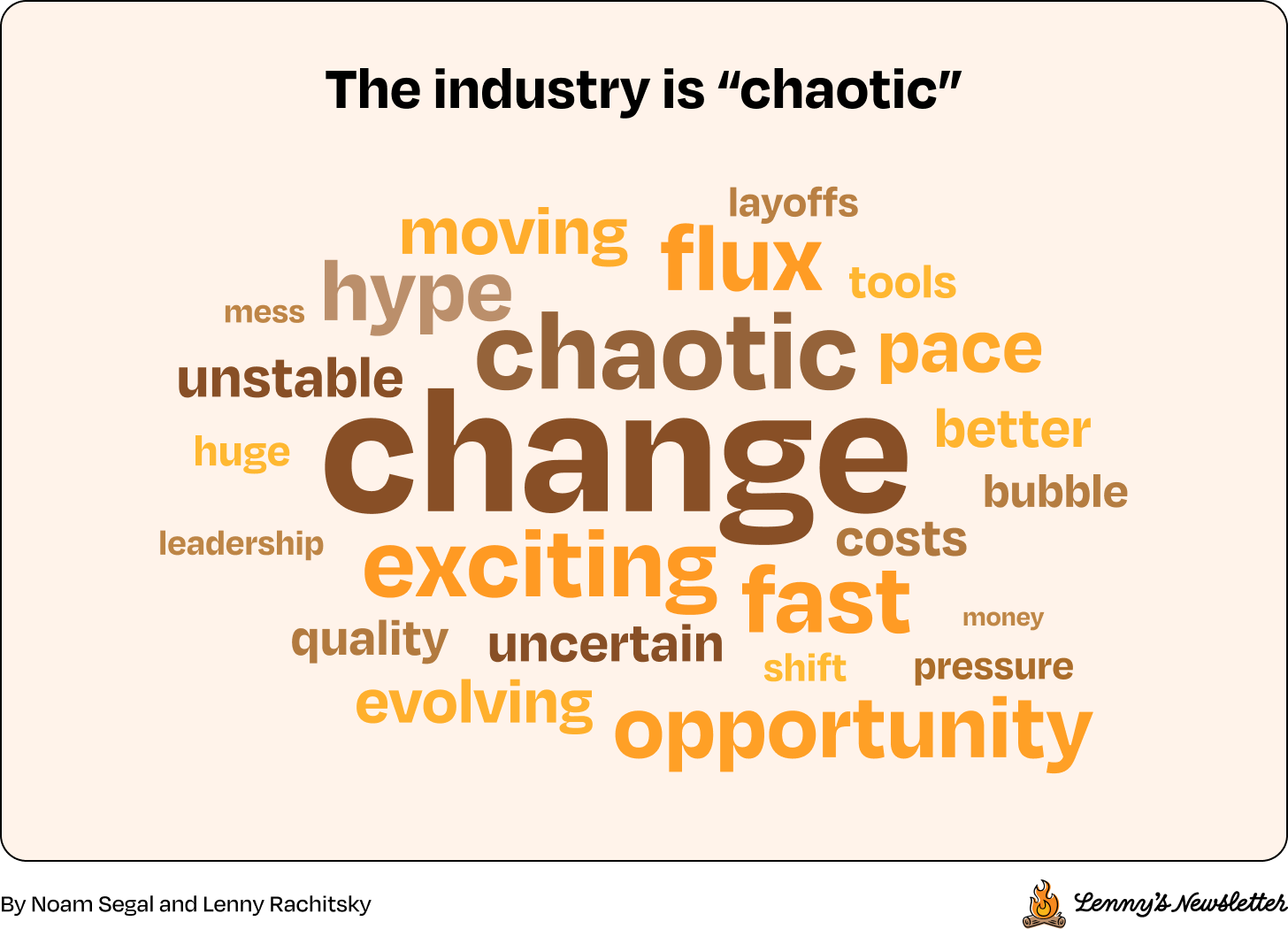
We asked, “In a sentence, how would you describe the state of the tech industry right now?” About 70% of respondents answered, and the single most common theme, by a wide margin, was chaos: roughly three in 10 explicitly used words like change, chaotic, uncertain, unstable, and in flux. Another one in six described an industry moving too fast to keep up with—treadmills, hamster wheels, hurricanes, “drinking from a firehose.” After that came AI hype and bubble talk (12%) and then, finally, a note of excitement and opportunity (11%).
A few responses capture the sentiment better than any percentage can:
“We’re in the 2nd inning of a massive shift, and no one knows how it will end, but all you can do is keep taking at-bats.”
“It feels like working on pure software is like picking up pennies in front of a steamroller.”
“The industry feels like it has lost its center of gravity—replacing curiosity about customers with an obsession over AI, automation, and efficiency.”
The chaos plus hype is well-described in this quote from a senior PM:
“Manic. Half are out of touch, clinging to the bandwagon, making the problem worse by pouring into the overhype. The other half are exhausted by the first half.” —Senior IC PM
When we ran sentiment analysis on the chaos-related quotes, the split was nearly even: 37% positive, 37% negative, and 26% neutral. The dominant theme is disorientation, but the emotional charge is truly bimodal. The same churn reads as thrilling to one person and terrifying to the next.
We confirmed this by splitting the responses by who wrote them. Career optimists and career pessimists describe the same industry in opposite terms. Optimists reach for “exciting,” “transforming,” “opportunity,” “fast-moving.” Pessimists reach for “chaos,” “layoffs,” “greed,” “dystopia.” Same disruption, opposite forecasts: half the room is anxiously bracing for AI’s impact; the other half is eagerly leaning into the AI era.
Where do we go from here?
The 2026 workforce is more burned out and less optimistic than a year ago, splitting along the fault line of AI into those who are thriving and those who are struggling, and a large, ambivalent middle caught between. Tech workers are mostly afraid of being squeezed by their jobs and increasing productivity expectations, privately convinced the field is no longer worth recommending to newcomers, while individually still finding real power and even joy in the tools. It’s a complicated moment. It’s also not a hopeless one.
So here’s what the data suggests you can actually do about it.