


👋 Hey there, I’m Lenny. Each week, I tackle reader questions about building product, driving growth, and accelerating your career. For more: Lennybot | Lenny’s Podcast | How I AI | Fav AI/PM courses | Fav public speaking course
Annual subscribers get 19 premium products for free for one year: Lovable, Replit, Gamma, n8n, Bolt, Devin, Wispr Flow, Descript, Linear, PostHog, Superhuman, Granola, Warp, Perplexity, Raycast, Magic Patterns, Mobbin, ChatPRD, and Stripe Atlas (while supplies last). Subscribe now.
I’m excited to share my (record) fourth collaboration with the great Noam Segal, AI Insights Manager at Figma and former UXR leader at Zapier, Airbnb, Meta, Twitter, Intercom, and Wealthfront. Let’s get to it.
Author’s note: Names have been changed to preserve participant anonymity.
There’s no shortage of debate about AI’s impact on work. Is it delivering real productivity gains? Where’s the ROI? Hot takes abound, but data have been scarce.
We took it upon ourselves to find out what’s actually happening on the ground by running one of the largest independent, in-depth surveys on how AI is affecting productivity for tech workers (1,750 respondents). We surveyed product managers, engineers, designers, founders, and others about how they’re using AI at work.
tl;dr: AI is overdelivering.
55% of respondents say AI has exceeded their expectations, and almost 70% say it’s improved the quality of their work.
More than half of respondents said AI is saving them at least half a day per week on their most important tasks. We’ve never seen a tool deliver a productivity boost like this before.
Founders are getting the most out of AI. Half (49%) report that AI saves them over 6 hours per week, dramatically higher than for any other role. Close to half (45%) also feel that the quality of their work is “much better” thanks to AI.
Designers are seeing the fewest benefits. Only 45% report a positive ROI (compared with 78% of founders), and 31% report that AI has fallen below expectations, triple the rate among founders.
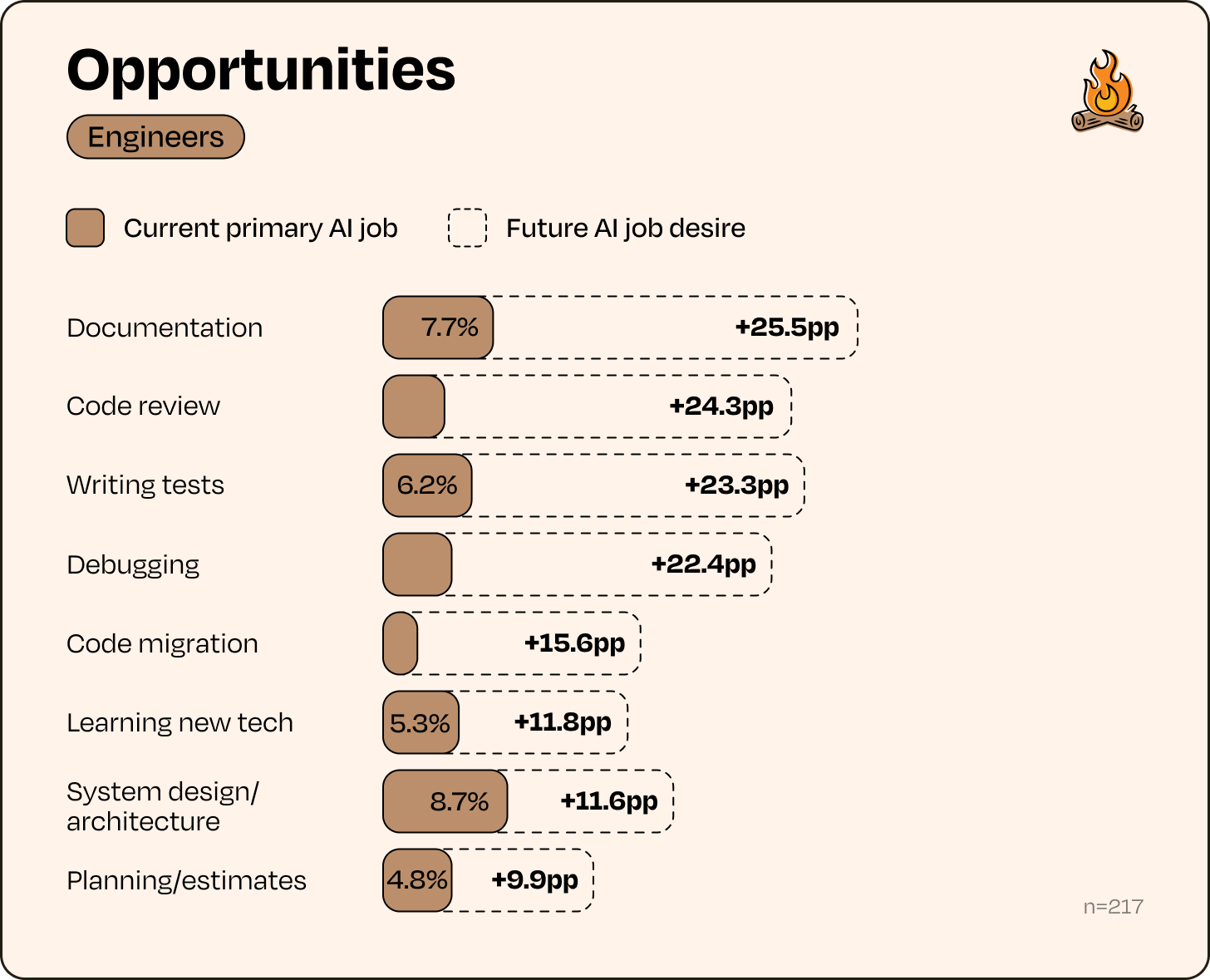
Engineers have accepted AI as a coding partner and now want it to handle the more boring (but necessary) work of building products: documentation, code review, and writing tests.
n8n is currently dominating the agent landscape, though actual adoption of agentic platforms in 2025 has been slow.
A whopping 92.4% of respondents report at least one significant downsides to using AI tools. There’s definitely room for improvement.
AI is far from the novelty it was a year or two ago. It has clearly cemented a place as work and productivity infrastructure, and AI tools are improving at a breathtaking pace. If AI is already giving most people back at least half a day per week in late 2025, what does 2026 look like? What about 2027? We’re watching the early innings of a compounding productivity revolution.
As Kevin Weil (VP at OpenAI) noted, “The AI model that you’re using today is the worst AI model you will ever use for the rest of your life.”
What exactly AI is doing for people, function by function
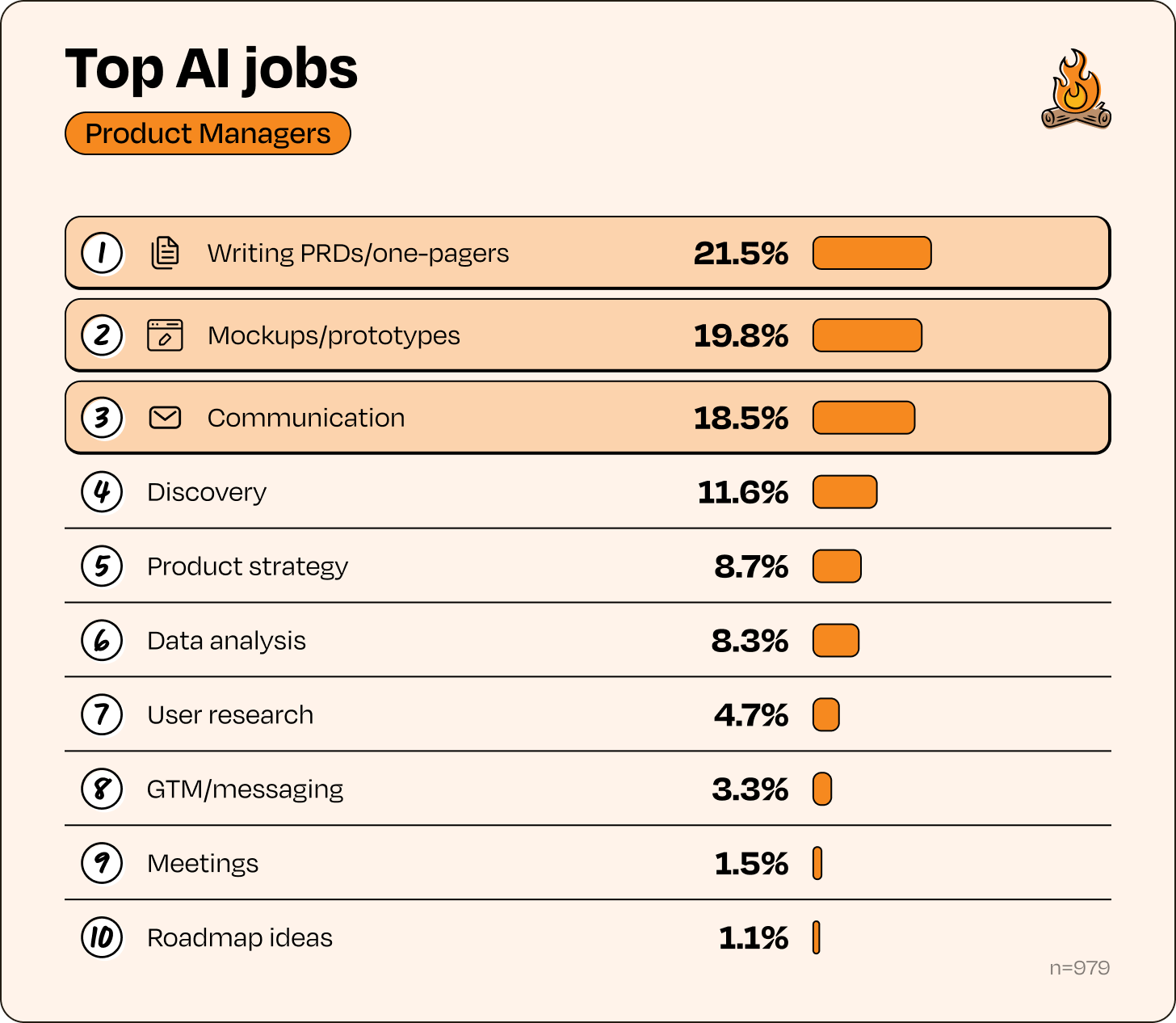
PMs are seeing the most value from AI tools to (1) write PRDs (21.5%), (2) create mockups/prototypes (19.8%), and (3) improve their communication across emails and presentations (18.5%).
Prototyping, at #2, signals one of many role-boundary shifts happening now. With tools like Lovable, v0, and others, PMs are increasingly going from idea to prototype without waiting on design.
But look farther down the list and a pattern emerges: AI is helping PMs produce, but it lags in helping them think. The top jobs are all production tasks (docs, prototypes, comms), while strategic and discovery work sits near the bottom (user research at 4.7%, roadmap ideas at 1.1%). PMs have cracked how to use AI for the “last mile” of getting ideas out of their head, but they still have a big opportunity to embrace AI for the upstream work of figuring out what to build.
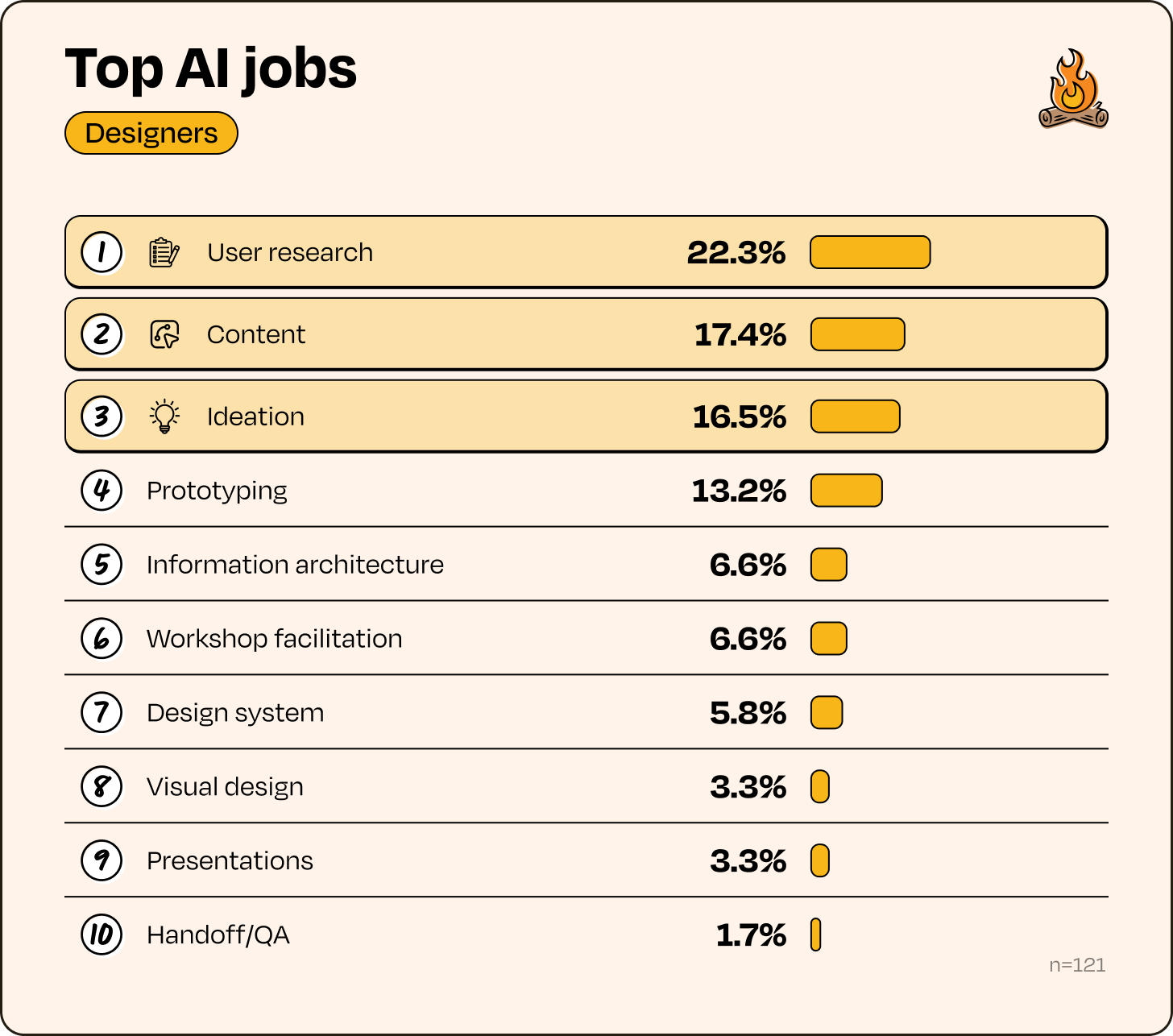
Designers are finding AI most helpful with user research synthesis (22.3%), content and copy (17.4%), and design concepts ideation (16.5%). Visual design ranks #8, at just 3.3%.
AI is helping designers with everything around design (research synthesis, copy, ideation), but pushing pixels remains stubbornly human. Meanwhile, compare prototyping: PMs have it at #2 (19.8%), while designers have it at #4 (13.2%). AI is unlocking skills for PMs outside of their core work (at least in the case of prototyping), whereas designers aren’t seeing the marginal improvement benefits from AI doing their core work.
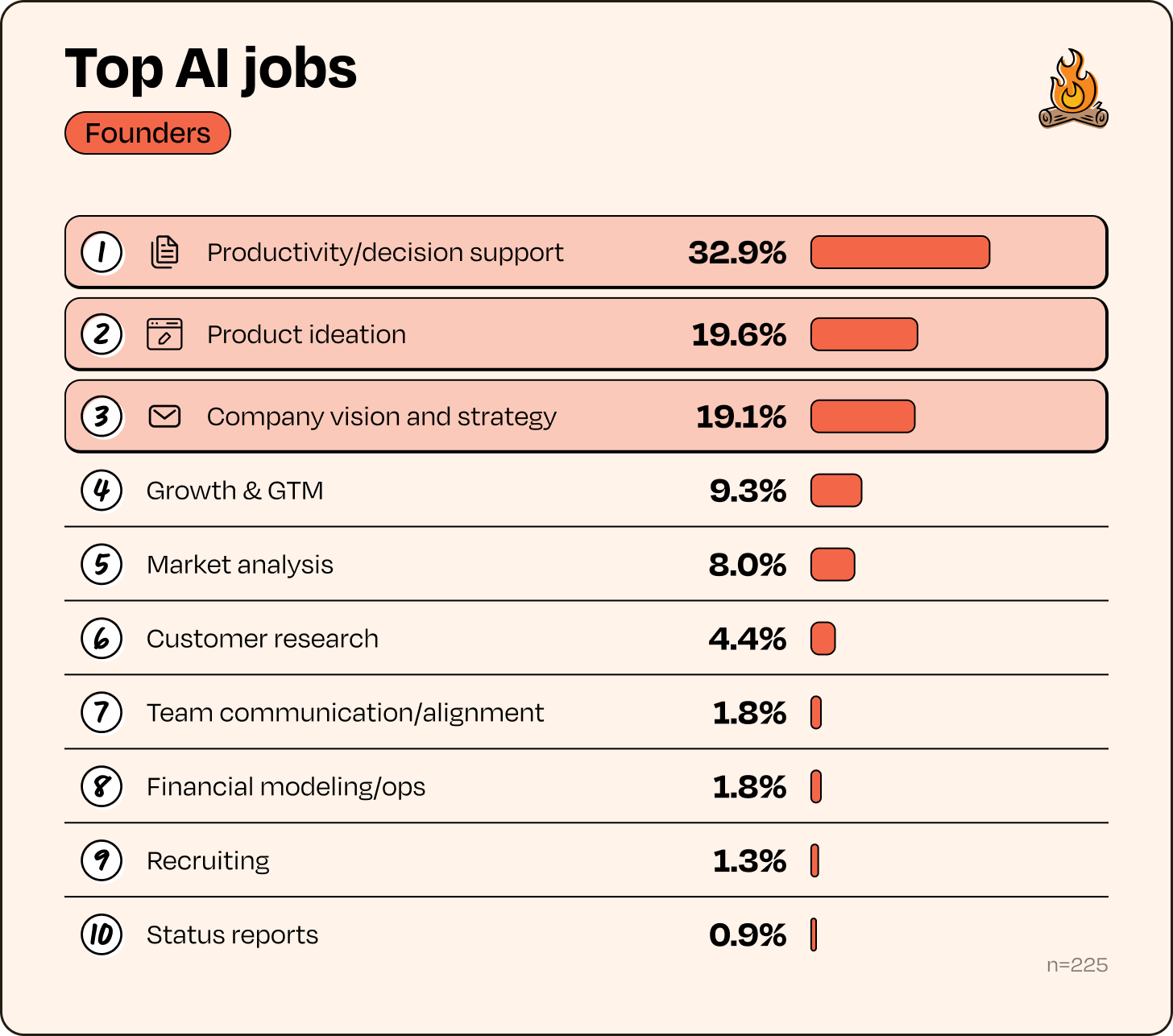
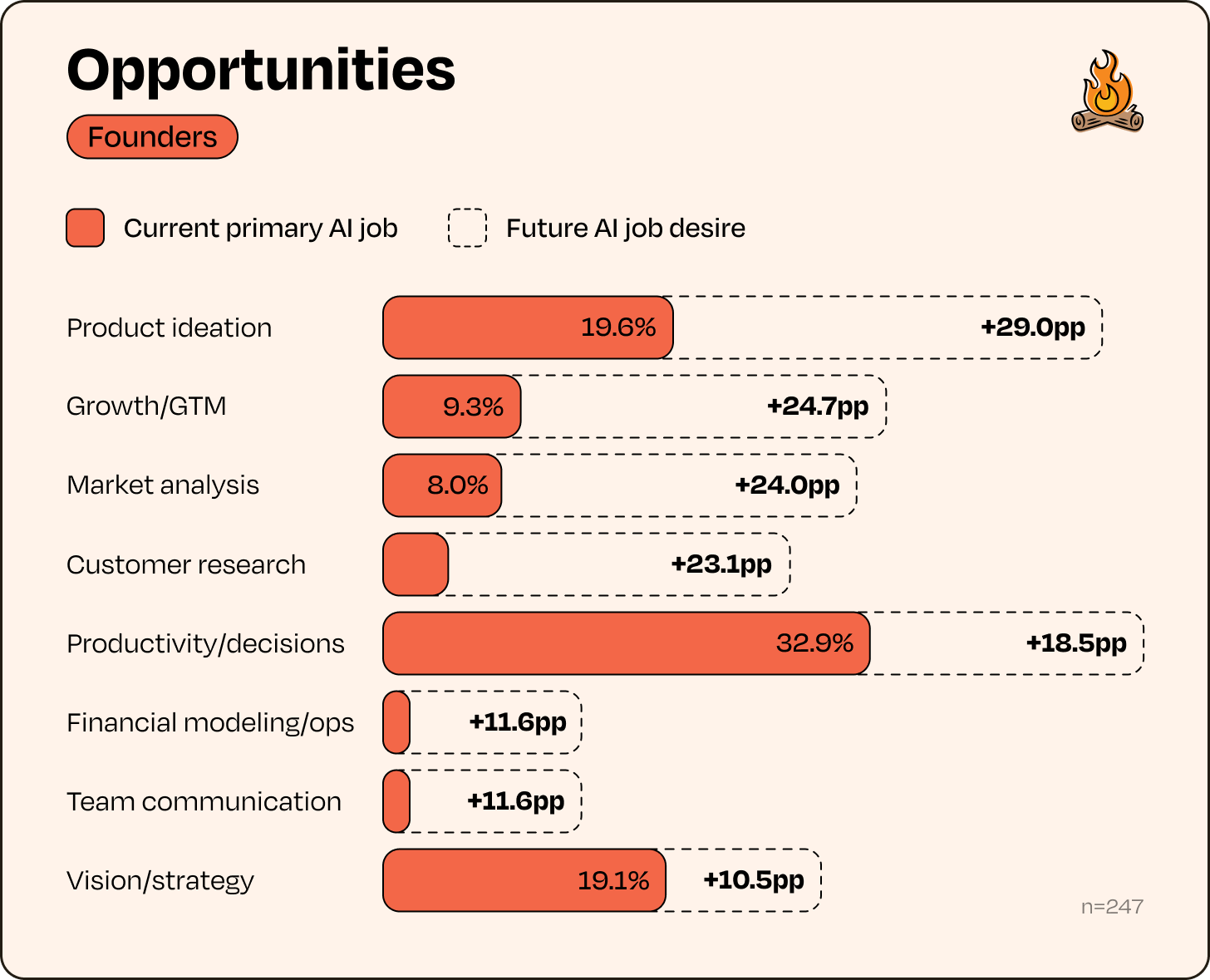
Founders lean heavily toward productivity and decision support (32.9%), product ideation (19.6%), and vision/strategy (19.1%).
Unlike others, founders are using AI to think, not just to produce. The top three jobs are all strategic: decision support, ideation, and vision/strategy. That’s a stark contrast to PMs (whose top jobs are documents and prototypes) and designers (research synthesis and copy). And look at that #1 category: “productivity/decision support,” at 32.9%, is unlike anything else in the survey. No other role has a single use case this dominant. Founders are treating AI as a thought partner and sounding board, not just a tool for specific deliverables. (This tracks with Tal’s excellent post on building AI copilots as long-term thinking partners and Amir’s recent post on building your second brain using ChatGPT.)
The surprise misses: Financial modeling sits at just 1.8%, despite founders living in spreadsheets during fundraising. Same with recruiting, at 1.3%, even though hiring consumes enormous founder time. These feel like opportunities waiting for better tools.
This pattern may explain why founders report the highest satisfaction throughout the survey—they’ve figured out how to use AI for higher-leverage strategic work, not just production tasks.
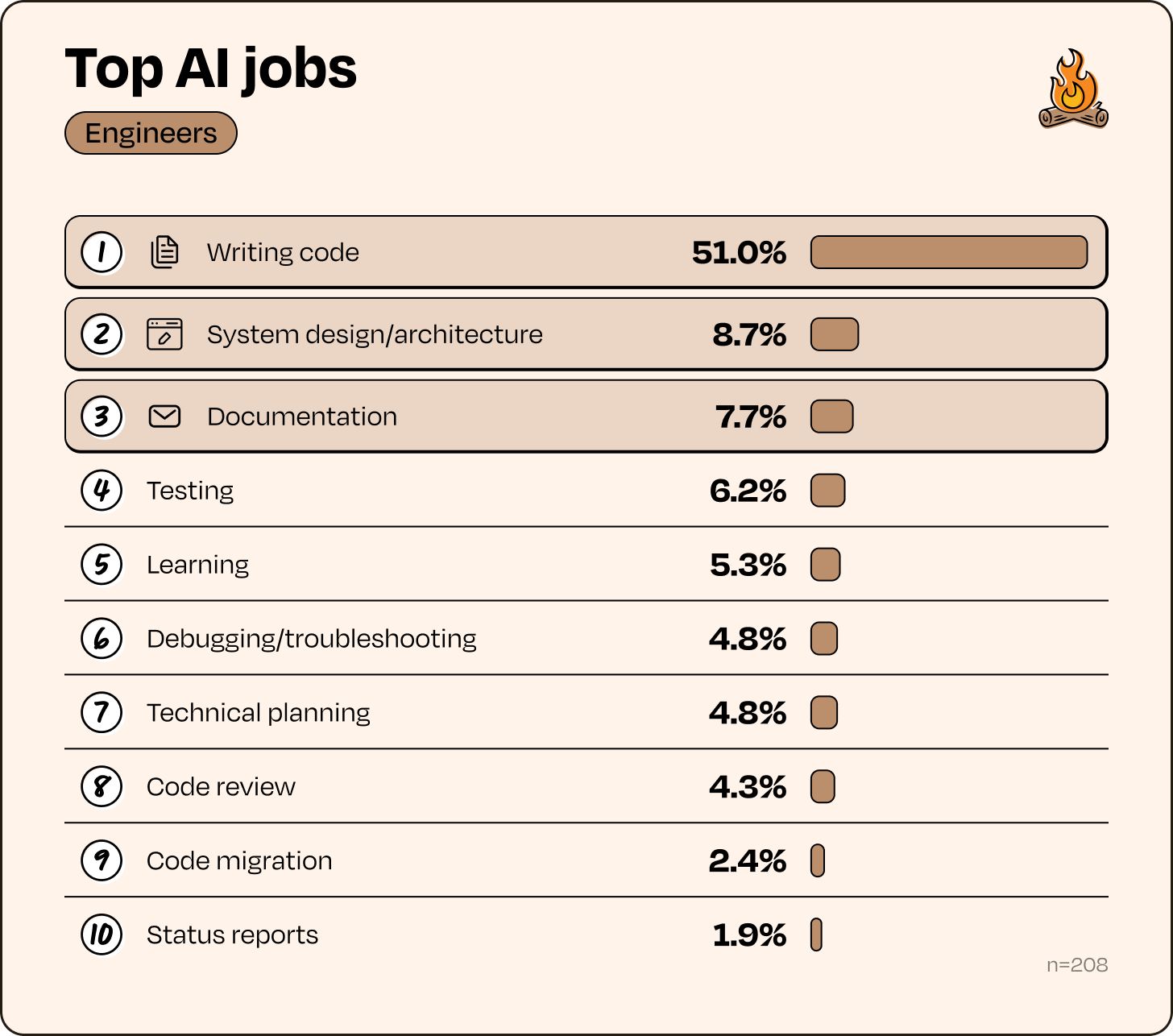
Engineers are the outlier. For them, AI is doing just one big job: writing code, the core engineering task. Whereas for the PMs and designers, AI is helping them with supporting work.
Farther down the list are jobs like documentation (7.7%), testing (6.2%), and code review (4.3%). These are the “boring but necessary” tasks engineers typically dislike. As you’ll see in the opportunities data below, that’s about to change. Engineers have accepted AI as a coding partner; now they want it to handle the tedious work that comes after the code has been written.
One more pattern worth noting: engineers report the most mixed results on quality later in the survey (51% better but 21% worse, the highest “worse” of any role).
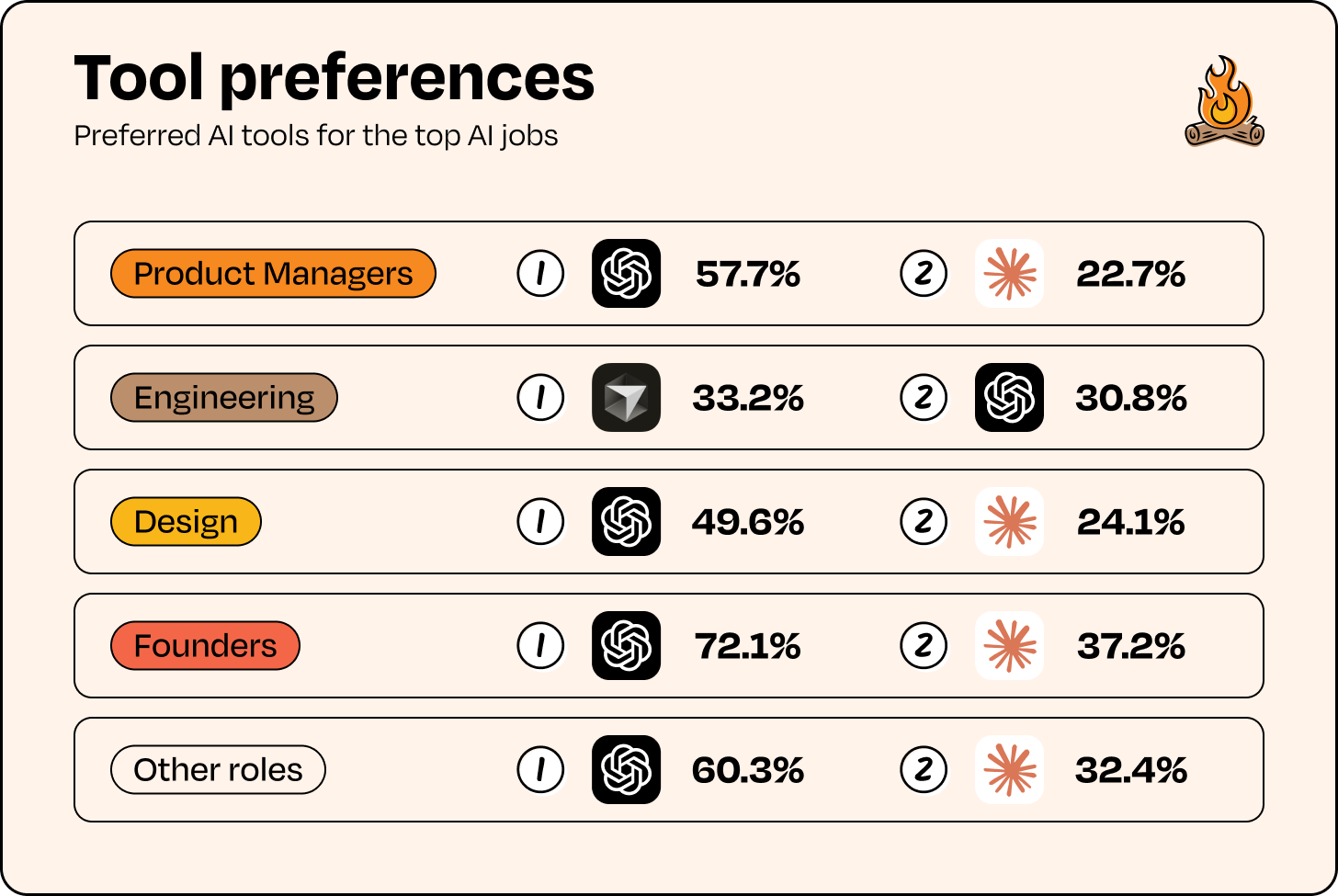
Engineers are the only role where ChatGPT isn’t #1
ChatGPT is the #1 most popular AI tool for most roles: 57.7% of PMs, 49.6% of designers, and 72.1% (!!!) of founders use ChatGPT over any other AI tool, with Claude coming in second for those three roles.
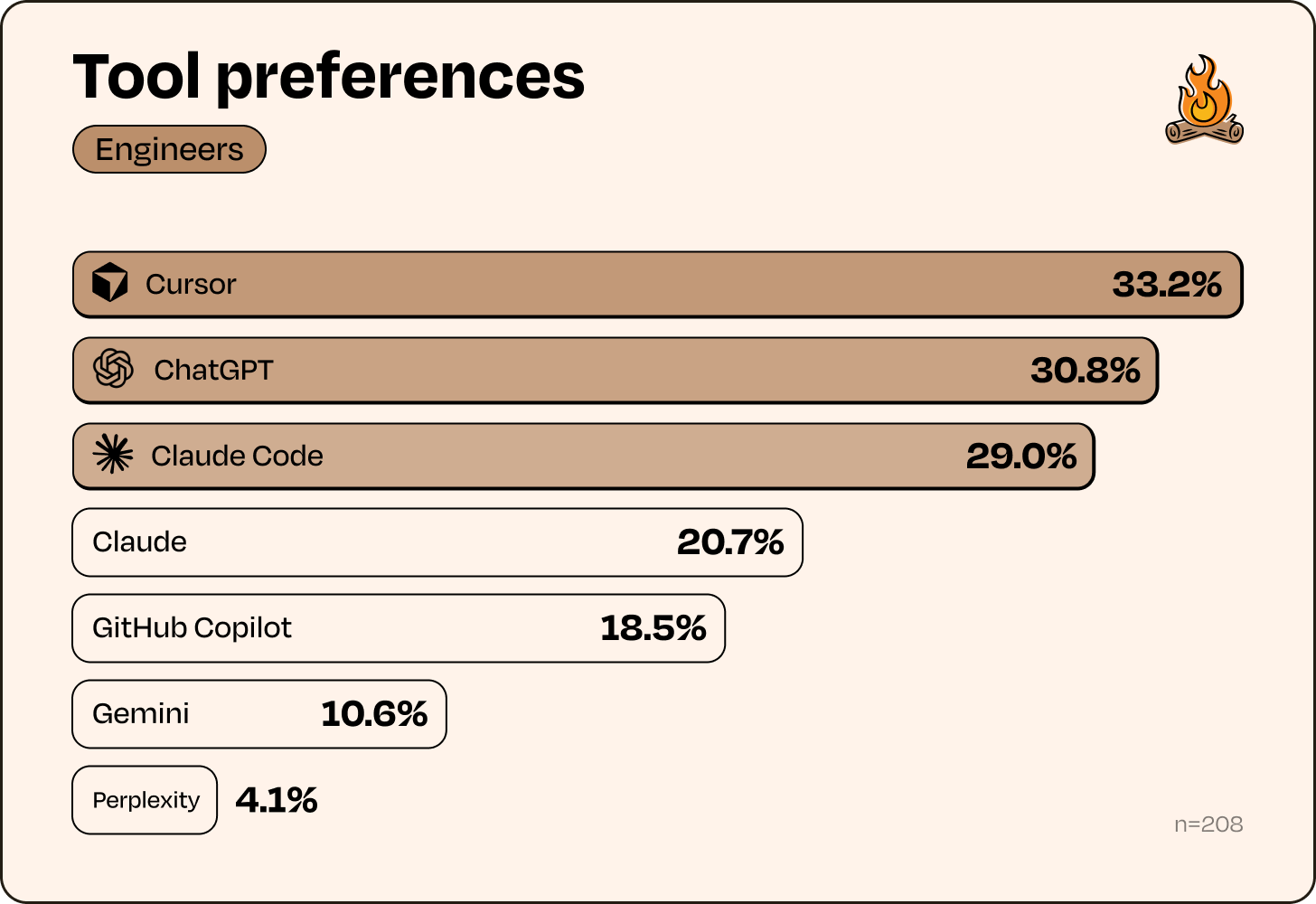
But engineers have a very different behavior. GitHub Copilot was first to market, has Microsoft and GitHub’s distribution muscle, and is baked into the world’s most popular code repository. Yet it sits behind three tools that launched after it. Engineers are choosing newer (better) alternatives over the incumbent.
For engineers, the top three are in a dead heat: Cursor (33.2%), ChatGPT (30.8%), and Claude Code (29.0%) are all within 4 percentage points. This market hasn’t consolidated, and switching costs are low. Also notable: Claude Code (29.0%) outpaces Claude’s chat interface (20.7%). Purpose-built tools are winning, but Claude is also helpful with several core coding-related tasks (e.g. code migration and more) that put it at fourth.
Gemini sits at a distant 10.6%, but a caveat: this space shifts fast. A few strong model releases or product updates could reshape these rankings quickly. What’s true today may look very different in six months.
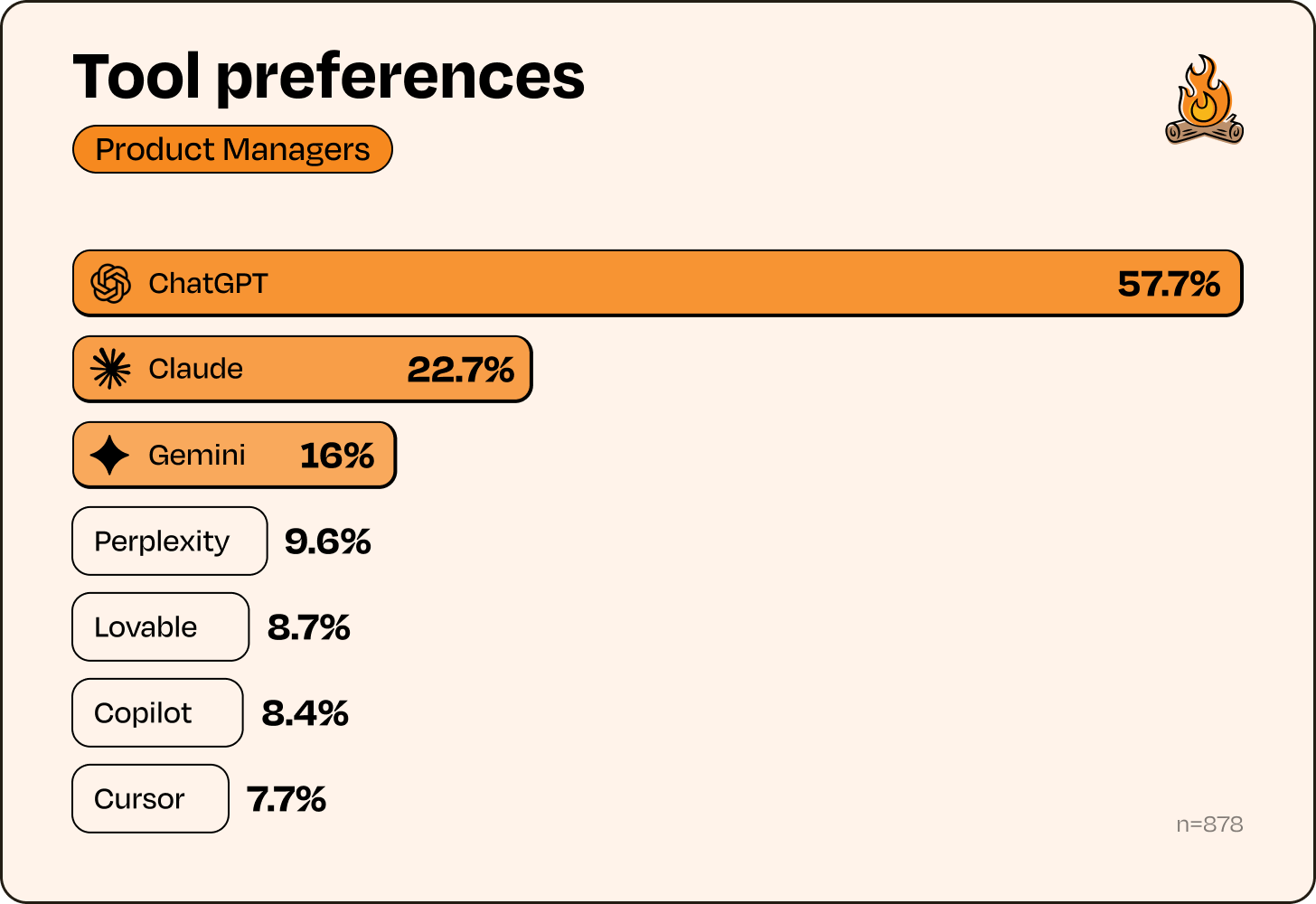
ChatGPT is a far-and-away winner for PMs.
Perplexity is also surprisingly highly ranked, probably due to its strong research capabilities.
However, farther down the list, Lovable (8.7%) and Cursor (7.7%) are cracking the top seven for PMs. This reinforces the pattern we saw earlier: PMs are increasingly building things themselves, encroaching on what’s traditionally design and engineering work. The PM toolkit is expanding beyond documents and decks.
One note: Copilot (8.4%) edges out Cursor (7.7%) among PMs, though the reverse is true for engineers. This may reflect Microsoft ecosystem lock-in at larger companies, or simply that PMs discovered Copilot first and haven’t yet explored alternatives.
AI is driving significant time and quality gains (for most)
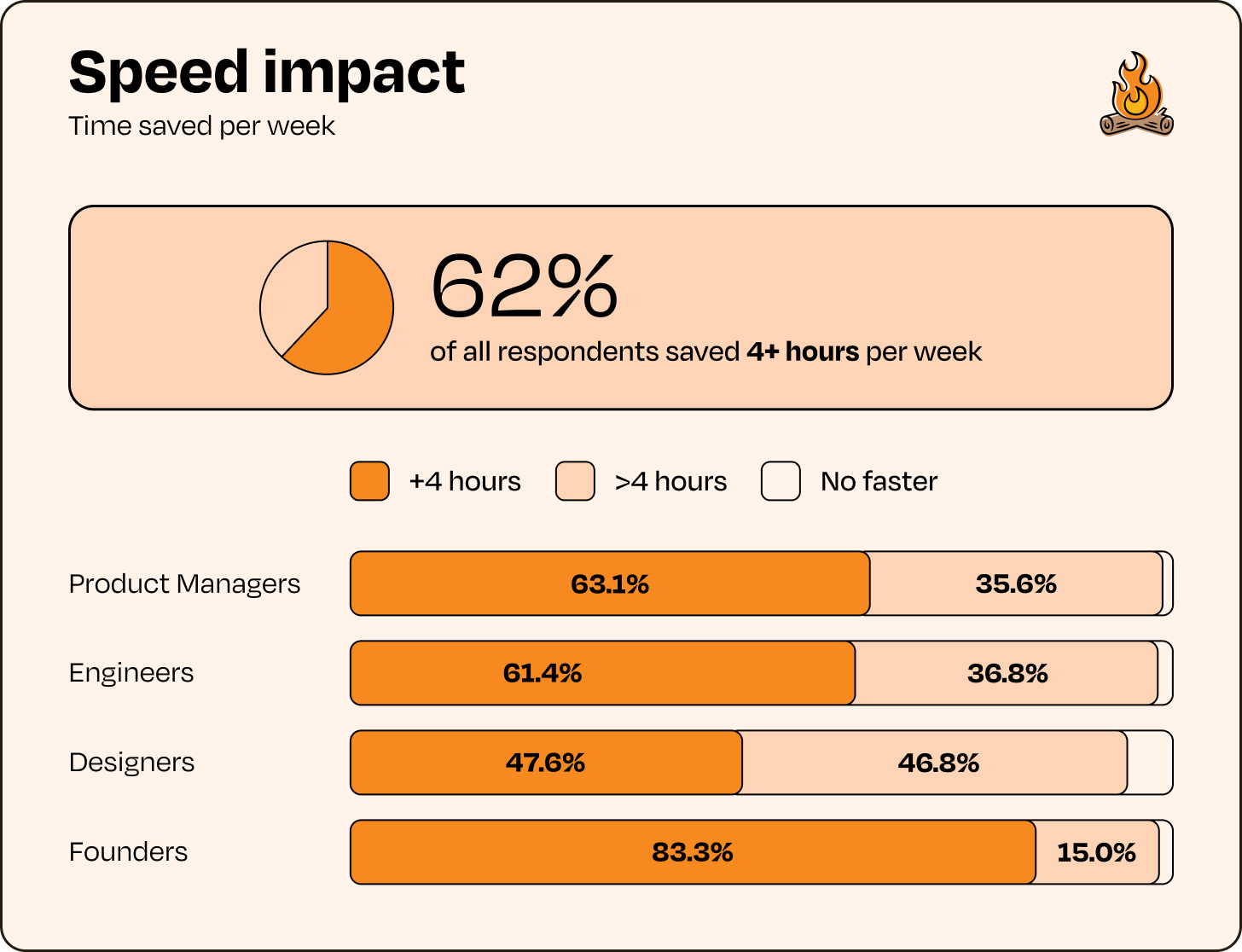
63% of PMs and 83% of founders report that AI saves 4+ hours per week. Even the most skeptical group, designers, still shows 47.5% reporting 4+ hours saved. Only 1% to 5% of respondents across roles say AI is “no faster than manual work.”
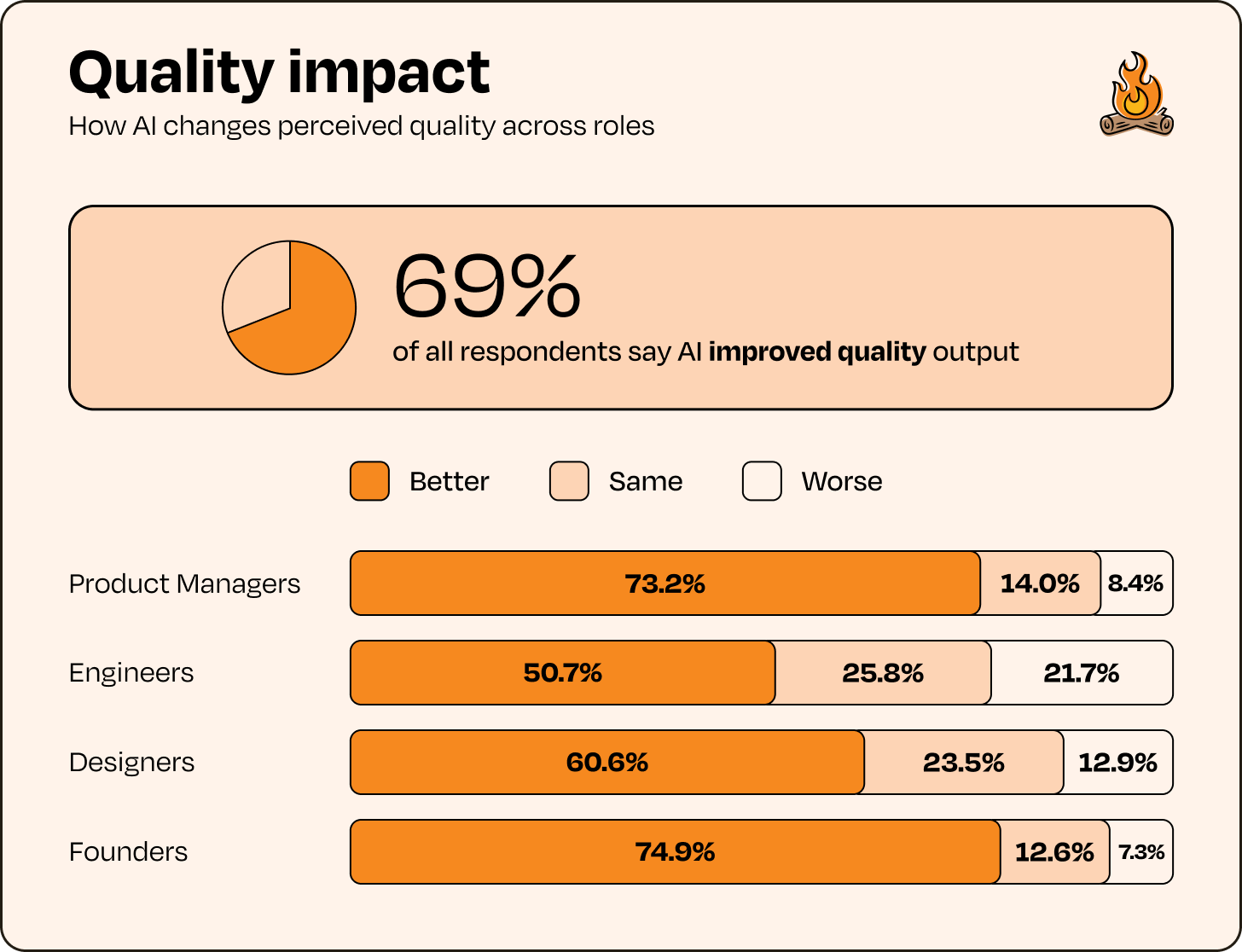
On quality, though, the story is more nuanced. PMs and founders are bullish (over 70% report quality improvements), but engineers are more mixed. 51% of engineers tell us that AI makes the quality of their work better, but 21% say it’s worse. Designers fall in between, at 60% better, 13% worse. The quality ratings among engineers may reflect the higher bar for correctness in code: a “somewhat better” first draft of a PRD is useful; a “somewhat better” but buggy function is not. Also, bad code is easier to spot than a bad PRD.
Where are the opportunities for more AI help?
The gap between where people are using AI today and where they want to use it next reveals a lot about where the opportunities are for founders and startups to jump in and deliver new tools and functions.
For PMs, the biggest opportunity story is research. User research shows the largest demand gap of any task (+27.2pp). Only 4.7% say it’s their primary AI use case today, but nearly a third want it to be. The pattern is clear: PMs have figured out how to use AI for output tasks like writing PRDs and drafting communications, but they’re hungry to apply it upstream, to the messy work of understanding what to build.
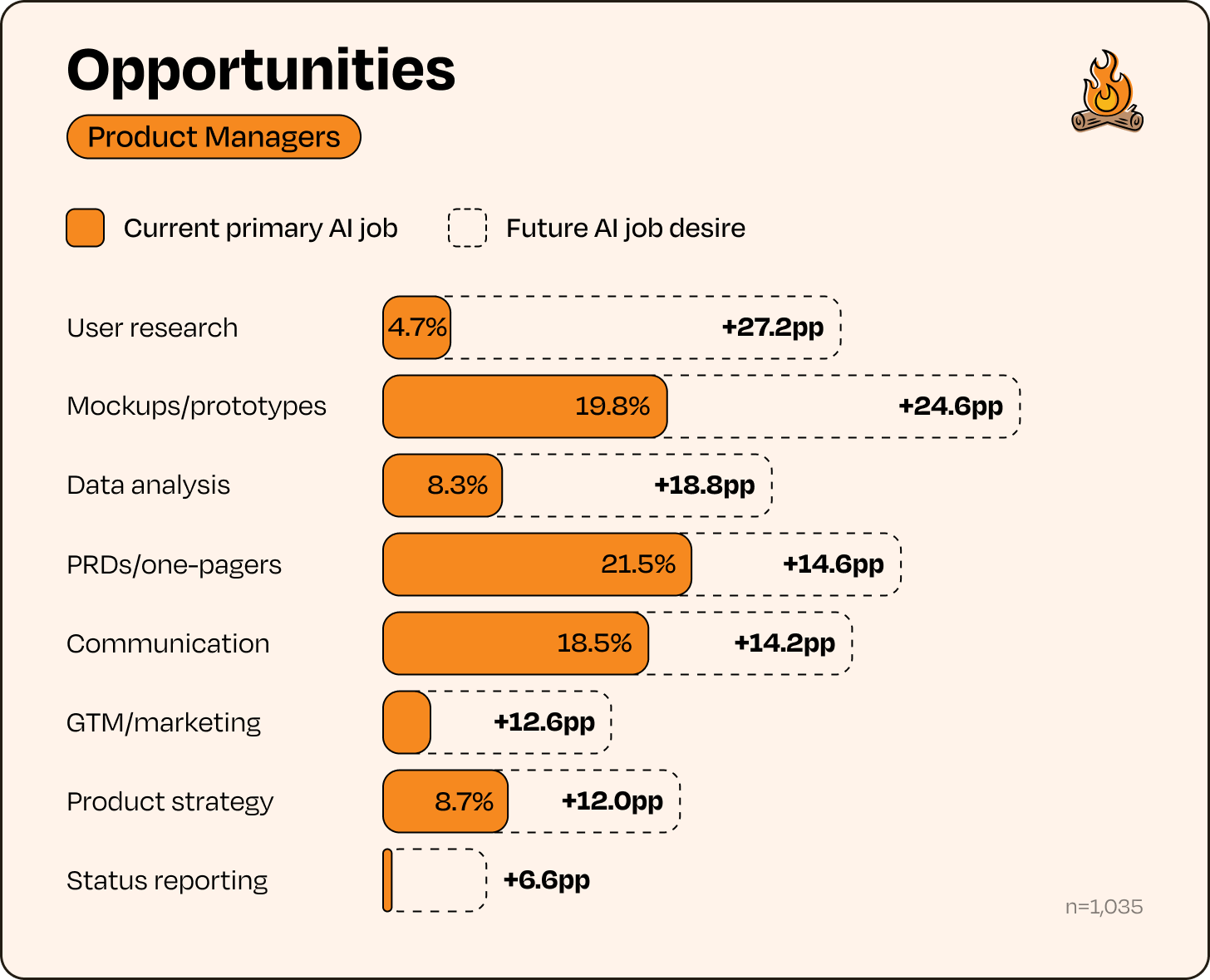
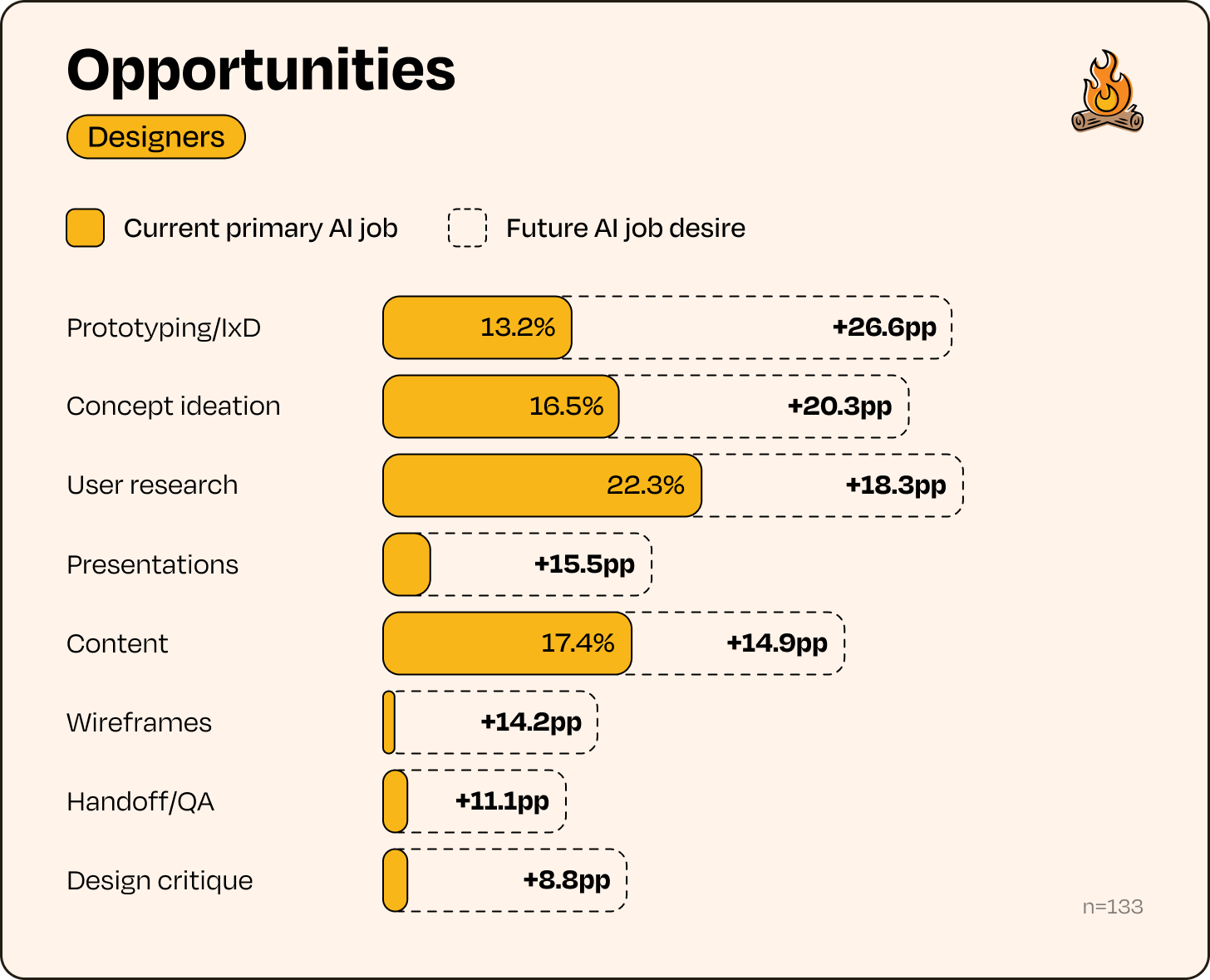
Prototyping is a breakout category. For PMs, “creating mockups/prototypes” jumps from 19.8% (currently using) to 44.4% (want to use next), a +24.6pp swing that makes it the single most-wanted future use case. For designers, prototyping and interaction design show similar momentum (+27.8pp). This tracks with the rise of tools like Lovable, v0, Replit, and Figma Make: people have seen what’s possible and want more.
Engineers are shifting their use of AI to handle work after writing the code. Writing code was by far their most popular use case (51% current), but it has a demand gap of only +5.6pp. However, documentation (+25.8pp), code review (+24.5pp), and writing tests (+23.5pp) all show massive opportunities for growth in engineering AI tooling.
Founders are doubling down on AI as a thinking partner. Product ideation shows massive demand, jumping from 19.6% (currently using) to 48.6% (want to use next), a +29.0pp gap. Growth strategy and GTM planning (+24.7pp) and market analysis (+24.0pp) follow close behind.
Founders already use AI heavily for personal productivity (32.9% currently), but they want to move upstream. They’re looking for a strategic collaborator to pressure-test ideas, explore markets, and think through go-to-market—AI as a co-founder, not just an assistant.
Based on these reported gaps, the next wave of AI adoption will require not just better models but better workflows for human-AI collaboration on fuzzy problems. Writing a PRD has a clear output; competitive research does not. Writing code can be tested; “product ideation” cannot.
Which AI tools have product-market fit?
We asked: “Which AI tool(s) would you be very disappointed to lose access to?” The classic Sean Ellis PMF question. 83.6% named at least one tool, which is itself a remarkable signal of how embedded AI has become in daily workflows. But the relationship between the number of people who regularly use a tool and would miss that tool if it went away tells the story of the products that have truly found product-market fit.
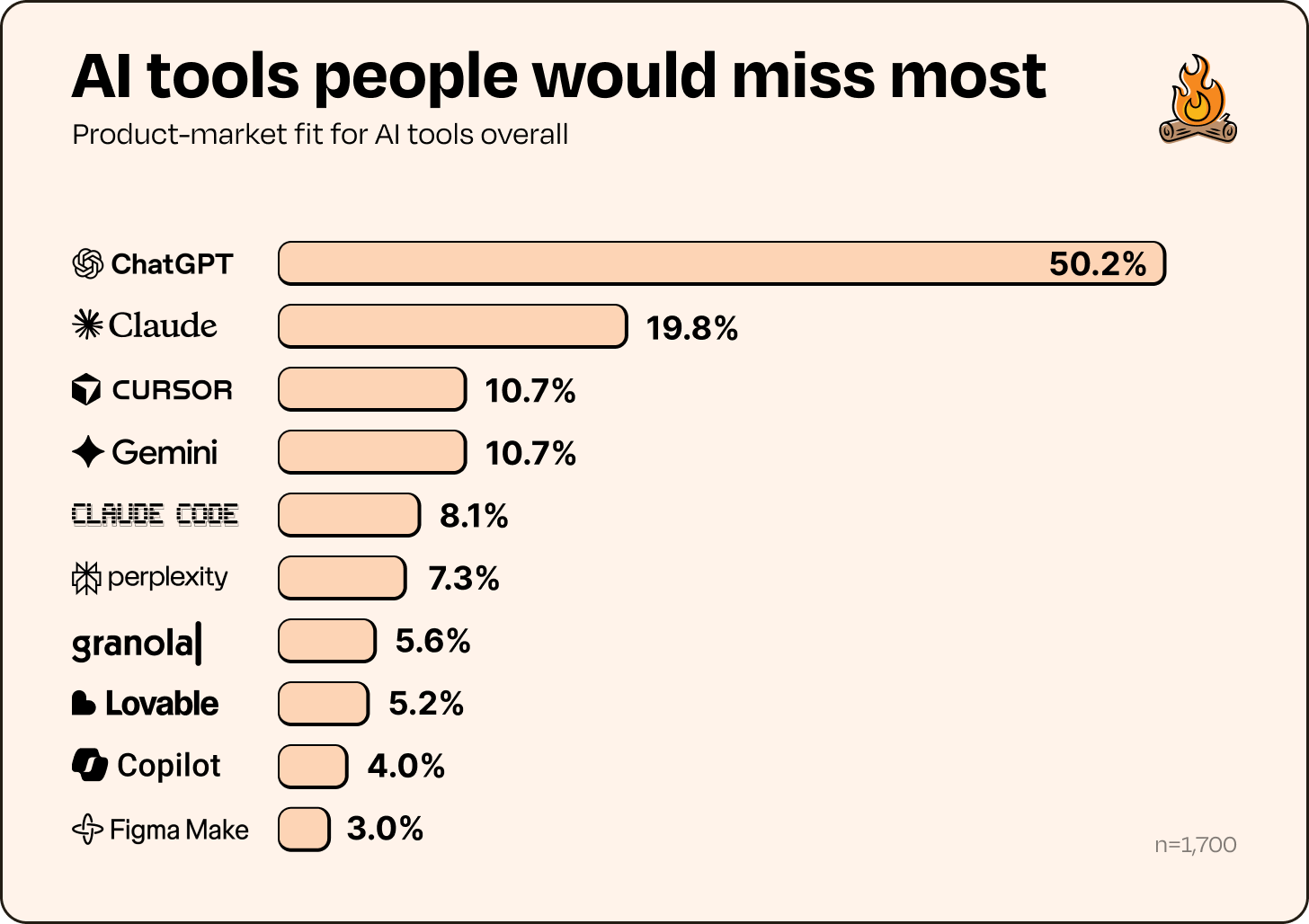
ChatGPT dominates, perhaps only for now. Half of respondents (50.2%) would be very disappointed to lose ChatGPT, but that’s notably lower than the 60% to 75% of respondents across most roles who say they regularly use the tool. This, in part, explains why OpenAI recently declared a “Code Red” as it watches Gemini and Claude begin to erode market share. Switching costs in AI are still very low.
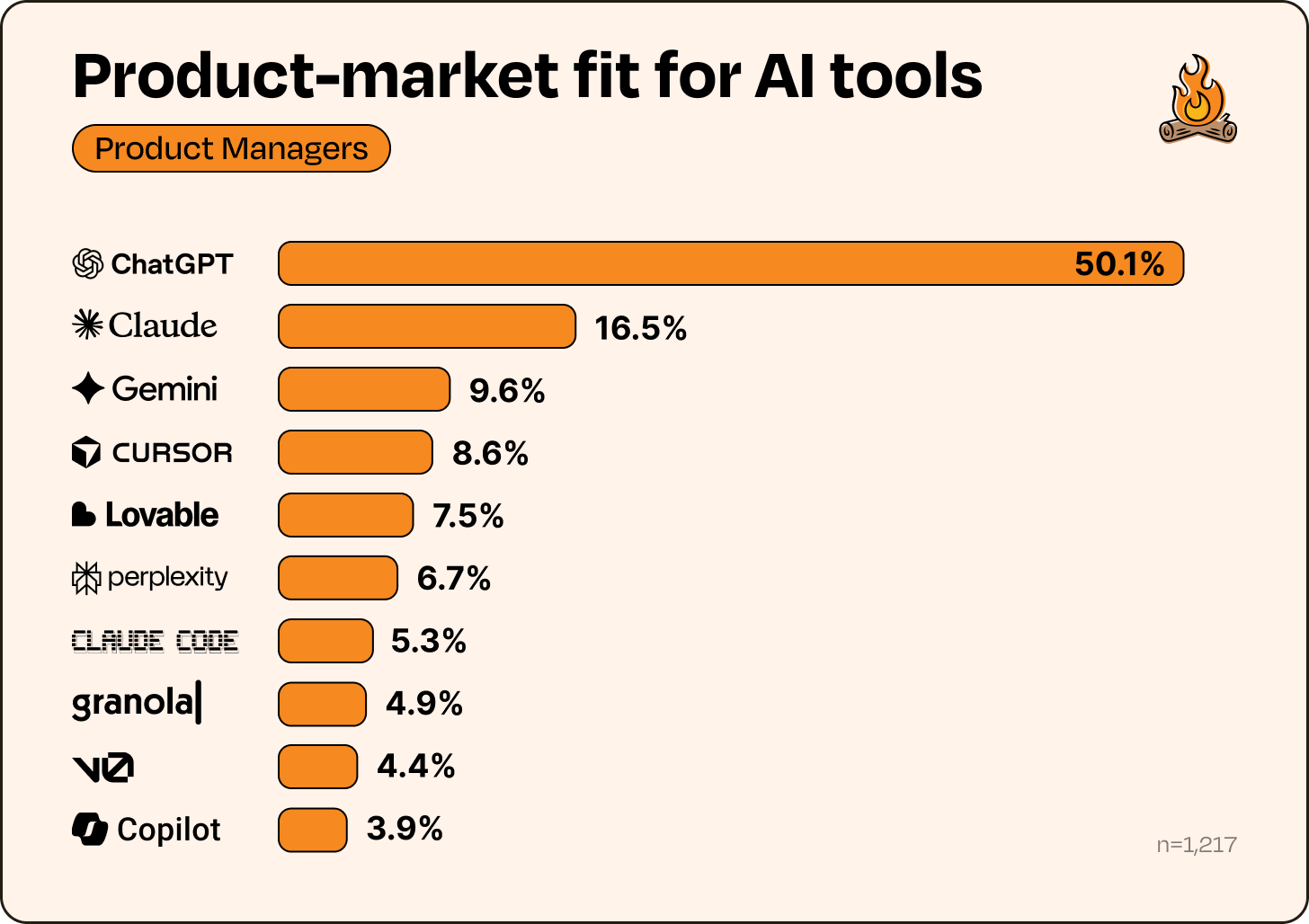
ChatGPT, Claude, and Gemini top the list for PMs—they’re such multi-purpose tools well-suited to the PM job. It’s most interesting to see Cursor right behind Gemini (we wouldn’t expect an engineering tool like Cursor to be so popular among PMs), followed by Lovable (which currently seems to be winning in the prototyping market).
Designers (23.3%) and founders (20.6%) index highest on Claude. The Claude ecosystem (Claude and Claude Code combined) reaches 27.5% overall. This feels like a big win for Anthropic.
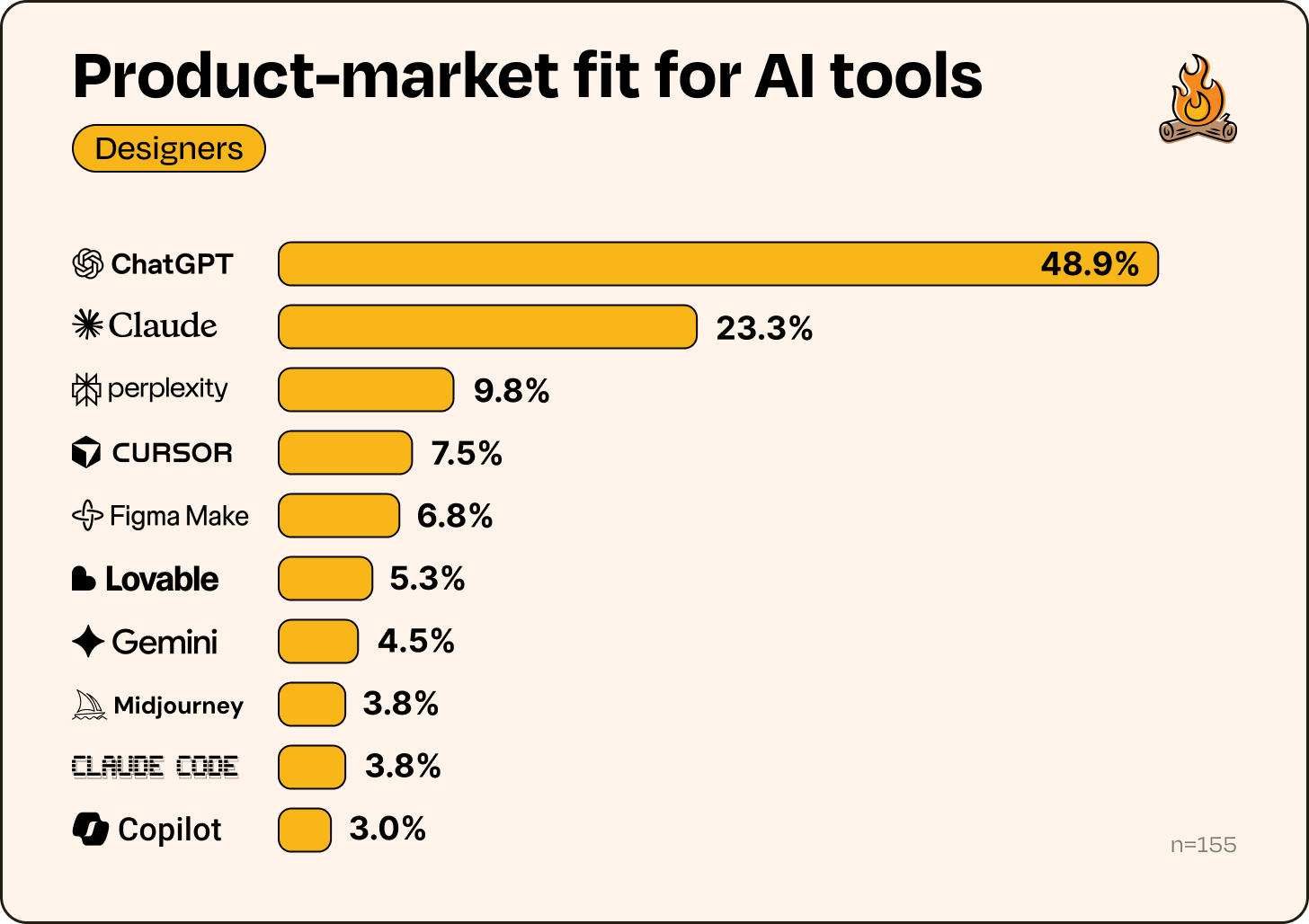
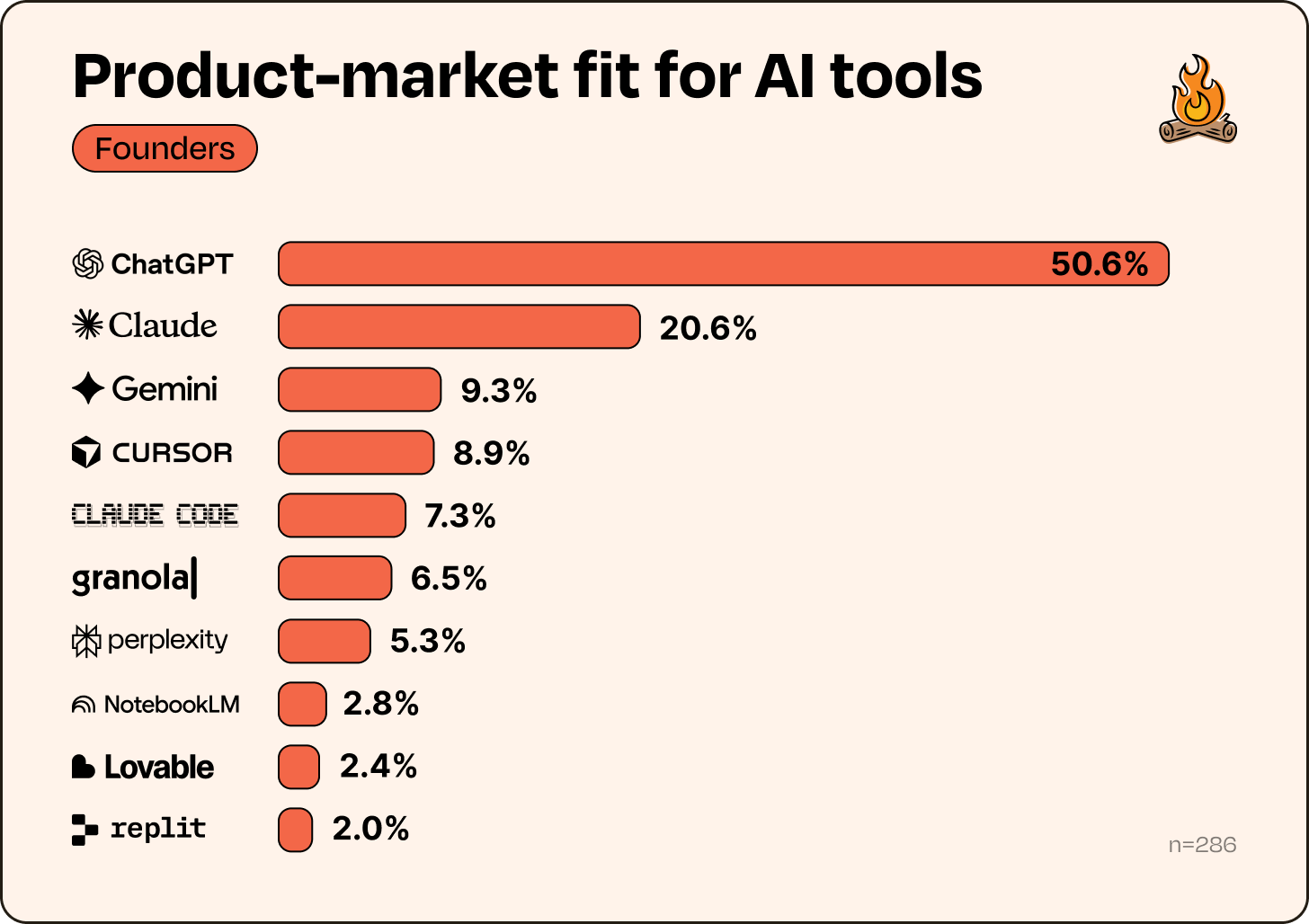
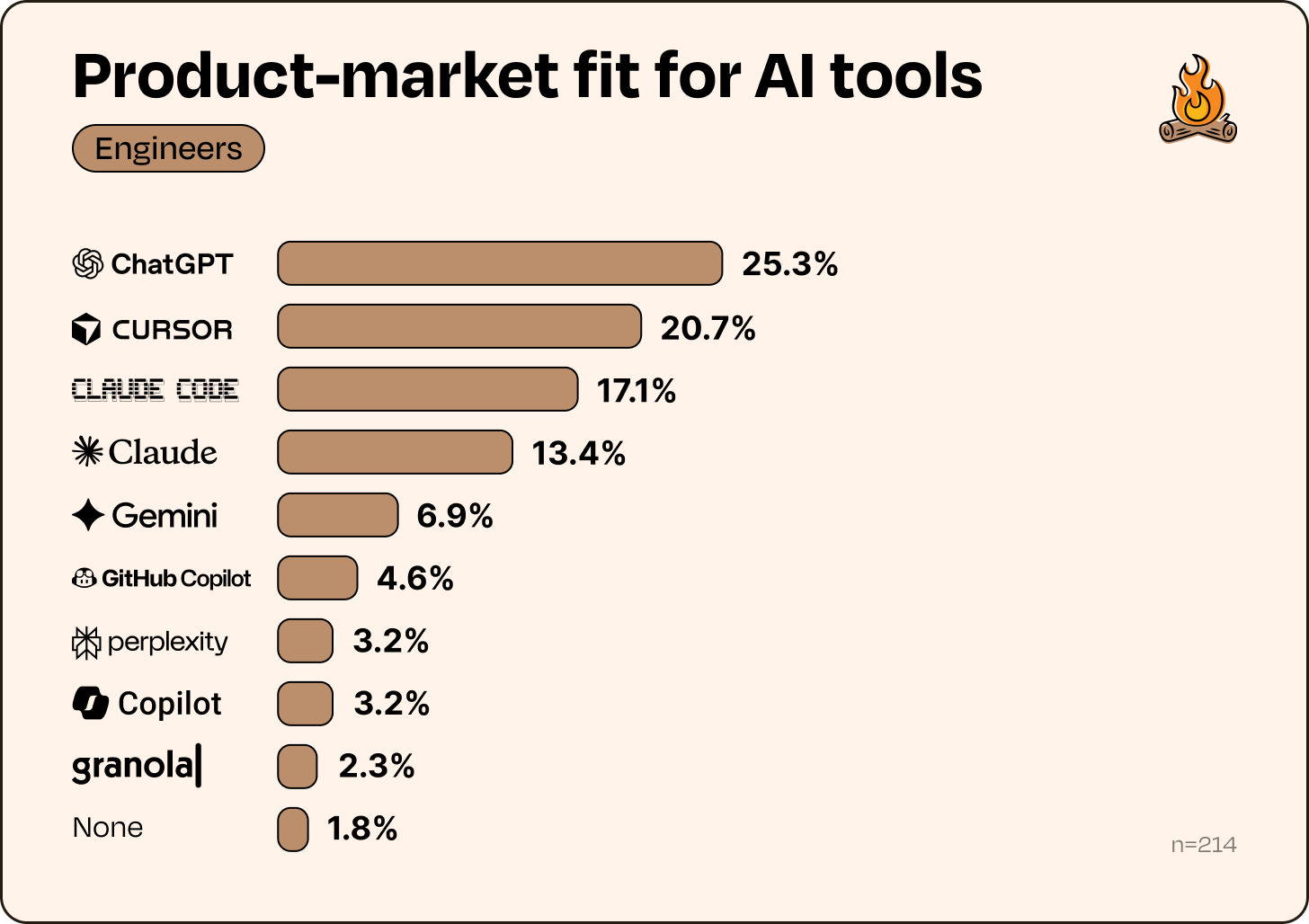
Specialized engineering tools have found loyal users and a clear product-market fit among engineers. For engineers, the PMF leaderboard looks completely different from everyone else: ChatGPT (25.3%), Cursor (20.7%), Claude Code (17.1%), and Claude (13.4%). Three of the top four products they’d miss are coding-specific tools. Engineers have found—and want to hold onto—specialized tools that fit their needs, rather than relying on general-purpose chat interfaces. Cursor’s 20.7% PMF among engineers (vs. 7% to 9% for other roles) shows how deeply it has embedded into coding workflows.
In fact, a handful of role-specific tools are winning their niches.
