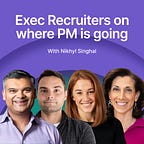
"New episode of The Skip! Nikhyl sat down with three top executive product recruiters to talk about how product management is changing, and what founders now look for when hiring a Head of Product / CPO. Really interesting!"
Chargebee—Billing and monetization infrastructure for the AI era
What do the hottest companies look for when they hire a CPO or head of product? The answer changed suddenly last year, has kept shifting since, and is a good barometer for where the product function is heading. I put the question to three people who sit in these searches every week. Andrew Abramson of Fusion Talent and Lindsay Keith of Daversa are two of the best product exec recruiters working in tech, and between them they fill head-of-product roles at Sierra, Cursor, Figma, Harvey, Decagon, and Autodesk. Caroline Horn leads executive talent for product at a16z and works the portfolio side of the same hires. I asked them for a clear read on what the top companies want now, how the best candidates are preparing, and what’s changed over the course of the year.
The market keeps swelling, so it’s no surprise that demand for top PM talent is rising with it. A year ago the profile founders wanted was narrow: a former founder, hands-on, willing to work 996 hours. That profile hasn’t gone away, but founders increasingly want adults as well. The winning profile is what I’ve been calling the executive builder: someone senior enough to run the function and still close enough to the work to build. Nearly everyone in product spent this year building with the new tools, and the interview process has moved up to match, with higher expectations on seniority and no relief on the hands-on bar. Even if you aren’t looking for an executive role, this podcast is a useful way to see which skills keep you attractive to the market.
The Traits Product Executives Share
All three recruiters said the product executives they place share a set of traits, whatever the stage of the company.
Hands-on is non-negotiable. Lindsay’s phrase: stay close to the metal. The bar applies to senior hires as much as to up-and-comers. Founders want someone tenured who isn’t afraid to do a lot of the work themselves. When the day job doesn’t allow for it, the best candidates find another way to build. Caroline described an executive who hired a PhD researcher to build with her on the side, purely to get reps working with research. Advising early-stage teams counts. So does the agent you built for your house.
Technical depth is a must-have. Lindsay called it the biggest theme of her year. Not a computer science degree, but the ability to go into the technical details of what’s being built. Engineering searches now want product sense, and product searches want technical depth. Each role is expected to understand the other’s work.
Brand over title. A smaller role at a hyper-growth company with great people beats a bigger title somewhere lesser known. Executives from the Mag 7 are taking exactly those roles at hot AI startups.
In person, in the Bay or New York. Companies want people in the office, and the earlier the stage, the more location matters. Physical AI companies can’t work any other way.
Founders Are Up-Leveling the Role
“Go be an IC” has been the standard career advice in product this year, and Andrew still gives it to individuals. For executive searches, he says, it stopped being true about six months ago.
Founders under-hired. They put a junior head of product in place, that person built the first roadmap and the first processes, and then couldn’t recruit senior people while engineering and go-to-market were hiring at a high clip.
Andrew’s most common kickoff now is a Series C or D company that needs a CPO with a philosophy on recruiting, on leading through others, and on where to allocate engineering between the core product and the next one. His other frequent complaint about a junior head of product is a lack of conviction. Founders don’t want an order taker. They want someone who will take a stand in the interview.
Lindsay sees the same up-leveling from the other direction. Enterprise AI means forward-deployed engineers, customization, and product leaders who live with customers and go-to-market. That takes seniority. Her read is that a lot of companies have realized they can compete for senior talent, and that a lot of senior operators have discovered they enjoy being back in the weeds.
Founder-Shaped Beats Founder
Ninety-five percent of Lindsay’s search kickoffs include a founder asking for former founders. It’s close to a cheat code. It tells a founder you took a risk and built something on your own, and nearly every founder responds to it. What’s new is that the aperture has widened. Andrew’s phrase is “founder-shaped”: founders hiring heads of product are looking for the attributes a founding stint signals, and candidates who show those attributes without having founded now make the list. The list is worth spelling out.
High agency. Strong judgment. Comfort with ambiguity. Staying close to the product and the customer. Creating leverage without a large organization. Being able to point at what you personally built.
That wider aperture matters because most executives aren’t going to found a company. The timing is wrong, the idea isn’t there, or the risk doesn’t fit their life. If you can demonstrate the attributes from inside one’s current employer, you can be as competitive as an overt founder.
Working Sessions Replace the Take-Home
Lindsay hasn’t run an executive search in two years without a working session. What’s new is what the session is. The take-home show-and-tell, where you prompt your way to a prototype and present it to a panel, is giving way to a live session with the team on a problem they’re working through right now. You build, and you talk it through with the people you’d work with, in the office, using whatever tools you choose. Part of what they’re watching is which tools you reach for and how you use them. The difference is a contrived test subject versus a simulation of the day-to-day.
Andrew predicts that within a year, AI fluency on its own will stop differentiating anyone, because everyone across the table will have it. Being able to prototype, analyze your own data, automate your workflow, and screen-share what you built becomes table stakes. What stays scarce is taste, judgment, curiosity, and knowing which problem to pick.
The Number One Is Hired to Attract the Builders
Even later-stage companies want the builder profile in the top seat, Caroline said, and a big part of that seat is recruiting AI-pilled PMs. That talent has options, is getting expensive, and won’t join for a number alone. The leader is hired partly as a magnet. Founders recoil from the classic “let me build an org” pitch. What they want is a lean team of builders who will pull the company forward, and a leader who can pull those builders in.
Demand Is Up, and It Moved Early
Caroline has already seen more product searches in 2026 than in all of 2025. The first half of the year was late-stage companies. The second half is different: about half the open roles are Series A, and about half are native AI companies. Andrew sees two distinct buyers. High-growth native AI companies up-leveling past a first head of product, and later-stage non-AI companies that feel behind on AI and want someone to reset the strategy. The surprise is the Series A cohort. Companies that stage usually run product from the founder’s seat for another round or two. This year they’re opening head-of-product searches alongside the growth-stage companies.
996 Went Quiet, Not Away
Lindsay thinks 996 has cooled. It’s very hard to run a company that way, and founders saw it cost them candidates once they started hiring more senior. Andrew’s amendment is that the overt version cooled. Companies won’t say 996, but if you aren’t working it, that may be a problem. Both sides now vet for it up front. Recruiters ask in the first call where you live and whether five days in the office is realistic. Founders answer questions about hours and office days in the kickoff. Lindsay’s observation is that pace mismatch is one of the main reasons searches don’t close, so the honesty comes earlier.
On whether people with families can do these jobs, both said yes. The people with constraints are the ones proving it works, and the founders often have kids themselves. Andrew’s honest caveat is that six months to a year is manageable for most. The open question comes next year, when two years at breakneck speed might hit a wall.
Comp Is a Pressure Cooker
A startup hiring a product leader now competes with everyone, Lindsay said: Meta, Google, the labs, and companies that might acqui-hire you. Two years ago it competed with startups one stage bigger. I wrote in July about builder-executives getting paid like pro athletes, and the recruiters see the same pressure from the buying side. Startups are running tender offers and secondaries earlier than they ever would have to offer liquidity. The lab door opens both ways. Lindsay has seen movement out of the labs, and Caroline has seen senior people take IC roles at Anthropic and OpenAI to be at the frontier.
The hardest version of the comp question is the paper-rich offer at a high valuation. Lindsay’s answer is diligence: press on comparables and multiples, and go in knowing that equity carries real risk, since startups fail more often than they succeed. Andrew takes the other side. In the past eight months he’s watched candidates turn down an offer because the valuation felt high, and then watched that company raise at two and a half times the number three months later. His advice is not to over-index on “slightly overvalued” at a native AI company with great investors.
If there’s a thread through all of it, the market is growing up. Founders want executive builders: senior people who never stopped building. The founder title matters less than the founder shape. And by next summer, once everyone can prototype, what separates candidates will be judgment, taste, and problem selection. Those traits hold across every kind of company, from a neolab founded by researchers to a public company resetting its AI strategy. The full conversation covers all of this in more depth.
Have your own career question? Get personalized guidance at Nikhyl.AI. It’s where the questions keep coming, and where I’ll keep sharing what I’m learning.
The Skip Podcast
The Skip podcast helps tech professionals get ahead in their career. It's hosted by Nikhyl Singhal, a three-time founder, CPO, and product executive at Meta and Google. Nikhyl has helped scale four of the most successful tech products ever: Facebook, Credit Karma, Google Photos, and Google Hangouts. He now runs Skip Coach, a career service powered by the world's top CPO community, and has coached hundreds of product leaders through career decisions, management challenges, and transitions.
Subscribe for career insights distilled from real coaching conversations.
The Skip podcast helps tech professionals get ahead in their career. It's hosted by Nikhyl Singhal, a three-time founder, CPO, and product executive at Meta and Google. Nikhyl has helped scale four of the most successful tech products ever: Facebook, Credit Karma, Google Photos, and Google Hangouts. He now runs Skip Coach, a career service powered by the world's top CPO community, and has coached hundreds of product leaders through career decisions, management challenges, and transitions.
Subscribe for career insights distilled from real coaching conversations.