"Nikhyl does this episode like this every hundred days or so, and times they are a-changing:
1. You no longer need to work at OpenAI or Anthropic to work on the frontier
2. Leadership skills are trending up (vs. being a builder)
3. The startup-or-big-company choice is increasingly a false dichotomy
4. Leaders need to stay hands-on and current
Enjoy!"
Three execs landed top AI roles this summer, and the approach they used was different from what we saw earlier in the year. The way you search for a job is changing about as fast as the technology. We used to hear “Join a lab if you want to learn AI.” “Avoid big tech, because the job there is managing an org, not living in the future.” “Steer clear of non-tech companies, they are spectators to the changes, stuck in their existing ways.” Yet all three leaders on our latest podcast episode ignored those rules, landed terrific AI-first roles, and came back with an approach that will help anyone starting a search today.
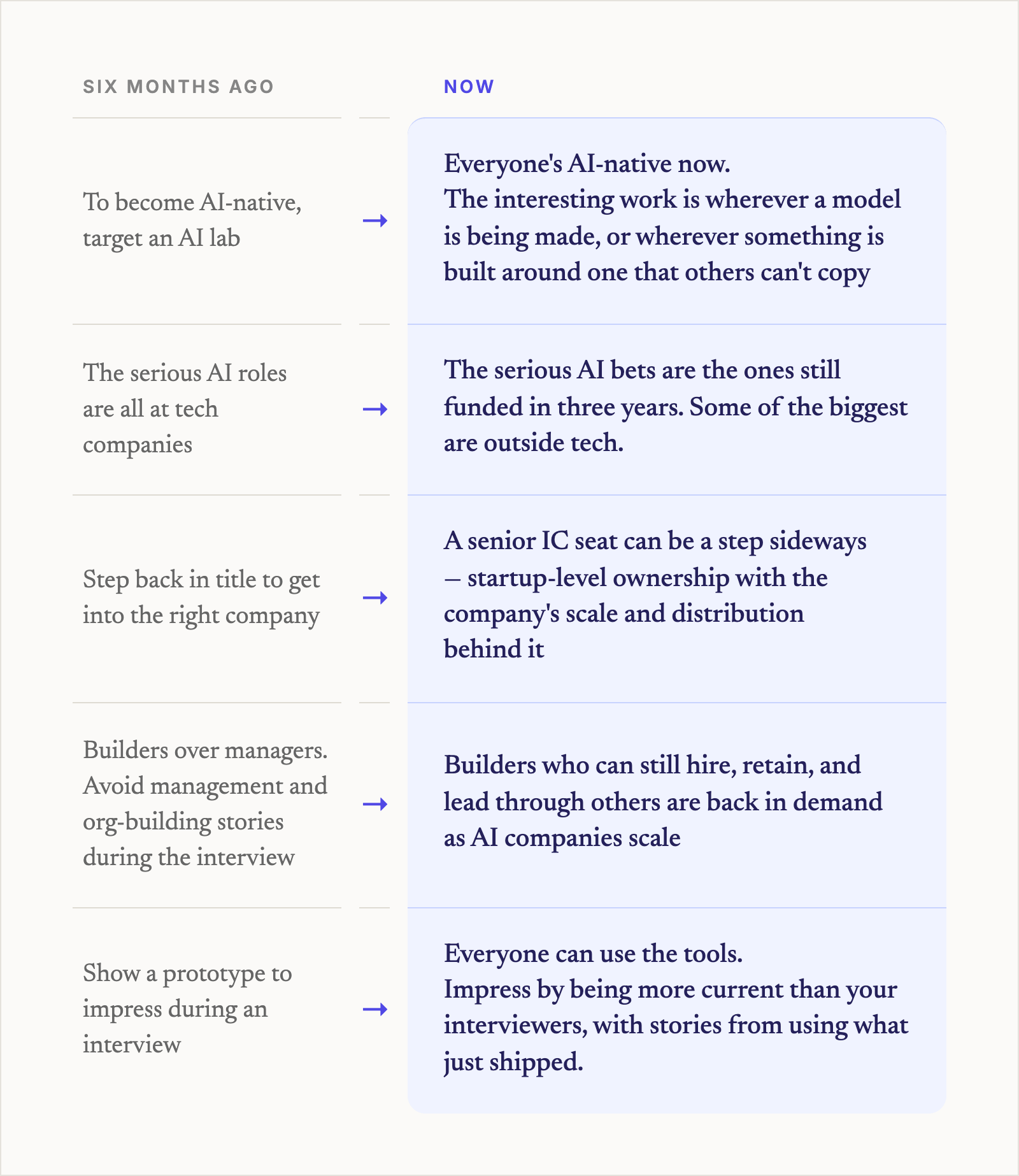
We’ve been updating this advice every quarter, in March and again in May, because the market doesn’t hold still long enough for any of it to last. This round I sat down with Anthony Maggio, who left Airtable after five and a half years to become CPO at Runway. Gadi Ben-Zvi left a fintech startup after its acquisition and now leads AI platform and products at Eli Lilly. Chandra Raghavan left Meta for Google, where he works on Search AI as a principal PM. Here is what has shifted already this year:
A bit more on each of these below.
You Don’t Need to work at OpenAI or Anthropic to Work on the Frontier
The advice six months ago was that the most interesting AI work lived at the labs, so that’s where you went to learn AI. Anthony wanted exactly that: to be as close as possible to where the models are made, in the product and in how the company operates. He considered the labs, but what he found surprised him.
“Both of the labs are now very large companies and in many ways operate like very large companies.”
He chose Runway, about 200 people, which builds its own video and world models. The product job there runs in the opposite direction from most companies. Instead of starting with a customer problem and looking for technology, “it’s a regular occurrence at Runway that our research team will have a breakthrough, will have a capability that we’re able to bring to market.” The PM’s job is to find the use cases for a capability that exists before any customer has asked for it. That’s the work he was looking for, at a company a fraction of the size of a lab.
Gadi wanted to live on the edge too, but at a company that uses models rather than builds them. His worry, in his words: “what do you really have around the model that somebody else can’t recreate easily?” Proprietary data, context, deep domain expertise, real workflows, and a feedback loop inside the company that validates things fast. A company with a good answer has a problem worth working on. A company without one is exposed to the next model release.
Look for the Bet That Lasts, Even Outside Tech
Gadi had no pharma or healthcare background. What he found was that Lilly had already built models that spot drug candidates likely to fail, years before a trial would. It had decades of data to train them on. And it had set up a loop with biotechs, who use the platform and contribute their data back, so the models keep getting better.
Two things surprised him. The first was pace: “the team was moving much faster than I expected.” The second was durability. The worry with a non-tech company, and the reason the old advice warned you off, is that it’s chasing headlines and will lose interest in the investment once the headlines move on. Gadi pressed on exactly that, and the answer came in drug-development time. “When they make a bet, they are willing to spend years on it.” It’s the same question Anthony asked of the labs and Gadi asked of the application companies: will this still be funded, and still interesting, in three years.
The other half of a good opportunity, for Gadi, is a place where he can learn and add value at the same time. He wasn’t an AI expert or a healthcare expert. What became clear during the interviews was that his depth in product management would add value right away, because it was a skill the team needed and didn’t have. Lilly had the science and the models but no product function, and he kept seeing places where that showed: models that were hard for a biotech to use, workflows the platform didn’t fit, tools built for internal scientists that had never been turned into a product. So he leaned in there, showing he could come up to speed on the science quickly and, in return, productize and scale what they had already built.
The Startup-or-Big-Company Choice Was a False Dichotomy
Chandra went in thinking about how his priorities had evolved from “2016 Chandra” to “2026 Chandra.” After nearly nine years at Forward, he wanted direct consumer product ownership, impact at scale, and a life outside work that wasn’t on the line. He initially assumed those priorities would force a trade-off between a startup and big tech. But at Google Search, “the kind of energy I felt having direct ownership as an operator in a startup was exactly the kind of ownership and momentum I was seeing on the team.” The startup-or-big-company choice, he realized, was “a false dichotomy.”
The old advice described that trade-off as fixed, and it holds less now. AI projects at large tech companies move at a startup’s pace, with decisions made on the edges rather than waiting on the org. AI Mode didn’t exist 18 months ago.
Builders Who Can Still Lead
At the start of the year the advice was builders over managers, and candidates learned to keep the management and org-building stories out of the interview. Six months on, those skills are coming back, because the companies that hired builders are now scaling. Anthony, who is now the one hiring, put it this way: “ability to recruit, hire, retain top talent, still really important,” along with business sense and finding product-market fit. What stays out of favor is managing through layers and cross-functional coordination. Our exec recruiters said the same thing two weeks ago: founders under-hired the role, and as their companies grew, searches moved back toward senior people who still build.
Being Current Is the Credential
What counts now is having done the work, and the interviews test how it went. Gadi’s conversations, at Lilly and at established tech companies alike, moved quickly from whether he’d used AI to what happened when he did. In his words, the questions were:
“Where did it fail? Where was it harder than I expected? What did we try that didn’t work? How did we evaluate the success? What were the trade-offs we made? Where was AI actually overused because we were so excited about this new tool? And what would you do differently?”
Current means continuous. Chandra’s warning: “you don’t want to be the person who tried ChatGPT in 2022 and just used that as your mental model.” What took dozens of workarounds a year ago often works on the first try now, so a lesson from last year can make you appear outdated. The good news is that catching up doesn’t take years. Gadi’s experience is that a few weeks of trying each new model and prototyping tool, and seeing where each one breaks, builds more usable judgment than any course. Both he and Chandra said the habit matters more than any single project: keep using whatever just shipped.
Reviewing your team’s AI products isn’t enough either. Anthony’s teams shipped two AI products at Airtable starting in early 2023. He still built a consumer app himself in February, because “I wasn’t actually hands-on enough in those projects.” His PMs and engineers were in the room. He was reviewing the output from altitude. It started as a nights-and-weekends project and became an important part of his interview process almost everywhere. The reason a leader needs a project of their own is the day job:
“In your corporate job, you’re limited by how quickly you can try those things. A new model comes out, you want to get your hands dirty and try it, and you run into the friction: we have to go through security reviews, we have to make sure this works with our enterprise customers first.”
A side project of your own, built on whatever shipped this month and answerable to nobody, is where you stay hands-on when your role doesn’t allow for it.
Perhaps it’s not surprising that the framework for a job search is adjusting as quickly as the technology. What is surprising is that these searches are more nuanced and complicated than ever. Non-tech companies are suddenly attractive destinations. Executive skills matter again, but only in combination with building. Big tech roles can be bureaucratic, but they can also be a great combination of scale and distribution meeting rapid innovation. If you’re considering a job change in 2027, listen to the full conversation. It has dozens of insights on how to find the best home for your talent.
Have your own career question? Get personalized guidance at Nikhyl.AI. It’s where the questions keep coming, and where I’ll keep sharing what I’m learning.
The Skip Podcast
The Skip podcast helps tech professionals get ahead in their career. It's hosted by Nikhyl Singhal, a three-time founder, CPO, and product executive at Meta and Google. Nikhyl has helped scale four of the most successful tech products ever: Facebook, Credit Karma, Google Photos, and Google Hangouts. He now runs Skip Coach, a career service powered by the world's top CPO community, and has coached hundreds of product leaders through career decisions, management challenges, and transitions.
Subscribe for career insights distilled from real coaching conversations.