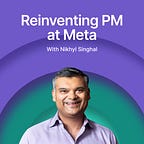
"Most "we do AI here now" stories are feeling pretty repetitive. Not this one.
Nikhyl asked a VP of Product at Meta, Jagjit Chawla, what has changed on the ground in his work life. The tl;dr is that as ideas got cheap, judging them has become the job. Which increasingly makes PM the biggest bottleneck."
This podcast is a live conversation I hosted for Skip Coach, a community of senior product and tech leaders navigating career transitions together. Members get access to live sessions like this one, including real-time Q&A, before the content is shared publicly. If you’re a product or tech leader looking to maximize your career, apply to join Skip Coach to access this content and other exclusive resources.
Framer—Design and build your website effortlessly with Framer Agents
I recently sat down with Jagjit Chawla to talk about how product management actually works at Meta today. Jagjit is a VP of Product there, running a growing share of the Facebook app — Feed, Reels, and recently Search — and someone I’ve worked alongside for almost ten years, since Google and then Credit Karma. Every company in tech is experimenting with AI right now, and it’s genuinely hard to tell what’s real: what’s only a test, what’s actually working, and who’s driving change versus talking about it.
Change is hardest at the largest, most mature companies — and Meta is one of the biggest dinosaurs in the park. Billions of users, tens of thousands of employees, a product old enough that its habits are set in concrete.
What I found was the opposite. From the top down to the bottom, Meta is rebuilding the product management function. The PRD every team relied on is now a paragraph and a prototype. Status no longer rolls up the chain in a deck — an agent reads the raw code overnight and tells leaders what actually shipped. Executives run their reviews off a doc the agent wrote, not the team. I spent time at Meta myself, and almost nothing about the job is as I remember it from two years ago.
And the changes are more accessible than that scale suggests. They weren’t handed down from the center or bought from a vendor — they were built by the teams themselves, sometimes in a single evening, to strip the mechanical work out of the role, move faster, and make the product measurably better. The personal systems below, you could build yourself tomorrow with tools you already have.
The Compression Algorithm Is Dead
The org chart used to be the information pipeline. His nightly agent replaced it.
Jagjit has a name for how information used to reach him. In a thousand-person organization, the ground truth of a software company is the code being written — and between that truth and the executive sits what he calls a compression algorithm. The engineer knows what they checked in. Their manager summarizes it. By the time it reaches the VP, each project has been squeezed to a sliver, and he has fifty projects. That sliver-times-fifty was the job. You ran reviews to decompress it.
Now, in his words: “the compression algorithm is thrown out.” His AI agent reads everything overnight — every diff checked in, every email and chat waiting on him, every document he needs to review — and at seven in the morning produces a punch list. Decisions his team made that he should know about. Decisions waiting on him. Decisions he needs to carry to the people above him. Project by project: red, yellow, green. That dashboard is what he opens with his morning coffee. Not chat, not email — because, as he put it, opening your inbox first thing means “you are letting the inbound drive your day.”
The brief is only the start. In parts of his org, the team no longer writes the product review doc — his agent writes it, flags the three questions worth debating, and names the five people who should be in the room. The meeting starts at the decision instead of spending half the hour building context. Afterward, the agent records what was decided. If a decision blows past its deadline, it shows up red the next morning with a suggestion of whom to ping; he presses a button and the follow-up goes out. He hasn’t rolled this out everywhere — but where it runs, the formal review with slides and pre-reads is simply gone.
The PRD Is Now a Paragraph, a Prototype, and an Eval
The PM stopped writing the spec and started judging the eval.
Two years ago, the IC job on Jagjit’s team looked the way it looks most places: sit with your engineers and researchers, come up with ideas, write a detailed PRD — the problem, the feature set, the hypotheses. Engineers would start building, holes would surface, the PM would fill them.
Today the artifact is one paragraph describing the problem, coupled with a prototype. For ML-heavy areas, add an eval set — a battery of test cases you run again and again, because these systems don’t give the same answer twice. You have to see the spread of outputs before you can call the result good or bad.
“Now you sit next to your engineer on the eval, and you agree or disagree whether this is a good outcome or a bad outcome. That is what real product management looks like right now.”
The work happens in pods of five people sitting together, not in document review cycles.
The same compression happened to data questions. A question that surfaced in a live review — how many Reels views come from people who follow you versus people who don’t? — used to become an action item, a handoff to data science, and a twenty-four-hour round trip. Now an analytics agent answers in five minutes — grounded in the real queries his data-science partner has already written, so it pulls from trusted sources instead of inventing its own numbers. The decision gets made in the room, and the review moves on.
None of It Was Bought — and He Insists the Tools Don’t Matter
Leaders now have to rebuild how they work — not delegate it. Jagjit found the tools good enough to do it himself, without waiting for someone to hand it to him.
The system above sounds like a seven-figure enterprise deployment. It isn’t. Jagjit’s phrase is that it was built by “N of one, which is me” — assembled from generally available tools, personalized to how he runs reviews. There’s a tuning loop: every night, the system compares the comments he actually left on that day’s documents against the comments it predicted, and adjusts. Six months in, it’s accurate. At the start, it wasn’t.
It still misbehaves in instructive ways. One morning the brief arrived with every source link stripped out. When he asked why, the answer was that the HTML was getting clunky, so it dropped them. His correction — never drop the sources — became a permanent rule. That’s the operating model: never do a task the old-school way, because every miss is a teaching moment in a closed loop. Browse Gmail by hand and you’ll keep missing things forever. Route everything through the system, and it gets better every week.
For everyone outside Meta, his advice on tools is almost dismissive:
“If I give you a ream of paper and say I want you to cut these into fourths, anything will be better than bare hands. Find a scissor. Doesn’t matter what scissor.”
The differences between the major AI tools are small next to the difference between using one and not. Start with what you have: a data-collection run over your email, chat, docs, and tickets at 2 AM, a summarization pass at 7, a list of the people whose messages can never slip, and a red-yellow-green punch list per project. His words: anyone can do this.
One caveat he’s honest about: the output is only as good as the data underneath it. His system works because Meta documents everything — every experiment, every result, written down. The method transfers anywhere; the discipline of writing things down is the real prerequisite.
Ideas Are Now Cheap. Judgment Is the Bottleneck
When anyone can produce a 50-page deck in half an hour, the scarce skill is deciding what deserves to exist.
The most quotable line of the hour:
“AI tools lower the floor of what you can try, but also raise the ceiling of what you can achieve.”
The lowered floor has a dark side, and Jagjit is living it. His team can now produce a fifty-page deck for any idea by chatting with tools for thirty minutes — and he receives five of them a week. “Now, I am the bottleneck.” His answer is to turn his own agents on the inbound, sift signal from noise, and teach the team to run the same filter themselves.
This is where the career ground is shifting. For the last decade, the mid-career PM skill set was dominated by process — prioritization, stakeholder management, running the machine — and ideation barely mattered, because so few ideas ever made it through the engineering bottleneck. You could spend a whole career never being seriously asked for your ideas. That constraint just dissolved. When agents can prototype and test almost anything, “what are your ideas?” becomes a real interview question — for many mid-career PMs, the first time anyone has pushed on it.
What separates good from great, in his ordering: ideas first — always true — then the agency to act on them, and only then the AI tools that accelerate the rest. As he put it, “you have the power of the sun in your hand with these LLMs, but the notion of what to build has to come from you.” The first conviction is yours.
The Generalists Are Making a Comeback
Technical pedigree was the moat. First-principles thinking is the new screen.
Jagjit grew up at Google — where we met — believing you couldn’t be a PM without an engineering background. Technical chops were the price of entry. On his team today, the opposite is happening: the PMs outperforming are PhDs in economics and physics, people without an engineering pedigree. They reason from first principles instead of jumping straight to how something gets built. His own engineer’s instinct on hearing an idea is “how are you gonna build this?” His econ PhDs ask a different question first: we run a marketplace of creators, users, and advertisers — what does this do to the incentives for each of them?
Two structural forces drive the flip. Domain expertise has been diluted, because AI tools build context for anyone in days. And technical expertise is getting discounted, because the tools now make architecture decisions and engineers cover more ground than before. What’s left is the thing the tools can’t supply: judgment. To Jagjit, that means first-principles thinking — reasoning up from what’s actually true about your users and your market, instead of from how things are usually done. It shows up most clearly back at the eval, sitting next to your engineer and making the case for why this output is good and that one isn’t.
Which answers a question I put to him from the audience: if you’re fluent in AI coding tools like Claude Code, is that enough to land a modern PM role? His answer is that fluency is the floor, not the bar — and the bar keeps rising. Building the prototype proves you can build. What he’s screening for is whether you can name the stakeholders for what you’re launching, name their incentives, and say whether your product will move them. At Meta there’s a second clause — will it hold up for two billion users — but the first part applies anywhere. Anyone can build the prototype now — the incentive map is the part that’s still on you.
Give People Real Space — This Is Not a Side Hustle
Mandates without time are theater. Meta canceled a week of meetings instead.
The principle behind everything Meta did organizationally is simple: if you want people to change how they work, you have to create real space for it — not ask them to moonlight AI on top of an unchanged workload. The move that proved it was almost embarrassingly basic: a dedicated week of no meetings for the entire org. Every review canceled. Every one-on-one canceled. The whole organization spent the week learning the tools and building with them. And it didn’t bubble up by accident — the push came from leadership, Jagjit included, who showed up with the three things adoption actually needs: space, budget, and excitement. Why a whole week and not an afternoon? These tools demand architectural thinking, and that takes uninterrupted time.
The week produced a flood of hack and prototype submissions. It also surfaced real gaps — the design tools were generating prototypes that violated Meta’s design system, a problem that only showed up once the whole org was building at once. That discovery led to the second move: AI captains, one per function. A PM captain, a design captain, a DS captain, an engineering captain — people who look across everything being built, collate it into shared tooling, write the runbooks, and teach their function to fish. It’s the closed loop from his morning brief, run at organization scale — collect what everyone learns, feed it back, compound.
The detail worth stealing: the captains are internal people, never new hires. The instinct is to recruit someone “AI-native” from outside; Jagjit’s argument is that the job is blending institutional knowledge with new ways of working — and only insiders have the first half. At a product like Facebook, two decades old and serving billions, that knowledge runs deep: “We run the world’s largest Jenga game, and when you’re gonna touch a piece, you need to know what’s gonna happen to other pieces.” Not every company is playing a game that intricate — but the more history your product carries, the more a captain has to have lived its friction points before redesigning them. The lesson isn’t the captains or the no-meeting week. It’s that clearing real time — a week, not an afternoon — is what unlocked all of it.
Other Notes from the Hour
This was a rich enough conversation that I’ve already asked Jagjit to come back later this summer for a second round. A few more points I appreciated as we wrapped:
The products themselves got better — not just the process. Shake your phone in the Facebook app and you file a bug report. At two billion daily users, that’s tens of thousands of reports a day — far more than any team could read, so for years nobody fully did. Now one agent triages them, another validates the issue is real by watching the attached screen recordings, another drafts the fix and routes it to the right engineer. Approved, shipped in the next build. Jagjit calls it ten, maybe a hundred times better than what came before. The same goes for the new “tune your algorithm” controls in Feed and Reels — tell it your interests in plain language, and it even handles transient ones. Mark yourself interested in cricket during the IPL, and it researches when the tournament ends and backs off the recommendations afterward.
AI broke things too. As AI-written code ramped over the past year, site incidents went up — at Meta’s scale, a 0.1 percent crash rate means tens of millions of people. The answer was more AI: safeguard agents that validate changes before they reach production. As Jagjit described the loop, AI creates problems, you stand up systems to solve them, those create a new set of problems, and you keep iterating. Anyone selling you a clean adoption curve is selling theater.
What hasn’t changed: “People do not fall in love with projects, teams, or technical problems. People fall in love with people.” Influence cannot be delegated — your agent will never persuade their human. Technical and analytical ability are now table stakes. Relationships separate good from great. And the time AI frees up compounds exactly here: Jagjit now has more time with his Instagram counterparts — similar problems, shared infrastructure — comparing techniques at both the exec and IC level.
Competitive analysis runs on autopilot. A daily summary of what competitors launched, the delta against his team’s feature set and declared priorities, plus queryable roadmaps for every internal team he depends on. The research he’d never have had time to do himself now arrives daily, and the judgment of which threads to pull stays his. As he put it: “your product sense is not gonna get replaced, but it’s gonna create more sparks in your brain because there’s now fodder — and once those little fires start, you decide whether to make them a big fire or douse them.”
Zero-to-one still starts at the whiteboard. The early-stage pods in his org — an engineer, a PM, a DS — still sit together and brainstorm the old way, then layer AI on top. The shift isn’t uniform, and it isn’t supposed to be.
The Playbook
Meta runs at a scale almost no one else does, and Jagjit has the influence and skill to lead a transformation most of us couldn’t. But the striking thing is how little of what he described is actually out of reach — nearly every tool he uses can be put to work in your own organization today. A few moves to start with:
Build the morning brief. A nightly run over your email, chat, docs, and tickets; a morning summary of decisions made, decisions waiting on you, and a red-yellow-green punch list. Any scissor will do — start with the tools you already have.
Stop doing tasks the old-school way. Route work through your system even when it’s imperfect, and teach it every time it misses. The closed loop is the whole point: browsing your inbox by hand means missing things forever.
Shrink the PRD. One paragraph, a prototype, and — for anything ML-shaped — an eval set. Then spend the recovered time sitting next to your engineer judging outcomes, because that’s where the PM job actually lives now.
If you lead: create real space. Cancel the meetings for a week and let people rebuild how they work. Appoint AI captains from inside the building — the role is blending institutional knowledge with new ways of working, and only insiders have the first half. Adoption needs more than your permission; it needs your push.
Taste it. Jagjit’s advice for individuals is visceral: once you’ve worked this way, you feel a kind of leverage you didn’t have before — and you can’t go back. “Once you drive the Porsche, you can’t go back.” The real choice now is whether to live in the future or watch it from the sideline.
Invest in first-principles judgment. The tools build the prototype and supply the context. What they can’t supply is your map of the stakeholders, their incentives, and whether the thing you’re building moves them. That’s the skill being interviewed for now.
The thread under all of it: every one of us now has both more power and more reason to change how we work. The first step is the only hard part — and the scissor is already on your desk.
Have your own career question? Get personalized guidance at Nikhyl.AI. It’s where the questions keep coming, and where I’ll keep sharing what I’m learning.
The Skip Podcast
The Skip podcast helps tech professionals get ahead in their career. It's hosted by Nikhyl Singhal, a three-time founder, CPO, and product executive at Meta and Google. Nikhyl has helped scale four of the most successful tech products ever: Facebook, Credit Karma, Google Photos, and Google Hangouts. He now runs Skip Coach, a career service powered by the world's top CPO community, and has coached hundreds of product leaders through career decisions, management challenges, and transitions.
Subscribe for career insights distilled from real coaching conversations.
The Skip podcast helps tech professionals get ahead in their career. It's hosted by Nikhyl Singhal, a three-time founder, CPO, and product executive at Meta and Google. Nikhyl has helped scale four of the most successful tech products ever: Facebook, Credit Karma, Google Photos, and Google Hangouts. He now runs Skip Coach, a career service powered by the world's top CPO community, and has coached hundreds of product leaders through career decisions, management challenges, and transitions.
Subscribe for career insights distilled from real coaching conversations.